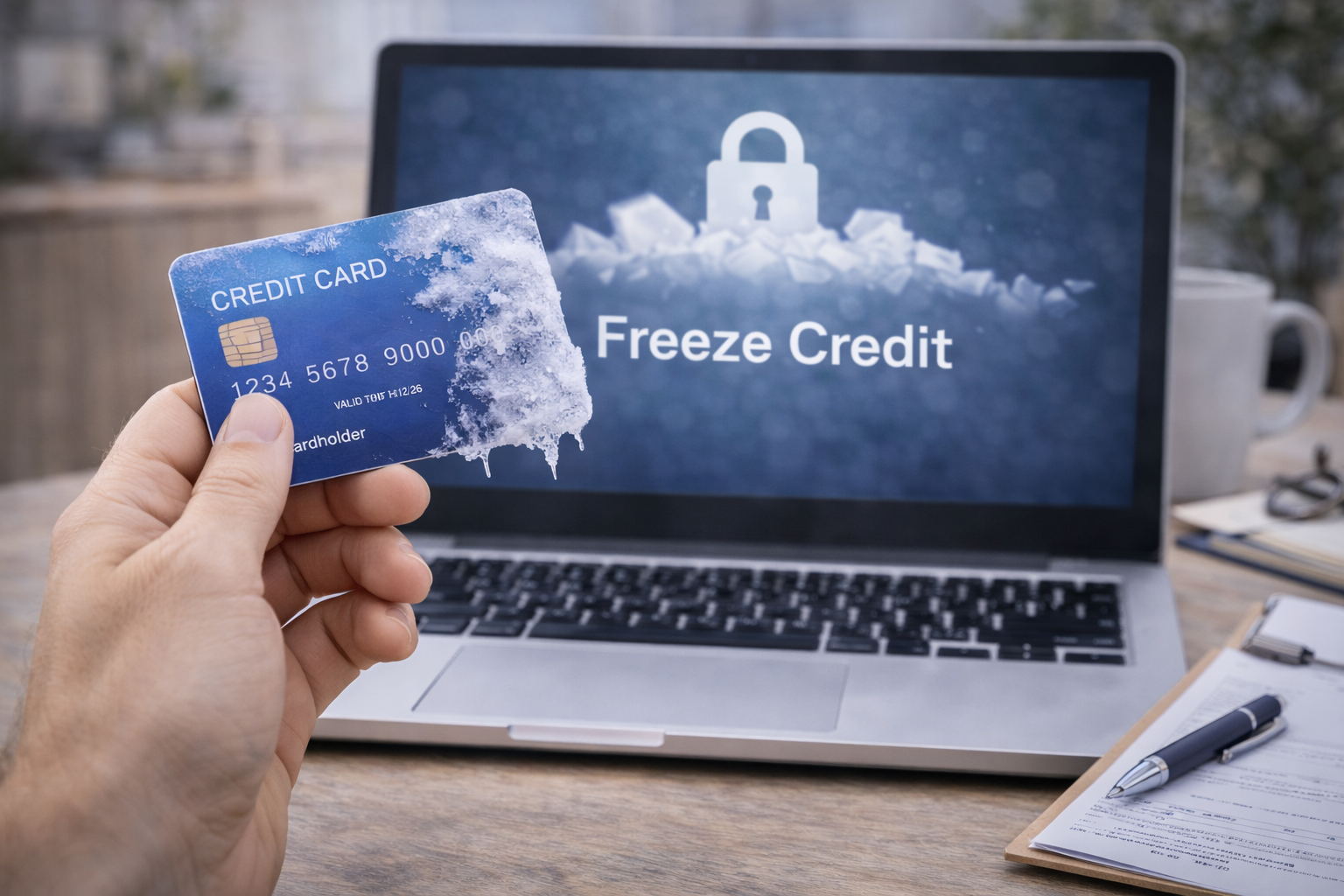



Learn how to freeze your credit step by step, when it makes sense, when it doesn’t, and how to temporarily lift a freeze without harming your credit.
Credit Freezes Are One of the Most Powerful (and Misunderstood) Security Tools
Identity theft doesn’t usually start with stolen money.
It starts with stolen credit access.
When someone opens a loan or credit card in your name, the damage can take months—or years—to undo. That’s why more people are asking how to freeze your credit, especially after data breaches, travel theft, or suspicious activity.
A credit freeze is not extreme.
It’s not permanent.
And it does not hurt your credit score.
This guide explains:
- What a credit freeze actually does
- Exactly how to freeze your credit (step by step)
- When you should freeze it
- When you shouldn’t
- How to temporarily lift or remove it safely
No fear tactics—just clarity.
What Is a Credit Freeze (Plain English)
A credit freeze prevents lenders from accessing your credit report unless you explicitly allow it.
That means:
- No new credit cards
- No personal loans
- No auto loans
- No financing accounts
Even if someone has:
- Your name
- Your Social Security number
- Your address
They cannot open credit without your approval.
This makes credit freezes one of the strongest protections against identity theft.
What a Credit Freeze Does Not Do
A credit freeze:
- ❌ Does not affect your credit score
- ❌ Does not stop existing accounts
- ❌ Does not block debit card fraud
- ❌ Does not replace account security
It protects future credit, not current balances.
When You Should Freeze Your Credit
Freezing your credit makes sense if any of the following apply:
1. You’re Not Actively Applying for Credit
If you’re not:
- Buying a house
- Leasing a car
- Opening new credit
There’s little downside to a freeze.
2. Your Data Was Involved in a Breach
If your:
- Social Security number
- Date of birth
- Address
was exposed, a credit freeze is a smart response—even if nothing bad has happened yet.
3. Your Phone or Email Was Compromised
Account takeovers often escalate into financial fraud.
A credit freeze stops that escalation.
4. You Want Long-Term Identity Protection
Many security professionals keep their credit frozen by default and only lift it temporarily when needed.
When You Shouldn’t Freeze Your Credit (Yet)
You may want to wait if:
- You’re actively applying for credit within days
- You’re unfamiliar with managing PINs or logins
- You won’t remember where you froze it
That said, even in these cases, a temporary freeze is often still manageable.
How to Freeze Your Credit (Step-by-Step)
You must freeze your credit separately at each major credit bureau.
Freezing is free in many countries, including the U.S.
Step 1: Freeze Your Credit at Each Bureau
In the U.S., the three major bureaus are:
- Equifax
- Experian
- TransUnion
You’ll need:
- Full name
- Date of birth
- Social Security number (or local equivalent)
- Address history
Each bureau will give you:
- A login or PIN
- Confirmation of the freeze
Freeze all three. One is not enough.
Step 2: Store Your Login Information Securely
This is critical.
Store:
- Bureau logins
- PINs (if provided)
- Recovery emails
Use:
- A password manager
- A secure offline backup
Losing access doesn’t harm your credit—but it does slow future applications.
Step 3: Confirm the Freeze Is Active
Check each bureau dashboard to ensure:
- Credit is frozen
- No pending access exists
- Alerts are enabled
You’re now protected against new credit fraud.
How to Temporarily Lift a Credit Freeze
Freezes are not permanent locks.
You can:
- Temporarily lift the freeze
- Set a time window (e.g., 24–72 hours)
- Lift it for a specific lender
This is useful when:
- Applying for a loan
- Renting an apartment
- Opening a new credit card
Once the window closes, the freeze reactivates automatically.
Does Freezing Your Credit Affect Your Score?
No.
Credit freezes:
- Do not lower your score
- Do not appear on credit reports
- Do not affect existing accounts
They are invisible to scoring models.
Credit Freeze vs Fraud Alert (Important Difference)
Fraud Alert
- Warns lenders
- Does not block credit
- Relies on lenders to double-check
Credit Freeze
- Blocks credit entirely
- Does not rely on human judgment
- Stronger protection
Fraud alerts are better than nothing.
Credit freezes are far more effective.
Common Myths About Credit Freezes
“Credit freezes hurt your credit.”
False.
“They’re only for people who were hacked.”
False. They’re preventive.
“They’re hard to undo.”
False. Lifting a freeze takes minutes.
“Identity theft protection replaces a freeze.”
False. Monitoring ≠ prevention.
How Credit Freezes Fit Into Personal Digital Security
A credit freeze:
- Complements account security
- Reduces long-term financial risk
- Protects against worst-case scenarios
It’s one of the few security steps that works even if everything else fails.
FAQs: How to Freeze Your Credit
1. Is freezing credit really free?
Yes, in many countries including the U.S.
2. Can I still use my existing credit cards?
Yes, without any changes.
3. How long does a credit freeze last?
Until you remove or lift it.
4. Can lenders still check my credit?
Only if you temporarily allow it.
5. What if I forget my PIN?
Recovery is possible—but slower.
6. Should everyone freeze their credit?
If you’re not applying for credit, it’s often a good idea.
Conclusion: A Credit Freeze Is Quiet, Boring, and Extremely Effective
If you’re researching how to freeze your credit, you’re already thinking ahead.
A credit freeze doesn’t:
- Announce itself
- Feel dramatic
- Solve every security problem
What it does is stop the most damaging form of identity theft cold.
For many people, freezing credit is one of the smartest, lowest-effort security decisions they’ll ever make.
Sometimes the best protection is the one you never notice—until it saves you.
FTC explains credit freezes and fraud alerts: FTC Credit Freeze Guide
All Rights Reserved © 2026