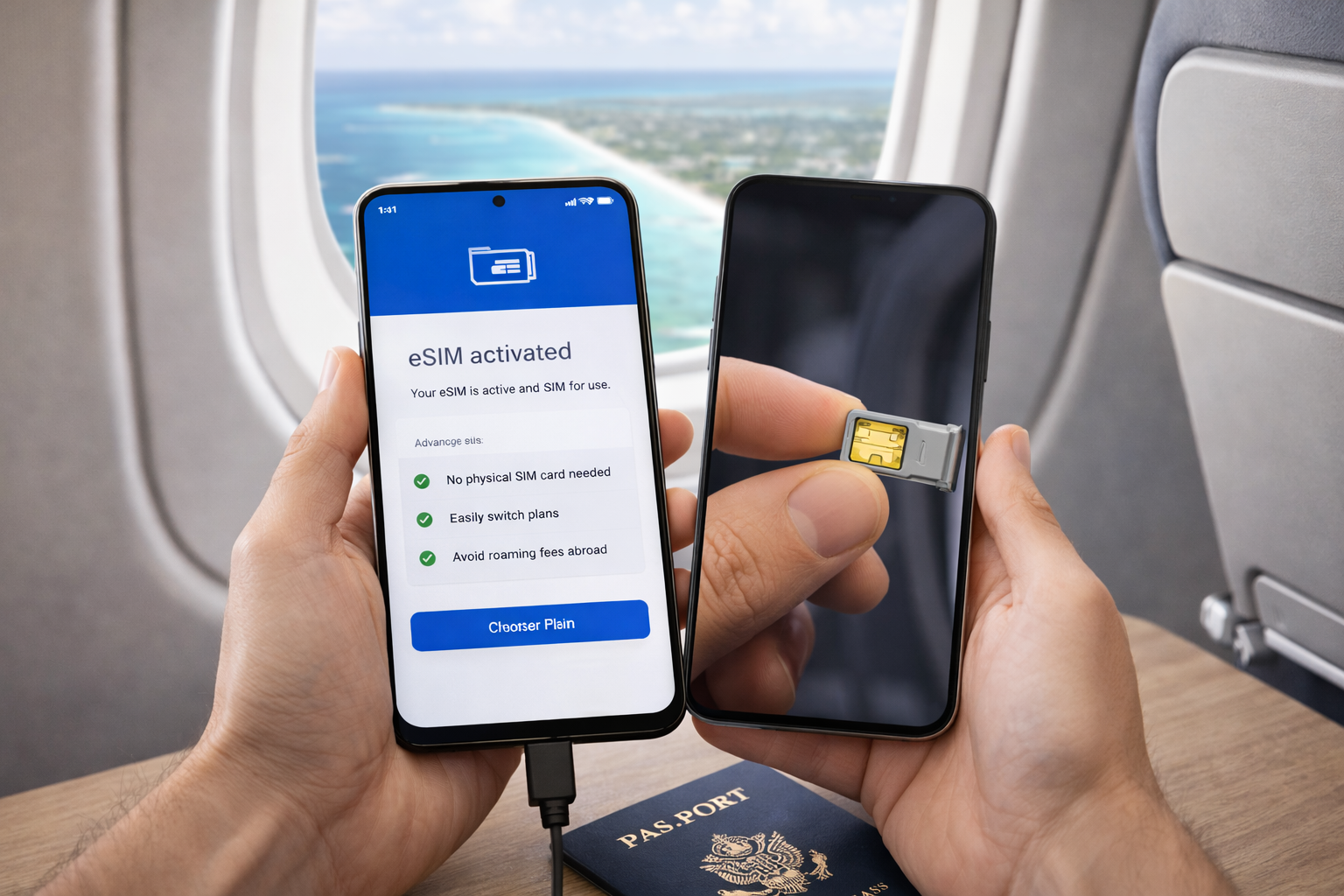



eSIM vs physical SIM for travel in 2026 explained. Compare cost, convenience, coverage, and reliability to choose the best option for your trips.
Travel Connectivity Has Quietly Changed
A few years ago, traveling with your phone meant one of three bad options:
- Paying high roaming fees
- Buying a local SIM at the airport
- Staying offline
In 2026, travelers have a real choice: eSIM vs physical SIM.
Both work. Both have advantages. And both are misunderstood.
If you’re trying to decide eSIM vs physical SIM for travel, this guide breaks down:
- What actually matters on trips
- Which option fits different travel styles
- When one is clearly better than the other
No hype—just practical decision-making.
What’s the Difference Between eSIM and Physical SIM?
Before comparing, let’s define them clearly.
Physical SIM
- A removable plastic card
- Inserted into your phone
- Tied to one carrier at a time
This is what most people have used for years.
eSIM
- A digital SIM built into your phone
- Activated by scanning a QR code or app
- Can store multiple profiles
In 2026, most midrange and flagship phones support eSIM—but not all budget models do.
Why Travelers Care About SIM Choice Now
Travel has changed.
People expect:
- Instant connectivity
- Maps and ride apps on arrival
- Messaging without delay
- Affordable data abroad
SIM choice affects:
- Cost
- Setup time
- Stress level
- Flexibility
That’s why the esim vs physical sim for travel decision matters more than it used to.
eSIM for Travel: Pros and Cons
Advantages of eSIM for Travel
1. Instant Setup (Huge Advantage)
You can:
- Buy an eSIM before your trip
- Activate it on landing
- Avoid airport SIM kiosks
No waiting. No language barriers.
2. No Physical Card to Lose
No tiny SIM trays.
No paper clips.
No lost cards in hotel rooms.
3. Multiple Profiles on One Phone
You can:
- Keep your home SIM active
- Add a travel eSIM
- Switch between them in settings
This is especially useful for:
- Two-factor authentication
- Banking apps
- Work messages
4. Better for Short Trips
For trips under 2–3 weeks, eSIMs are often cheaper and far more convenient.
Disadvantages of eSIM for Travel
1. Not All Phones Support eSIM
Especially:
- Older devices
- Budget Android phones
- Some regional models
Always check compatibility before relying on eSIM.
2. Limited Voice Options
Most travel eSIMs are:
- Data-only
- No local phone number
This usually isn’t a problem—but it matters in some countries.
3. Switching Phones Is Harder
You can’t simply move an eSIM to another phone mid-trip without reactivation.
Physical SIM for Travel: Pros and Cons
Advantages of Physical SIM
1. Works on Almost Any Unlocked Phone
Physical SIMs are universal.
If your phone is unlocked, it will likely work.
2. Local Phone Number
Some travelers prefer:
- Local calls
- SMS verification
- Local services that require a number
3. Easy to Swap Between Phones
If your phone breaks, you can move the SIM instantly.
Disadvantages of Physical SIM
1. Setup Takes Time
You usually need to:
- Find a store
- Communicate with staff
- Present ID
- Wait for activation
After a long flight, this is frustrating.
2. Risk of Losing Your Home SIM
Many travelers remove their main SIM and misplace it.
That creates problems with:
- Banking
- Authentication
- Work access
3. Inconsistent Pricing
Tourist SIM pricing varies wildly by country and location.
eSIM vs Physical SIM: Side-by-Side Comparison
| Factor | eSIM | Physical SIM |
|---|---|---|
| Setup speed | Instant | Slow |
| Convenience | Very high | Medium |
| Phone compatibility | Limited | Universal |
| Local number | Usually no | Yes |
| Multi-SIM use | Excellent | Limited |
| Risk of loss | None | High |
| Best for | Short trips | Long stays |
Which Is Better for Different Travel Styles?
Short Trips (1–14 days)
✅ eSIM wins
Fast, flexible, and stress-free.
Long Stays (1+ month)
✅ Physical SIM often wins
Cheaper long-term plans and local numbers matter more.
Multi-Country Trips
✅ eSIM wins
One plan, multiple countries, no SIM swapping.
Budget Travel
⚖️ Depends
Local physical SIMs can be cheaper—but require effort.
Business Travel
✅ eSIM wins
Keeps your main number active while adding travel data.
Common Myths About eSIM and Travel
“eSIMs are unreliable”
→ Coverage depends on the network, not the SIM type.
“Physical SIMs are always cheaper”
→ Not for short trips or multi-country travel.
“eSIM drains battery faster”
→ Battery impact is negligible.
“eSIM is complicated”
→ Setup is usually easier than physical SIMs.
Security and Reliability Considerations
Both options are secure.
However:
- eSIMs can’t be physically stolen
- Physical SIMs can be lost or damaged
For most travelers, eSIM is safer by default.
How to Decide Quickly (Simple Framework)
Ask yourself:
- Does my phone support eSIM?
- Is my trip short or multi-country?
- Do I need a local phone number?
- Do I want zero setup stress?
If convenience matters → eSIM
If flexibility across devices matters → Physical SIM
FAQs: eSIM vs Physical SIM for Travel
1. Is eSIM better than physical SIM for travel?
For most short trips, yes.
2. Can I use eSIM and physical SIM together?
Yes, on dual-SIM phones.
3. Is eSIM more expensive?
Sometimes—but often worth it for convenience.
4. What if my phone doesn’t support eSIM?
Physical SIM is still a solid option.
5. Do eSIMs work worldwide?
Coverage depends on the provider and plan.
6. Can I keep my home number active with eSIM?
Yes, that’s one of the biggest advantages.
Conclusion: Convenience vs Flexibility
The esim vs physical sim for travel decision isn’t about technology—it’s about how you travel.
In 2026:
- eSIM is best for convenience, short trips, and multi-country travel
- Physical SIM still makes sense for long stays and older phones
Most travelers now choose eSIM for simplicity—and never go back.
If staying connected matters, choosing the right SIM makes travel smoother from the moment you land.
GSMA explains how eSIM technology works: What Is eSIM?
All Rights Reserved © 2026