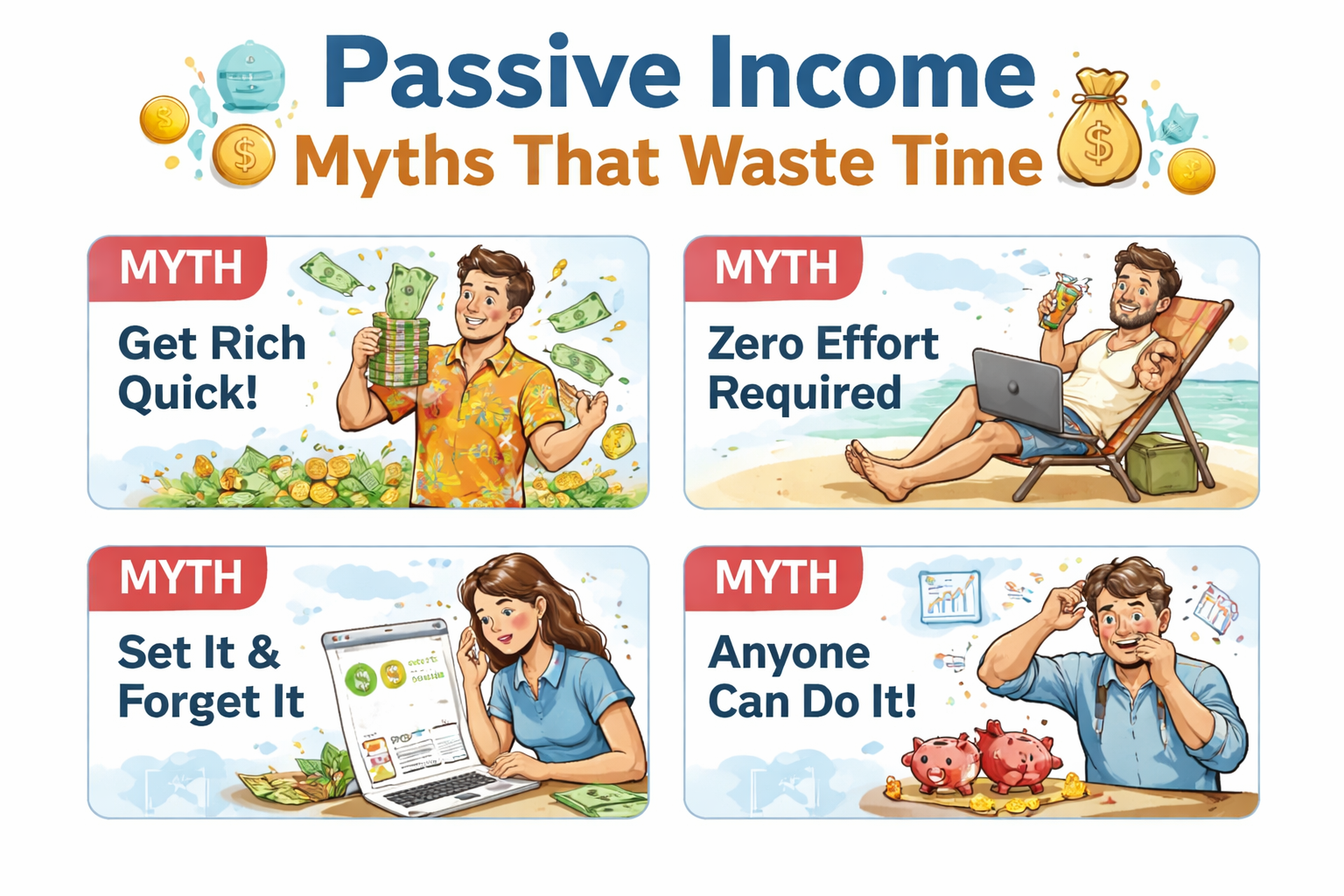



The most common passive income myths explained—why popular ideas waste time, what “passive” really means, and how to think realistically about income streams without false promises
To see which passive income strategies actually work in real life, read our full guide to best passive income ideas for 2025.
Passive income is one of the most attractive ideas on the internet.
“Make money while you sleep.”
“Build once, earn forever.”
“Escape the 9–5 with passive income.”
It sounds simple. Almost magical.
And that’s exactly why so many people lose years chasing the wrong things.
This article breaks down the biggest passive income myths, why they’re so convincing, how they waste time, and what a more realistic, honest approach actually looks like.
No hype.
No guru language.
Just clarity.
🧠 Why Passive Income Is So Appealing
Passive income promises relief from:
- Financial pressure
- Time scarcity
- Burnout
- Uncertainty
It offers a story where:
- Effort happens once
- Rewards arrive continuously
- Work fades into the background
The problem isn’t the desire for leverage.
The problem is that passive income myths blur the difference between leverage and laziness.
❌ Myth #1: Passive Income Requires Little or No Work
This is the most damaging myth.
The truth:
All passive income requires active work—either upfront or ongoing.
Examples:
- Rental properties require management
- Online courses require updates and marketing
- Affiliate sites require content and SEO
- Dividends require capital and risk
The work doesn’t disappear.
It just changes shape.
People quit too early because they expect no work instead of different work.
⏱️ Myth #2: Anyone Can Build Passive Income Quickly
Many stories imply:
“Follow this method and you’ll have passive income in months.”
Reality:
- Most successful passive income streams take years
- Early stages are often unpaid
- Skill development comes first
Speed is the exception—not the rule.
This myth wastes time because people abandon strategies right before momentum builds.
🔄 Myth #3: Passive Income Is Truly “Set and Forget”
Even the best systems decay.
Algorithms change.
Markets shift.
Competition grows.
Passive income streams need:
- Maintenance
- Optimization
- Adaptation
The idea of “set it once and never touch it again” is one of the most persistent passive income myths—and one of the least realistic.
📈 Myth #4: You Need Multiple Streams to Be Successful
You’ve heard this advice:
“Millionaires have seven income streams.”
What’s missing:
- Timing
- Sequence
- Context
Most people struggle because they:
- Start too many things
- Spread attention thin
- Never reach profitability in one stream
One solid, boring income stream beats five half-built ones.
💻 Myth #5: Digital Products Are Easy Money
Courses, ebooks, templates, and memberships are often framed as effortless.
In reality, they require:
- Audience building
- Trust
- Marketing
- Continuous updates
Most digital products fail not because they’re bad—but because distribution is harder than creation.
This myth causes people to overvalue ideas and undervalue execution.
🤖 Myth #6: Automation Replaces Skill
Tools are powerful—but they don’t create value on their own.
Automation:
- Amplifies what already works
- Scales existing skill
- Accelerates failure when fundamentals are weak
Passive income myths often suggest that tools can replace:
- Expertise
- Judgment
- Market understanding
They can’t.
Automation without skill just produces faster mistakes.
😌 Myth #7: Passive Income Means No Stress
Many people chase passive income to escape stress.
Ironically, poorly built passive income creates:
- Uncertainty
- Inconsistent revenue
- Platform dependence
- Constant monitoring
Stress doesn’t vanish—it changes form.
True relief comes from stability and predictability, not just automation.
🧠 What Passive Income Actually Is
Here’s the grounded definition:
Passive income is income that decouples earnings from hours—but not from responsibility.
It usually involves:
- Front-loaded effort
- Delayed rewards
- Ongoing stewardship
It’s less “money while you sleep” and more:
“Money from systems you’ve already built.”
🧭 A Smarter Way to Think About Income Streams
Instead of chasing passive income myths, use this framework:
1. Active First, Then Leverage
Most passive income comes from:
- Skills developed actively
- Audiences built over time
- Capital accumulated slowly
Leverage follows competence.
2. Fewer Streams, Done Well
Depth beats variety.
Focus on:
- One market
- One model
- One system
Then expand after stability.
3. Expect Maintenance
Budget time for:
- Updates
- Optimization
- Customer support
Passive doesn’t mean neglected.
4. Measure Sustainability, Not Hype
Ask:
- Is this predictable?
- Can I maintain this long-term?
- Does this fit my life?
If not, it’s not worth scaling.
🚫 Why Passive Income Myths Waste So Much Time
They waste time because they:
- Set unrealistic expectations
- Encourage shortcuts
- Devalue patience
- Oversell tools
- Undersell fundamentals
People don’t fail because passive income is impossible.
They fail because they chase fantasies instead of systems.
❓ Frequently Asked Questions
Is passive income real?
Yes—but it’s rarely passive in the way it’s marketed.
What’s the most realistic passive income model?
Ones built on existing skills, audiences, or capital.
How long does it take to build passive income?
Often years, not months.
Is passive income better than active income?
Not inherently. Stability matters more than labels.
What’s the biggest passive income myth?
That effort disappears once income starts.
🏁 Conclusion
The biggest passive income myths aren’t just misleading.
They’re expensive.
They cost:
- Time
- Energy
- Focus
- Confidence
Passive income isn’t a shortcut.
It’s a long-term strategy that rewards patience, skill, and consistency—not urgency or hype.
If something promises:
“Easy, fast, and effortless income”
It’s usually selling motivation—not results.
The real opportunity is quieter, slower, and far more reliable.
- Best Passive Income Ideas (Hub)
- Passive Income Ideas for Digital Nomads
- Top Online Side Hustles
- Side Hustle Ideas
- How to Start a Side Hustle
- How to Build a Personal Brand Online
- Harvard Business Review: Stop Chasing the Dream of Passive Income
- Investopedia: What Passive Income Really Is
All Rights Reserved © 2026