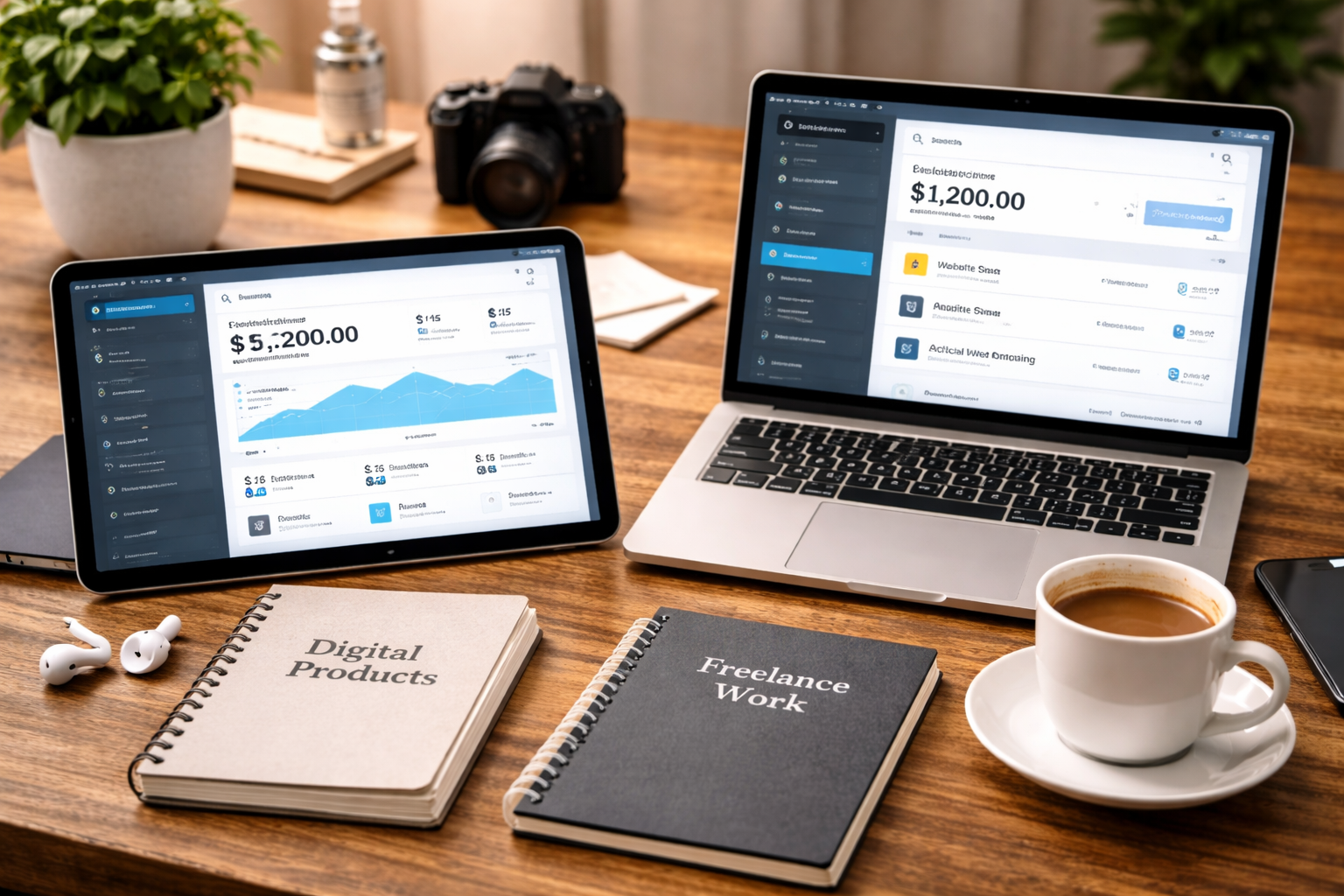



A realistic breakdown of digital products vs freelancing—how each model performs long term, where people burn out, what actually compounds over time, and which path fits different goals and energy levels.
When people want to earn online sustainably, they often end up choosing between two paths:
- Freelancing – selling time, skills, or services
- Digital products – selling assets like courses, templates, guides, or tools
Both can work.
Both can fail.
Both are misunderstood.
The real question isn’t which one makes money faster.
It’s this:
Between digital products vs freelancing, which one actually pays off long-term—financially, mentally, and practically?
This article breaks that down without hype, extremes, or influencer math.
🧠 Why This Comparison Matters More Than Ever
A decade ago, freelancing and digital products lived in different worlds.
Today, they overlap constantly:
- Freelancers are told to “productize”
- Creators are told to “escape client work”
- Everyone is told to scale
But most people aren’t choosing between good and bad options.
They’re choosing between:
- Predictability and leverage
- Short-term cash and long-term optionality
- Energy now vs effort later
That’s why the digital products vs freelancing decision deserves a realistic look.
💼 What Freelancing Really Looks Like Long-Term
Freelancing is often the fastest way to make money online.
Long-term realities:
- Income is tied to time or capacity
- Cash flow is relatively predictable
- Client management is ongoing
- Skill value increases over time
What Freelancing Does Well
- Immediate income
- Clear value exchange
- Low upfront risk
- Skill compounding
- Easier to start with no audience
Where Freelancing Struggles
- Income ceilings
- Burnout risk from availability
- Dependency on clients
- Limited leverage without restructuring
Freelancing pays off long-term if it evolves—through higher rates, retainers, productized services, or reduced scope.
📦 What Digital Products Really Look Like Long-Term
Digital products promise leverage—but not immediately.
Long-term realities:
- Income is delayed
- Distribution is harder than creation
- Maintenance is ongoing
- Revenue can be uneven
What Digital Products Do Well
- High leverage after traction
- Decoupling income from hours
- Global reach
- Asset ownership
- Optional passive income layers
Where Digital Products Struggle
- High upfront effort
- Uncertain demand
- Marketing dependence
- Platform risk
- Emotional toll of low initial sales
Digital products pay off long-term only if distribution is solved—which most people underestimate.
💰 Income Stability: Digital Products vs Freelancing
This is where the difference becomes clear.
Freelancing
- More stable month to month
- Easier to forecast
- Faster to replace lost income
- Less volatility
Digital Products
- Income comes in waves
- Can spike—or disappear
- Often seasonal
- Requires cash runway early
If stability matters, freelancing wins early and often.
If upside matters, digital products have more potential—but less reliability.
⚡ Time, Energy & Burnout Risk
Burnout risk is not equal in the digital products vs freelancing debate.
Freelancing Burnout Comes From
- Constant availability
- Emotional labor
- Too many clients
- Poor boundaries
Digital Product Burnout Comes From
- Promotion fatigue
- Algorithm chasing
- Low conversion discouragement
- Constant iteration pressure
Neither is burnout-proof by default.
Burnout depends on:
- Boundaries
- Scope
- Expectations
- Recovery time
📈 Skill Growth & Career Optionality
This is an overlooked factor.
Freelancing Builds
- Transferable skills
- Industry credibility
- Professional network
- Career insurance
Digital Products Build
- Audience
- Distribution skills
- Brand equity
- Intellectual property
Freelancing strengthens employability.
Digital products strengthen optionality.
Both matter—but at different life stages.
📉 Scalability Myths vs Reality
Many people choose digital products because they want scale.
But here’s the truth:
Most digital products don’t scale without a system behind them.
Scaling requires:
- Marketing systems
- Email lists
- SEO or paid traffic
- Customer support
- Updates and improvements
Freelancing can also scale—but only when:
- Scope is fixed
- Delivery is standardized
- Rates reflect expertise
Scale is not automatic in either model.
⚠️ Risk Profiles Compared
Risk is unevenly distributed.
Freelancing Risk
- Client loss
- Rate pressure
- Platform dependency (Upwork, Fiverr, etc.)
Digital Product Risk
- Zero sales
- Platform changes
- Algorithm dependency
- Market saturation
Freelancing risks are visible and manageable.
Digital product risks are hidden and delayed.
🔀 Hybrid Models (Often the Smartest Choice)
In practice, the best long-term outcome is rarely one or the other.
Smart hybrids include:
- Freelancing + small digital products
- Services that lead to templates or guides
- Consulting + async courses
- Retainers + internal tools
This approach:
- Funds experimentation
- Reduces pressure
- Builds leverage gradually
- Protects mental health
Most people who succeed long-term blend both sides of the digital products vs freelancing equation.
🧭 Which Model Pays Off for Different People
Freelancing Pays Off If You:
- Need income quickly
- Value predictability
- Prefer clear expectations
- Don’t want to build an audience
Digital Products Pay Off If You:
- Have patience and runway
- Enjoy marketing and iteration
- Want leverage over time
- Can tolerate uncertainty
Neither path is superior universally.
Fit matters more than theory.
❓ Frequently Asked Questions
Which makes more money long-term?
Digital products have higher upside, but freelancing has higher reliability.
Is freelancing a dead end?
No—many people build excellent long-term careers through it.
Are digital products passive income?
Rarely. Most require ongoing maintenance and promotion.
Should beginners start with digital products?
Usually no. Freelancing builds skill, insight, and cash first.
Can you switch from freelancing to products later?
Yes—and that’s often the ideal path.
🏁 Conclusion
The real lesson in digital products vs freelancing isn’t about choosing the “better” model.
It’s about timing.
Freelancing pays off when you need:
- Stability
- Skill growth
- Immediate returns
Digital products pay off when you have:
- Experience
- Distribution
- Patience
- Capital or time buffer
Long-term success doesn’t come from rejecting one path.
It comes from sequencing them intelligently—and choosing sustainability over hype.
All Rights Reserved © 2026