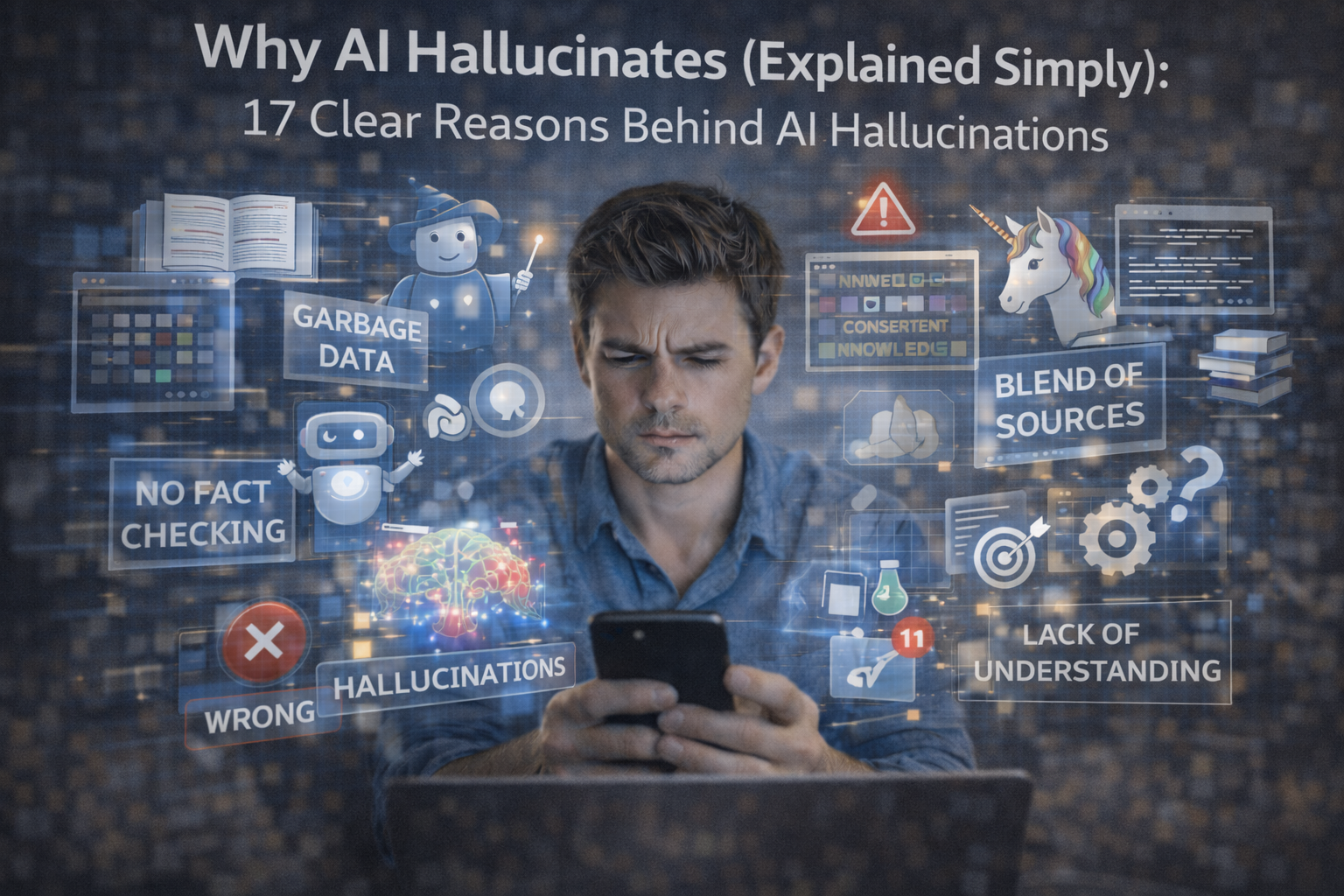



Learn why AI hallucinates, what AI hallucinations really are, why confident false answers happen, and how to reduce risks when using AI systems.
One of the most confusing—and unsettling—experiences with artificial intelligence is watching it confidently say something that is completely wrong.
It doesn’t hesitate.
It doesn’t warn you.
It just sounds right.
This phenomenon is known as an AI hallucination.
Understanding why AI hallucinates does not require technical expertise. It requires a clear explanation of what AI is actually doing—and what it is not capable of doing.
What People Mean When They Say AI “Hallucinates”
When people say AI hallucinates, they usually mean:
- The AI invents facts
- The AI cites sources that don’t exist
- The AI confidently states false information
The word hallucination is metaphorical.
AI does not see things.
It does not imagine.
It does not “go crazy.”
It predicts—incorrectly.
Why AI Hallucinations Feel So Strange
Hallucinations feel strange because:
- The tone remains confident
- The structure looks logical
- The explanation feels complete
Humans associate these signals with truth.
When the content is false, trust breaks abruptly.
What AI Hallucinations Actually Are
An AI hallucination occurs when:
- The model generates a response
- That response is statistically plausible
- But factually incorrect or fabricated
The AI is not lying.
It is completing patterns.
Why AI Hallucinates by Design
AI hallucinations are not bugs.
They are a side effect of how modern AI systems work.
Language models are designed to:
- Predict the most likely next word
- Continue text fluently
- Avoid empty responses
Silence or “I don’t know” is often penalized in training.
Prediction, Not Knowledge
This is the most important idea.
AI does not retrieve truth.
AI predicts language.
If the system lacks:
- Enough data
- Clear signals
- Explicit grounding
It guesses—confidently.
The Role of Language Models
Large language models are trained on:
- Massive text corpora
- Patterns of language usage
- Statistical relationships
They do not have:
- Access to live databases
- Built-in fact-checking
- Understanding of reality
They model how language looks, not how truth works.
Why Plausible Lies Sound Convincing
Plausible hallucinations are dangerous because they:
- Use familiar terms
- Follow correct structure
- Mirror expert explanations
They fail quietly.
Most users cannot detect them without verification.
Missing Data and Guessing
When AI lacks information, it:
- Does not pause
- Does not ask clarifying questions automatically
- Completes the pattern anyway
Missing data becomes invented detail.
Over-Generalization From Training Data
AI generalizes from patterns.
This leads to:
- Mixing similar concepts
- Applying rules incorrectly
- Inventing examples
Generalization works—until it doesn’t.
Confidence Without Awareness
AI does not know when it is wrong.
It has:
- No internal uncertainty signal
- No awareness of correctness
- No concept of error
Confidence stays constant—regardless of truth.
Why Asking for Explanations Makes It Worse
Explanations:
- Increase confidence
- Add structure
- Reduce skepticism
But explanations are generated after the answer.
They do not reveal internal reasoning.
Hallucinations vs Simple Errors
Not all mistakes are hallucinations.
Hallucinations specifically involve:
- Fabricated information
- Non-existent facts
- Confident invention
This makes them harder to detect than typos or miscalculations.
When AI Hallucinates Most Often
Hallucinations increase when:
- Questions are vague
- Topics are niche
- Data is sparse
- The model is pushed beyond its limits
High confidence + low grounding = high risk.
Why Hallucinations Are Hard to Eliminate
Hallucinations persist because:
- Prediction-based models require output
- Silence reduces usefulness
- Accuracy and fluency compete
Perfect accuracy would require fundamentally different architectures.
How Companies Try to Reduce Hallucinations
Companies attempt mitigation through:
- Reinforcement learning
- Safety tuning
- External tools and plugins
How Users Can Reduce Hallucination Risk
Users can reduce risk by:
- Asking for sources
- Verifying critical information
- Using AI for drafts, not facts
- Avoiding blind trust
Human oversight is essential.
Frequently Asked Questions
Why does AI hallucinate instead of saying “I don’t know”?
Because training rewards fluency over uncertainty.
Are hallucinations dangerous?
Yes—when used without verification.
Will hallucinations ever disappear completely?
Unlikely with known architectures.
Do all AI models hallucinate?
Yes, to varying degrees.
Can prompting fix hallucinations?
It can reduce—but not eliminate—them.
Is hallucination the same as lying?
No. It is prediction without awareness.
Conclusion: Hallucinations Are a Feature of Prediction
Understanding why AI hallucinates removes fear and restores responsibility.
AI hallucinations are not signs of intelligence or deception.
They are signs of prediction under uncertainty.
When users understand this, AI becomes safer, clearer, and more useful.
Fluency should never replace verification.
A clear, non-hyped explanation of why language models hallucinate is provided by IBM’s overview of AI hallucinations.
All Rights Reserved © 2026