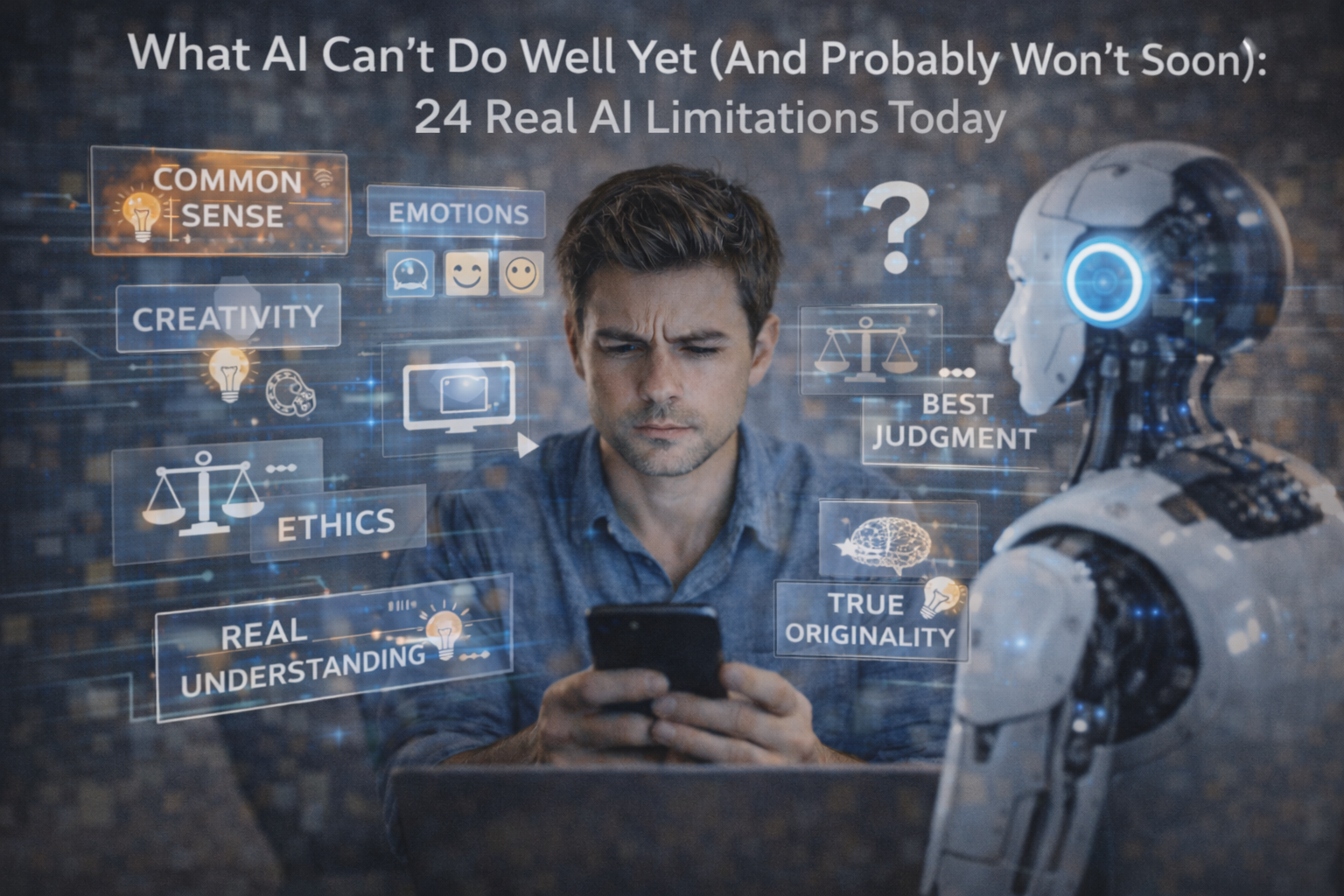



Learn what AI can’t do well yet, the most important AI limitations today, and why some human abilities remain difficult—or unlikely—for AI to replicate soon.
Artificial intelligence has made extraordinary progress. It can write, summarize, generate images, and assist with complex tasks. This rapid improvement creates an understandable impression that AI is approaching—or surpassing—human capability across the board.
But that impression is incomplete.
Understanding what AI can’t do well yet is as important as knowing what it can do. The most meaningful AI limitations today are not temporary bugs. Many are structural, philosophical, or tied to what intelligence actually is.
This article explains those limits clearly, without hype or fear.
Current structural limitations of modern AI systems are explained clearly by Scientific American’s overview of AI limitations.
Why Talking About Limits Matters
Ignoring limits leads to:
- Over-trust
- Poor decisions
- Misplaced responsibility
Recognizing limits leads to:
- Safer use
- Better design
- Stronger human–AI collaboration
Limits are not weaknesses. They are boundaries that guide effective use.
What “AI Limitations Today” Actually Means
AI limitations today do not mean AI is “bad” or “failing.”
They mean:
- Certain capabilities are incomplete
- Some abilities are fundamentally different from human intelligence
- Progress does not guarantee replacement
Understanding limits protects judgment.
Why Progress Feels Faster Than Reality
AI progress feels exponential because:
- Outputs are highly visible
- Improvements stack quickly
- Fluency masks gaps
But visible performance is not the same as deep capability.
Understanding Without Meaning
AI does not understand meaning.
It processes symbols, patterns, and probabilities.
When AI explains a concept, it does not:
- Grasp truth
- Hold beliefs
- Know consequences
It predicts what an explanation should look like.
This is one of the most fundamental AI limitations today.
Common Sense and Real-World Judgment
Humans rely on common sense:
- Social norms
- Physical intuition
- Unspoken rules
AI struggles with:
- Implicit knowledge
- Everyday reasoning
- Situational nuance
This is why AI can fail spectacularly in simple, real-world contexts.
Long-Term Reasoning and Planning
AI performs best on:
- Short-term tasks
- Isolated problems
It struggles with:
- Long-term goals
- Multi-step planning over time
- Delayed consequences
Planning requires sustained context ownership—something AI does not truly possess.
Causal Understanding vs Correlation
AI detects correlations.
It does not understand causality.
This means:
- It can predict outcomes
- But not explain why reliably
- Or reason about interventions
Correlation without causation is a major limitation in decision-making.
True Creativity vs Pattern Remixing
AI appears creative because it:
- Combines existing patterns
- Generates novel-looking outputs
But it does not:
- Experience inspiration
- Set creative intent
- Break conventions intentionally
AI remixing is impressive—but not the same as human creativity.
Moral and Ethical Judgment
Ethics require:
- Values
- Responsibility
- Context-sensitive judgment
AI has none of these.
It can:
- Mimic ethical language
- Apply rules superficially
But it cannot decide what is right.
This makes ethics one of the hardest AI limitations today to overcome.
Accountability and Responsibility
AI cannot be responsible.
It cannot:
- Bear consequences
- Be blamed
- Be held accountable
Responsibility always falls to humans and institutions.
Delegating accountability to AI is a category error.
Context Ownership Over Time
Humans maintain identity and continuity.
AI does not:
- Own long-term context naturally
- Understand evolving situations
- Remember meaningfully across time
Context resets are common failure points.
Handling Novel Situations
AI performs poorly when:
- Situations are truly new
- Data is sparse
- Rules are unclear
Humans adapt creatively under novelty.
AI extrapolates—and often fails.
Embodied Intelligence and Physical Interaction
Human intelligence is embodied.
We learn through:
- Movement
- Sensation
- Physical feedback
Most AI lacks physical grounding.
This limits understanding of the real world.
Emotional Understanding vs Emotional Simulation
AI can simulate empathy.
It cannot:
- Feel emotion
- Understand emotional stakes
- Care
This distinction matters deeply in sensitive contexts.
Self-Awareness and Intent
AI has no self.
It has:
- No goals
- No intent
- No awareness
Any appearance of agency is projection.
Learning With Scarce or Messy Data
AI requires large, clean datasets.
It struggles when:
- Data is limited
- Signals are weak
- Environments change
Humans learn efficiently from small samples.
Robustness Under Pressure
AI can fail under:
- Distribution shifts
- Unexpected inputs
- Stress conditions
Humans often perform better under pressure.
Explaining Decisions Reliably
AI explanations are generated—not traced.
They:
- Sound logical
- May not reflect real processes
- Can mislead
This limits transparency in high-stakes contexts.
AI limitations today Bias Awareness and Value Alignment
AI reflects data biases.
It does not:
- Recognize bias independently
- Adjust values intentionally
Bias mitigation requires human oversight.
AI limitations today Why These Limits Persist
Many limits persist because:
- Intelligence is not just computation
- Human cognition is embodied and social
- Some abilities require consciousness
More data does not solve every problem.
What AI Is Actually Best Used For
AI excels at:
- Pattern detection
- Speed
- Scale
- Repetition
Humans excel at:
- Judgment
- Ethics
- Meaning
- Responsibility
The best systems combine both.
AI limitations today Frequently Asked Questions
Are these AI limitations temporary?
Some may improve; many are structural.
Will AI ever match human intelligence fully?
That remains uncertain and highly debated.
Does acknowledging limits slow innovation?
No. It guides responsible progress.
Should AI be trusted at all?
Yes—but with oversight and context.
Are these limits widely understood?
Not enough, which increases misuse.
Is human judgment still essential?
Absolutely.
AI limitations today Conclusion: Limits Are a Feature, Not a Failure
Understanding what AI can’t do well yet clarifies how to use it wisely.
The most important AI limitations today remind us that:
- Intelligence is more than output
- Judgment cannot be automated
- Responsibility cannot be delegated
AI is powerful—but bounded.
And within those boundaries, it becomes most useful.
Why These Limits PersistMany limits persist because:
Intelligence is not just computation
Human cognition is embodied and social
Some abilities require consciousness
What AI Is Actually Best Used ForAI excels at:
Pattern detection
Speed
Scale
Repetition
Judgment
Ethics
Meaning
Responsibility
Frequently Asked QuestionsAre these AI limitations temporary?Some may improve; many are structural.Will AI ever match human intelligence fully?That remains uncertain and highly debated.Does acknowledging limits slow innovation?No. It guides responsible progress.Should AI be trusted at all?Yes—but with oversight and context.Are these limits widely understood?Not enough, which increases misuse.Is human judgment still essential?Absolutely.
Conclusion: Limits Are a Feature, Not a FailureUnderstanding what AI can’t do well yet clarifies how to use it wisely.The most important AI limitations today remind us that:
Intelligence is more than output
Judgment cannot be automated
Responsibility cannot be delegated
All Rights Reserved © 2026