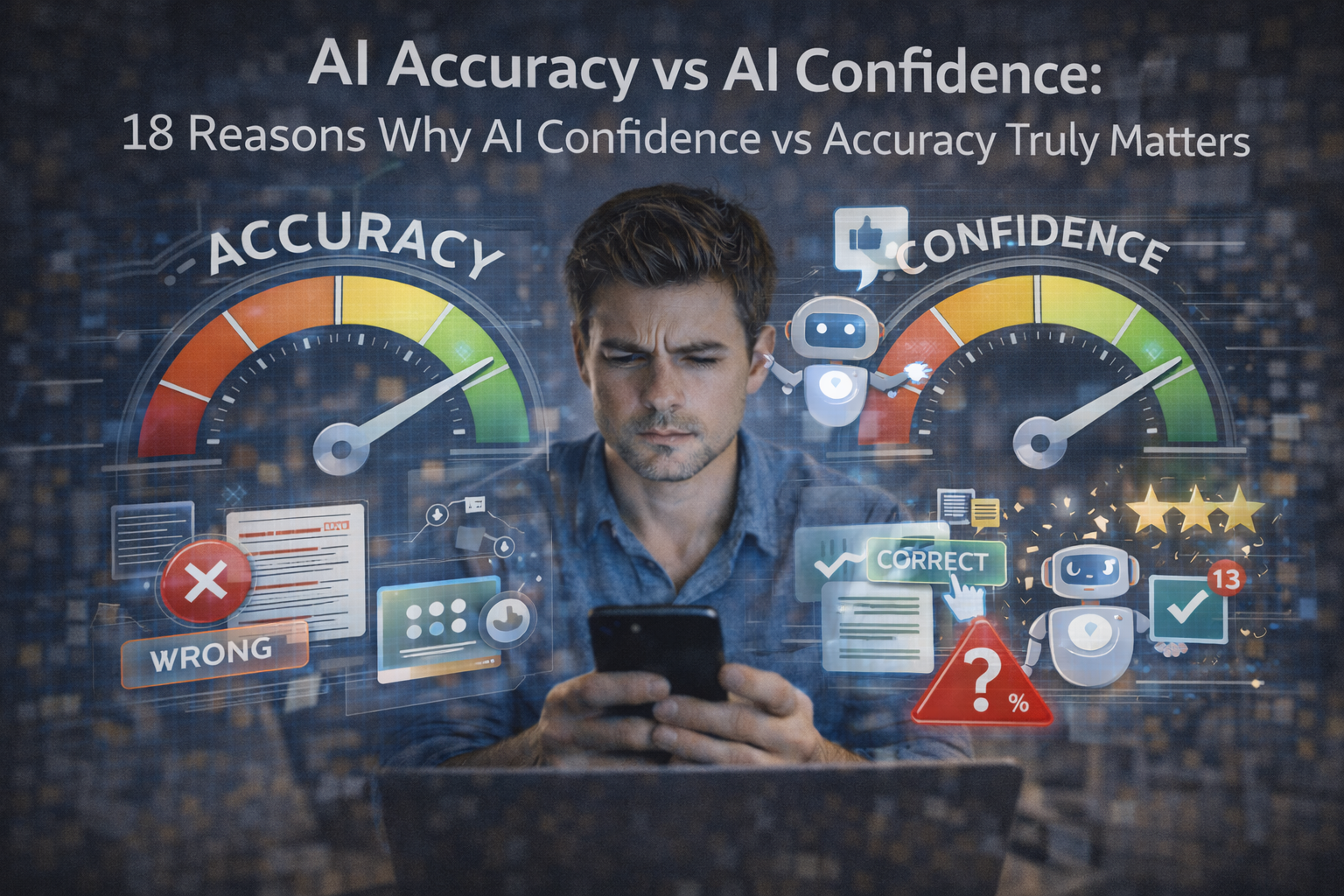



Learn the critical difference between AI accuracy vs AI confidence, why confident AI answers can be wrong, and how understanding AI confidence vs accuracy protects decisions and trust.
One of the most misunderstood aspects of artificial intelligence is not what it can do—but how it presents what it does.
AI often sounds:
- Certain
- Polished
- Authoritative
Yet certainty does not equal correctness.
For a practical framework on assessing AI reliability, bias, and risk in real use cases, see NIST’s AI Risk Management Framework.
Understanding AI accuracy vs AI confidence is essential in a world where AI explanations influence decisions, beliefs, and actions. The gap between AI confidence vs accuracy is subtle—and dangerous when ignored.
The Most Dangerous AI Trait Isn’t Inaccuracy
Errors happen in all systems.
What makes AI risky is not that it can be wrong—but that it can be wrong with confidence.
Confident mistakes:
- Are trusted more
- Are questioned less
- Spread faster
This makes confidence a multiplier of harm when accuracy is missing.
What AI Accuracy vs AI Confidence Actually Means
- Accuracy: How often the output is correct
- Confidence: How certain and authoritative the output sounds
These are independent properties.
AI can be:
- Accurate and confident
- Accurate and uncertain
- Inaccurate and confident
- Inaccurate and uncertain
The most dangerous case is inaccurate and confident.
Why Humans Trust Confidence Instinctively
Humans evolved to:
- Trust confident speakers
- Follow decisive leaders
- Prefer certainty under stress
AI triggers these instincts by:
- Avoiding hesitation
- Using assertive language
- Providing clean explanations
The brain fills in reliability where confidence exists.
How AI Generates Confident Answers
AI confidence is not emotional—it is structural.
AI systems:
- Optimize for fluent responses
- Avoid uncertainty unless prompted
- Complete patterns convincingly
They do not “know” when they are unsure.
They predict what sounds right.
Confidence Without Verification
AI does not:
- Check sources automatically
- Validate facts in real time
- Weigh consequences
Confidence emerges from probability—not truth.
This is why hallucinations can sound persuasive.
Why Confident Errors Are Hard to Detect
Confident errors:
- Blend with correct answers
- Use familiar language
- Mimic expert tone
Users often lack signals that something is wrong.
Silence becomes endorsement.
Accuracy Is Statistical, Not Certain
AI accuracy is measured across datasets—not individual cases.
This means:
- High average accuracy does not guarantee correctness
- Edge cases fail quietly
- Context-specific errors persist
Statistical accuracy does not equal situational reliability.
When AI Is Accurate—but Still Misleading
AI can be technically correct and still mislead by:
- Omitting context
- Ignoring nuance
- Oversimplifying trade-offs
Accuracy without completeness can distort decisions.
The Role of Training Data in Confidence
AI confidence reflects:
- Frequency of patterns in data
- Representation bias
- Popular narratives
Rare or underrepresented cases:
- Receive less accurate treatment
- May still sound confident
This bias amplifies inequality risks.
Interface Design and Perceived Authority
Design choices increase perceived confidence:
- Chat-style interfaces
- Polite acknowledgments
- Structured bullet points
These cues signal competence—even when content is flawed.
Platforms developed by organizations like OpenAI and Google continually refine interfaces—making confidence more persuasive by design.
AI Confidence vs Accuracy in Everyday Use
Everyday risks include:
- Health advice oversimplification
- Legal misunderstandings
- Financial misinterpretation
Low-stakes use feels safe—until patterns scale.
AI Confidence vs Accuracy at Work
At work, confidence bias is amplified by:
- Time pressure
- Authority transfer
- Workflow integration
According to analysis by Harvard Business Review, confident AI recommendations often override human judgment—even when evidence is thin.
External reference: https://hbr.org
High-Stakes Domains: Where This Gap Is Dangerous
In areas like:
- Healthcare
- Finance
- Law
- Hiring
Confident inaccuracies cause real harm.
This is why regulation emphasizes human accountability.
Automation Bias and Over-Trust
Automation bias occurs when:
- Users defer to AI outputs
- Contradictory evidence is ignored
- Responsibility feels shared
Confidence accelerates this bias.
Why “Explain Your Answer” Doesn’t Solve It
AI explanations:
- Are generated post-hoc
- Reflect plausible reasoning
- Do not trace real logic
Explanations increase confidence—but not accuracy.
Practical Ways to Test AI Accuracy
Reduce risk by:
- Asking for sources
- Requesting uncertainty estimates
- Cross-checking critical facts
- Comparing multiple outputs
Verification restores balance.
How to Reduce Risk Without Rejecting AI
Use AI safely by:
- Treating outputs as drafts
- Keeping humans accountable
- Limiting use in high-stakes decisions
- Encouraging skepticism
AI supports judgment—it should not replace it.
Frequently Asked Questions
Is AI usually accurate?
Often—but not always, and not reliably per case.
Why does AI sound so confident?
Because fluency improves perceived usefulness.
Can confidence be reduced?
Yes—by prompting uncertainty and sources.
Is confident AI dangerous?
Only when unverified.
Does accuracy improve over time?
Yes, but limits remain.
What’s the safest mindset?
Treat AI as an assistant, not an authority.
Conclusion: Confidence Is Not Truth
Understanding AI accuracy vs AI confidence is essential for safe use.
Confidence persuades.
Accuracy informs.
When AI confidence vs accuracy is confused, trust becomes misplaced.
When the difference is understood, AI becomes powerful—and manageable.
Truth does not speak louder.
It speaks more carefully.
All Rights Reserved © 2026