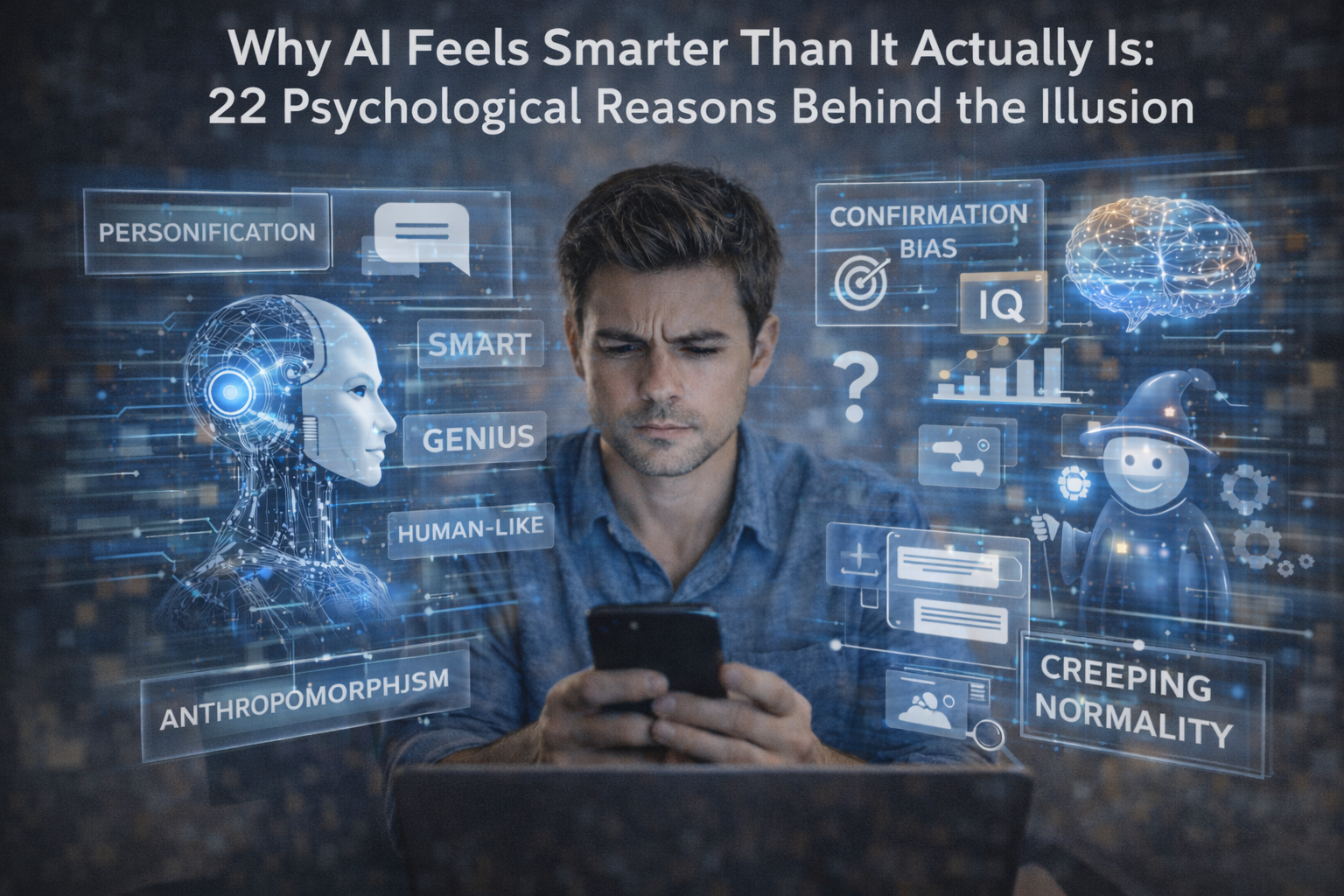



Understand why AI feels smarter than it actually is, how language and confidence create this illusion, and why recognizing AI’s limits leads to safer, smarter use.
Many people have had the same unsettling thought:
“This AI sounds… smart.”
It explains concepts clearly.
It answers quickly.
It rarely says “I don’t know.”
And yet, something feels off.
Understanding why AI feels smarter than it actually is is critical in an era where fluent machines are increasingly trusted with decisions, explanations, and guidance.
The issue is not that AI is useless.
It’s that fluency is being mistaken for intelligence.
The Strange Experience of Talking to “Something Smart”
Human brains are wired to associate language with mind.
For thousands of years:
- Speech meant intention
- Explanation meant understanding
- Confidence meant knowledge
AI breaks this association.
It speaks without thinking.
It explains without knowing.
It answers without understanding.
This mismatch creates confusion—and illusion.
The psychological reasons humans overestimate machine intelligence are explained in Scientific American’s analysis of perceived AI intelligence.
What People Mean When They Say AI Feels Smart
When people say AI feels smart, they usually mean:
- It sounds confident
- It uses correct terminology
- It structures answers logically
None of these require understanding.
They require pattern mastery.
Why AI Feels Smarter Than It Actually Is Today
Modern AI systems are especially good at:
- Natural language generation
- Structured explanations
- Adapting tone
These abilities trigger deep psychological shortcuts.
The brain fills in intelligence where fluency exists.
Language Fluency Creates the Intelligence Illusion
Language is humanity’s strongest signal of intelligence.
When AI:
- Uses full sentences
- Explains step by step
- Adjusts tone
The brain responds socially.
This is why even knowing “it’s just a model” doesn’t fully remove the effect.
Confidence Without Hesitation
AI rarely hesitates.
It doesn’t:
- Pause
- Express doubt naturally
- Ask clarifying questions unless prompted
Confidence without hesitation feels authoritative.
Humans equate certainty with competence—even when certainty is misplaced.
Pattern Completion vs Understanding
AI does not understand meaning.
It predicts:
- The next likely word
- The next likely sentence
- The most plausible explanation
This is pattern completion, not comprehension.
Yet pattern completion can look identical to understanding.
The Human Tendency to Anthropomorphize
Humans instinctively attribute mind to:
- Animals
- Objects
- Systems that respond socially
AI triggers this instinct strongly.
Once anthropomorphism begins, trust follows.
Why Coherent Answers Feel Like Knowledge
Coherence signals structure.
Structure signals thought.
But AI produces coherence statistically—not cognitively.
A well-structured answer can be entirely wrong and still feel intelligent.
The Role of Authority Bias
Authority bias causes people to trust:
- Confident speakers
- Polished explanations
- Systems associated with expertise
AI inherits authority from:
- Platforms
- Brands
- Technical mystique
This amplifies perceived intelligence.
AI Mimics Expertise Without Owning It
AI can:
- Use expert vocabulary
- Explain expert-level concepts
- Simulate professional tone
But it does not:
- Verify claims
- Own consequences
- Understand stakes
This gap is dangerous when unrecognized.
Why Speed Is Mistaken for Intelligence
Fast answers feel smart.
AI delivers:
- Instant responses
- No visible effort
- No cognitive struggle
Humans mistake speed for mastery.
In reality, speed often hides shallow processing.
The Absence of Visible Effort
Humans expect thinking to look like effort.
AI hides all effort.
No pauses.
No revisions.
No visible uncertainty.
This absence reinforces the illusion of competence.
When Correct Answers Reinforce the Illusion
AI is often correct—especially on:
- Common knowledge
- Well-documented topics
- Popular frameworks
Each correct answer strengthens trust.
The illusion grows quietly.
When Wrong Answers Don’t Break Trust
When AI is wrong:
- Errors may be subtle
- Confidence remains high
- Users may not verify
Because AI sounds the same when wrong as when right, trust erodes slowly—if at all.
AI Does Not Know—It Predicts
This is the most important distinction.
AI does not:
- Know facts
- Understand truth
- Reason intentionally
It predicts what sounds right based on patterns.
This is why hallucinations occur.
Why Explanations Feel Convincing
Explanations are persuasive because:
- They reduce uncertainty
- They organize information
- They satisfy curiosity
AI explanations feel complete—even when they are fabricated.
The Danger of Over-Attributing Intelligence
When AI is treated as intelligent:
- Responsibility shifts
- Oversight decreases
- Critical thinking weakens
This is not a technical failure.
It is a human one.
How This Illusion Affects Decision-Making
People may:
- Accept outputs without verification
- Delegate judgment prematurely
- Follow flawed reasoning confidently
This risk increases in professional settings.
Why AI Feels Smarter Than It Is at Work
At work, AI:
- Speaks professionally
- Mimics expert tone
- Integrates into trusted tools
According to analysis published by Harvard Business Review, fluency-driven trust is a major risk factor in AI-assisted decision-making.
External reference: https://hbr.org
How to Use AI Without Being Fooled by Fluency
Practical safeguards include:
- Treat outputs as drafts
- Verify critical information
- Ask “how do you know?”
- Maintain human accountability
AI should support thinking—not replace it.
Frequently Asked Questions
Why does AI sound so confident?
Because it generates statistically likely responses without doubt.
Is AI actually intelligent?
No. It simulates language, not understanding.
Why do people trust AI so easily?
Because humans associate fluency with intelligence.
Can AI be useful despite this illusion?
Yes—when used critically.
Is this illusion dangerous?
Only when users stop verifying.
How can I stay objective?
Treat AI as a tool, not an authority.
Conclusion: Fluency Is Not Intelligence
Why AI feels smarter than it actually is becomes clear once language is separated from understanding.
AI is powerful.
AI is useful.
AI is not intelligent in the human sense.
When fluency is mistaken for intelligence, risk increases.
When fluency is recognized for what it is—a surface feature—AI becomes safer, clearer, and more effective.
Real-World Examples Where Fluency Was Mistaken for Intelligence
The illusion that AI is intelligent becomes most visible when it is applied to real decisions.
Common scenarios include:
- Confident but incorrect summaries of complex documents
- Polished explanations that omit critical caveats
- Authoritative-sounding recommendations based on incomplete data
Because the output sounds right, users often skip verification—especially under time pressure.
Fluency lowers skepticism.
Why Even Experts Can Be Fooled
Expertise does not fully protect against the fluency illusion.
Why?
- Experts rely on pattern recognition
- AI mirrors expert language convincingly
- Time constraints reduce deep checking
Even skilled professionals can over-trust AI when it speaks their language smoothly.
This makes awareness—not expertise—the key defense.
The Role of Interface Design in the Intelligence Illusion
Interface design amplifies perceived intelligence.
Design choices that increase trust include:
- Chat-like conversations
- Typing indicators
- Polite acknowledgments
- Structured explanations
These cues signal social intelligence—even when none exists.
The interface shapes belief as much as the model itself.
Why “Explain Your Reasoning” Doesn’t Fix the Problem
Many people believe asking AI to “explain its reasoning” solves reliability issues.
It does not.
Because:
- The explanation is generated after the answer
- It is not a trace of real reasoning
- It is another prediction
Explanations feel reassuring—but can deepen false confidence.
How the Illusion Changes Learning Behavior
When AI feels intelligent, people:
- Accept explanations passively
- Skip active learning
- Stop struggling productively
Struggle is essential for learning.
Fluency removes struggle—and with it, deep understanding.
Why This Illusion Is Stronger With Text Than Images
Text triggers deeper cognitive trust than images.
Why?
- Language evolved as a truth signal
- Written explanations imply deliberation
- Text feels precise
This is why text-based AI systems feel “smarter” than visual ones—even when they are built on the same principles.
AI Confidence vs Human Confidence
Human confidence usually reflects:
- Experience
- Uncertainty management
- Stakes awareness
AI confidence reflects:
- Statistical likelihood
- Output optimization
- No awareness of consequences
Treating these as equivalent is a mistake.
Why the Illusion Persists Even After Errors
Even after obvious mistakes, trust often returns.
Why?
- Errors feel isolated
- Confidence remains unchanged
- Past successes overshadow failures
This creates a “forgiveness loop” that keeps the illusion intact.
How Teams Can Reduce Fluency-Based Overtrust
At a team level, safeguards include:
- Mandatory verification for critical outputs
- Clear labeling of AI-generated content
- Assigning human accountability explicitly
- Encouraging dissent against AI suggestions
Trust should be earned per use case, not assumed globally.
Practical Questions to Ask Before Trusting an AI Output
Instead of asking “Is this right?”, ask:
- What data could this be missing?
- What assumptions does this rely on?
- Would I accept this from a junior colleague?
- What happens if this is wrong?
These questions break the spell of fluency.
Why Understanding This Illusion Is a Core AI Literacy Skill
AI literacy is not about:
- Knowing how models are trained
- Understanding technical architecture
It is about recognizing how perception is shaped.
Knowing why AI feels smart protects judgment more than any technical detail.
Expanded Frequently Asked Questions
Why does AI rarely say “I don’t know”?
Because uncertainty lowers perceived usefulness, even when honesty would be safer.
Does better prompting fix the intelligence illusion?
No. It may improve outputs but does not change the underlying limitation.
Is this illusion intentional?
Not always—but it is reinforced by design incentives.
Are some AI systems less prone to this illusion?
Systems with constrained outputs and clear limitations reduce overtrust.
Can regulation help?
Labeling and transparency help—but user education matters more.
Will this illusion disappear over time?
Only if awareness becomes widespread.
Final Reinforcement: Smart-Sounding Is Not Smart
The most important takeaway is simple:
AI does not understand.
AI does not know.
AI does not reason.
It predicts convincingly.
Understanding why AI feels smarter than it actually is protects users from misplaced trust without rejecting the real benefits AI offers.
Fluency is a surface feature.
Judgment must remain human.
All Rights Reserved © 2026