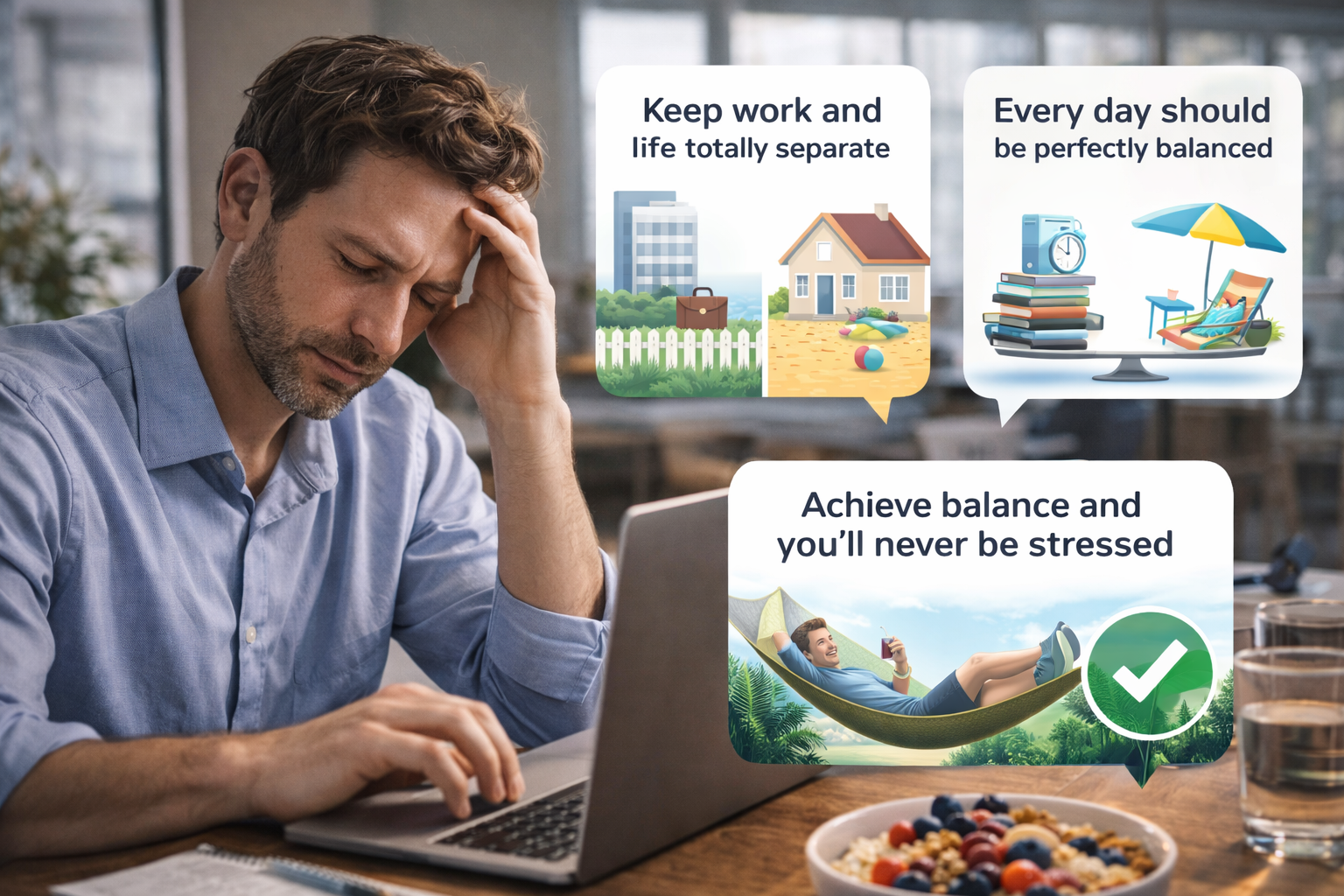



Work life balance myths explained in depth—why popular beliefs about balance fail in real life, how work and life actually interact, and what sustainable balance really looks like in 2026.
Work-life balance is one of the most talked-about ideas of the modern era.
It’s promised in job ads.
Preached in self-help books.
Hashtagged on social media.
And yet—most people feel more exhausted, guilty, and conflicted than ever.
So let’s ask the uncomfortable question:
Why do so many work life balance myths still survive—even when real life keeps proving them wrong?
This long-form guide breaks down the most common work life balance myths, why they’re so appealing, why they fail in practice, and what actually creates a sense of balance in the real world.
This isn’t about hustle culture or quitting work altogether.
It’s about reality.
🧠 Why the Idea of Work-Life Balance Is So Confusing
The phrase work-life balance sounds simple—but it hides a massive contradiction.
It suggests:
- Work is one thing
- Life is another
- They compete for time and energy
In reality:
- Work is part of life
- Life affects work
- Energy flows unevenly
The reason work life balance myths persist is because people want clarity in a messy system.
Balance feels like a promise of control.
⚖️ Myth #1: Work-Life Balance Means Equal Time
This is the most common—and damaging—myth.
The belief:
“If I split my time evenly between work and life, I’ll feel balanced.”
Why This Fails
Life doesn’t operate in equal slices.
Some weeks require:
- More work
- More caregiving
- More recovery
Other weeks allow:
- Rest
- Play
- Exploration
Trying to force equal time creates:
- Guilt when work dominates
- Anxiety when life demands more
- A constant feeling of failure
Balance is not symmetry.
📆 Myth #2: Balance Is a Daily Achievement
Another common belief:
“I should feel balanced every day.”
This expectation alone guarantees disappointment.
Why This Fails
Daily life includes:
- Unexpected problems
- Emotional swings
- Deadlines
- Fatigue
Balance doesn’t happen daily.
It happens over time.
People who feel balanced zoom out:
- Weeks instead of days
- Seasons instead of moments
The myth turns normal fluctuations into personal shortcomings.
🏢 Myth #3: The Right Job Fixes Balance
Many people believe:
“If I find the right job, balance will fall into place.”
While job fit matters, it’s not a cure-all.
Why This Fails
Even good jobs include:
- Busy periods
- Stress
- Responsibility
And even flexible jobs can:
- Blur boundaries
- Increase availability pressure
- Expand expectations
Work life balance myths often place all responsibility on employers—or employees—when balance is shaped by systems, culture, and personal limits.
⚙️ Myth #4: Productivity Creates Balance
This myth sounds logical:
“If I work efficiently enough, I’ll have more time for life.”
In practice, productivity often expands expectations.
Why This Fails
When you become more productive:
- You’re given more work
- Standards rise
- Availability increases
Efficiency doesn’t automatically buy freedom.
Without boundaries, productivity becomes:
- A reward for others
- A burden for you
This is one of the most subtle work life balance myths—because it feels empowering while quietly increasing load.
🚧 Myth #5: Boundaries Alone Solve Everything
“Just set better boundaries” is common advice.
Boundaries matter—but they’re not magic.
Why This Fails
Boundaries are hard when:
- Power dynamics exist
- Financial pressure exists
- Care responsibilities exist
Telling someone to “just say no” ignores reality.
Balance isn’t only about personal strength—it’s about structural constraints.
😴 Myth #6: You’re Failing If You Feel Tired
This myth creates constant self-judgment.
The belief:
“If I were doing balance right, I wouldn’t be exhausted.”
Why This Fails
Tiredness doesn’t always mean imbalance.
It can mean:
- Growth
- Stressful seasons
- Learning curves
- Life transitions
Fatigue becomes a problem when it’s chronic and ignored, not when it appears at all.
Work life balance myths turn normal human limits into moral failures.
🧍 Myth #7: Balance Looks the Same for Everyone
Social media makes balance look aesthetic:
- Calm mornings
- Short workdays
- Perfect routines
Reality is messier.
Why This Fails
Balance depends on:
- Age
- Health
- Family situation
- Personality
- Values
A schedule that works for one person may destroy another.
Comparing balance is like comparing sleep needs—it’s meaningless.
🔀 Myth #8: Work and Life Are Opposites
This myth frames work as:
- Draining
- Oppressive
- Separate from meaning
And life as:
- Rest
- Freedom
- Identity
Why This Fails
For many people:
- Work provides purpose
- Work enables life
- Life stress affects work
The real problem isn’t work—it’s unmanageable work.
When work is aligned and limited, it can support life instead of stealing from it.
❤️ Myth #9: You Must Always Love Your Work
This belief creates quiet pressure:
“If I don’t love my job, something is wrong.”
Why This Fails
Most work is:
- Sometimes meaningful
- Sometimes boring
- Sometimes stressful
Expecting constant fulfillment creates dissatisfaction.
Balance doesn’t require loving work—it requires work not consuming everything else.
🧨 Myth #10: Balance Is a Personal Failure
This is the most harmful myth.
When balance feels impossible, people conclude:
“I’m bad at managing my life.”
Why This Fails
Work life balance myths ignore:
- Economic pressure
- Cultural expectations
- Always-on technology
- Shrinking recovery time
When systems are broken, individuals blame themselves.
That’s not balance—that’s burnout culture.
🧭 What Work-Life Balance Actually Is
After stripping away the myths, balance looks different.
Real balance is:
- Dynamic, not fixed
- Seasonal, not daily
- Energy-based, not time-based
- Forgiving, not rigid
It’s not about perfection—it’s about sustainability.
🔥 How Hustle Culture Reinforced Work Life Balance Myths
To understand why work life balance myths are so persistent, we need to talk about hustle culture.
Hustle culture didn’t just promote overwork.
It reframed imbalance as virtue.
What Hustle Culture Did
It taught people that:
- Being busy = being important
- Exhaustion = commitment
- Sacrifice = success
Then, paradoxically, it sold work-life balance as the reward:
“Grind now, balance later.”
That “later” rarely arrives.
Why Hustle Culture Is So Sticky
Hustle culture works because it:
- Offers identity (“hard worker”)
- Creates community (“we’re all grinding”)
- Provides moral clarity (“lazy vs disciplined”)
But it quietly destroys balance by:
- Normalizing chronic overwork
- Shaming rest
- Making boundaries feel like weakness
This is why so many work life balance myths survive — they’re emotionally reinforced, not logically tested.
🧠 Why “Do What You Love” Backfires
One of the most dangerous myths adjacent to balance is:
“If you do what you love, balance will take care of itself.”
This idea sounds positive — but it often leads to worse imbalance.
How Passion Becomes Exploitation
When work is tied to identity:
- Boundaries blur
- Overwork feels justified
- Saying no feels disloyal
People who love their work often:
- Work longer hours
- Recover less
- Internalize stress
Enjoyment does not protect against burnout.
This is a core work life balance myth that harms creatives, caregivers, and purpose-driven professionals the most.
Liking Your Work Is Not the Same as Limitless Capacity
You can:
- Care deeply about your job
- Find meaning in it
- Still need rest and limits
Balance isn’t about emotional alignment alone — it’s about finite energy.
🧍 Work-Life Balance Across Life Stages (The Missing Context)
Another reason work life balance myths fail is that they assume a static life.
But life is not static.
Early Career
Common reality:
- Proving yourself
- Learning fast
- Accepting instability
Balance here often looks like:
- Short-term imbalance with long-term awareness
The myth is expecting perfect balance immediately.
Mid-Career
Reality shifts:
- Increased responsibility
- Family obligations
- Cognitive load
Balance now depends on:
- Boundaries
- Saying no
- Letting go of “doing it all”
Productivity myths do the most damage here.
Later Career
The value equation changes:
- Experience > hours
- Judgment > output
Balance improves when people:
- Delegate
- Reduce urgency
- Focus on leverage
Balance isn’t lost with age — it often emerges once people stop proving themselves.
🏠 Work-Life Balance and Caregiving
One of the most ignored realities in balance conversations is care work.
Caregiving:
- Has no clear boundaries
- Is emotionally demanding
- Is unpredictable
Most work life balance myths collapse completely under caregiving realities.
Advice like:
- “Just plan better”
- “Optimize your schedule”
Fails immediately.
Real balance here looks like:
- Flexibility
- Support systems
- Lower expectations
Not hacks.
⚖️ Balance Is About Energy, Not Time
This is one of the most important reframes.
Work life balance myths focus on hours.
Real balance depends on:
- Mental energy
- Emotional capacity
- Physical recovery
You can work fewer hours and still feel depleted.
You can work more hours and still feel okay — temporarily.
Balance is about sustainable energy flow, not perfect schedules.
🧠 Why Guilt Is the Enemy of Balance
Many people technically have:
- Time off
- Flexible work
- Autonomy
But still feel unbalanced.
Why?
Guilt.
Guilt shows up as:
- Thinking about work during rest
- Feeling lazy when resting
- Feeling behind when offline
Work life balance myths teach people that rest must be earned.
In reality, rest is maintenance, not reward.
📉 Why Balance Advice Fails at the System Level
Another uncomfortable truth:
Many balance problems are structural, not personal.
Examples:
- Understaffing
- Always-on communication
- Economic pressure
- Cultural expectations
Telling individuals to “find balance” in broken systems creates:
- Self-blame
- Burnout
- Quiet resentment
This is why balance advice feels hollow for many people.
🧭 What Work-Life Balance Actually Looks Like (In Practice)
After stripping away the myths, balance looks surprisingly unglamorous.
Real balance often looks like:
- Saying no more often
- Accepting unfinished work
- Being “good enough”
- Letting seasons be uneven
It’s not Instagrammable.
It’s livable.
🧩 A Realistic Framework for Work-Life Balance
Instead of chasing myths, use this framework.
1. Think in Seasons, Not Days
Ask:
“Over the next month, does my life feel sustainable?”
Daily balance is a myth.
Seasonal balance is achievable.
2. Protect Recovery First
Sleep, rest, and downtime are inputs, not leftovers.
If recovery goes, balance follows.
3. Reduce, Don’t Optimize
Balance improves more by:
- Removing commitments
- Reducing scope
- Lowering expectations
Than by optimizing schedules.
4. Accept Trade-Offs Without Guilt
Every yes creates a no.
Balance is choosing trade-offs consciously — not eliminating them.
5. Redefine Success
Success that requires constant exhaustion is not success.
Balance improves when definitions change.
❓ Final Expanded FAQs
Is work-life balance even possible today?
Yes — but not in the myth-based way it’s often described.
Why does balance feel harder now than before?
Because work expanded while recovery shrank.
Is remote work the solution?
It helps some — and hurts others. Structure still matters.
Can I have balance in a demanding career?
Yes, but balance may be seasonal, not constant.
What’s the biggest lie about work-life balance?
That it’s purely a personal responsibility.
🏁 Final Conclusion: Why Work-Life Balance Myths Still Hurt Us
The reason work life balance myths persist is simple:
They offer simple answers to complex lives.
But real balance is:
- Messy
- Contextual
- Imperfect
- Human
Balance is not something you achieve once.
It’s something you renegotiate continuously as life changes.
The goal isn’t perfect harmony.
The goal is:
A life that doesn’t require you to constantly recover from it.
That’s what real balance looks like.
All Rights Reserved © 2026