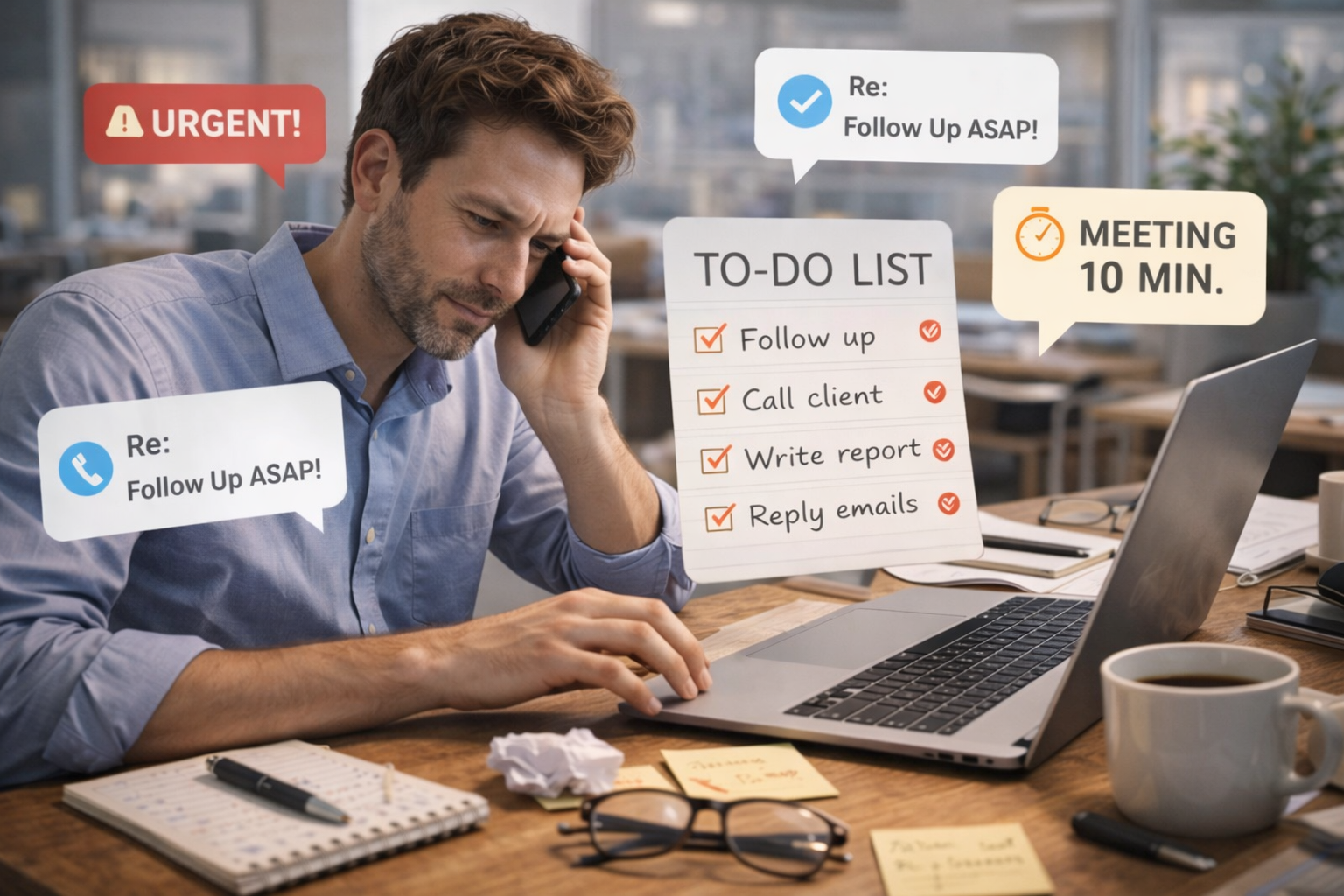



Busy vs productive explained in depth—why constant busyness feels like progress, why it often isn’t, and how to build real effectiveness without burnout, guilt, or hustle culture traps.
Being busy feels good.
It feels responsible.
It feels disciplined.
It feels like forward motion.
And yet, many people who are constantly busy end their weeks feeling:
- Behind
- Exhausted
- Unclear about what actually mattered
This is the central paradox of modern work:
Busy vs productive — why does being busy feel productive, even when it isn’t?
This long-form guide breaks down why busyness is so convincing, why it’s often mistaken for real progress, and how modern work environments quietly reward activity over impact.
This is not an anti-work manifesto.
It’s a reality check.
🧠 Why Being Busy Feels So Good
Busyness feels productive because it provides immediate feedback.
When you:
- Answer emails
- Attend meetings
- Check off tasks
- Respond quickly
You get:
- Closure
- Validation
- A sense of usefulness
The brain rewards movement, not meaning.
This is the first reason the busy vs productive distinction is so hard to notice in daily life.
🎯 The Psychological Reward of Busyness
Busyness triggers several powerful psychological reinforcements.
1. Busyness Reduces Anxiety
Doing something feels safer than deciding what matters.
When work is ambiguous or overwhelming, staying busy:
- Avoids uncertainty
- Delays hard choices
- Provides temporary relief
This makes busyness emotionally soothing—even when it’s ineffective.
2. Busyness Feels Like Control
In complex environments, control is scarce.
Checking tasks off a list creates the illusion of control, even if the tasks are low-impact.
This is why people default to activity when overwhelmed.
3. Busyness Protects Identity
Being busy signals:
- Importance
- Commitment
- Value
In many cultures, saying “I’m busy” feels safer than saying “I’m done.”
This identity protection reinforces the busy side of busy vs productive, even when results are thin.
🏢 How Modern Work Incentivizes Activity
Busyness isn’t just personal—it’s structural.
Most workplaces reward:
- Visibility
- Responsiveness
- Availability
They struggle to measure:
- Thinking
- Judgment
- Long-term impact
So people adapt.
They optimize for being seen doing things, not doing the right things.
The Visibility Bias
Work that is:
- Loud
- Fast
- Communicative
Is more visible than work that is:
- Quiet
- Strategic
- Reflective
As a result, busy work often receives more recognition than productive work.
⚖️ Busy vs Productive: The Core Difference
Let’s be precise.
Busy Is:
- Reactive
- Fragmented
- Short-term
- Activity-driven
Productive Is:
- Intentional
- Focused
- Outcome-driven
- Energy-aware
Busy work answers:
“What can I do right now?”
Productive work answers:
“What actually moves things forward?”
This distinction is simple—but living it is hard.
🧠 Why Smart People Fall Into the Busyness Trap
Busyness is not a sign of incompetence.
In fact, high performers are often more vulnerable.
Why?
1. Competence Attracts More Work
Capable people:
- Get asked more
- Are trusted more
- Become default problem-solvers
This increases load without increasing leverage.
2. Responsiveness Gets Rewarded Early
Early career success often comes from:
- Fast replies
- Saying yes
- Taking on extra tasks
Over time, this trains people to equate speed with value.
3. Thinking Work Is Hard to Defend
It’s easier to justify:
- Five meetings
- Dozens of emails
Than:
- Two hours of thinking
So people stay busy to appear productive.
📨 Meetings, Messages & the Illusion of Progress
Modern tools amplify the busy vs productive problem.
Email, chat, and meetings create:
- Constant interruptions
- Endless micro-tasks
- Perpetual urgency
Each interaction feels productive in isolation.
Collectively, they fragment attention and destroy momentum.
Why Communication Feels Like Work
Communication produces:
- Immediate responses
- Social validation
- Clear endpoints
This makes it feel like progress—even when it displaces real work.
🎭 Productivity Theater at Work
Many organizations engage in what can be called productivity theater.
This includes:
- Over-reporting
- Excessive check-ins
- Status meetings without decisions
- Metrics that track activity, not outcomes
People perform productivity instead of practicing it.
This blurs the line between busy vs productive until they feel identical.
💸 The Hidden Cost of Constant Busyness
Busyness isn’t harmless.
Over time, it creates:
- Mental fatigue
- Shallow thinking
- Chronic stress
- Reduced creativity
Ironically, the more busy people become, the less productive they often are.
The Burnout Curve
Constant busyness:
- Feels productive short-term
- Becomes draining mid-term
- Leads to disengagement long-term
By the time people notice, habits are deeply ingrained.
📉 Why Productivity Advice Often Makes This Worse
Much productivity advice unintentionally reinforces busyness.
Examples:
- “Optimize your schedule”
- “Do more in less time”
- “Track every task”
These approaches often:
- Increase activity
- Multiply tasks
- Add cognitive load
They make people better at being busy, not more productive.
🧠 What Real Productivity Actually Looks Like
Real productivity is quieter than most people expect.
It often looks like:
- Fewer tasks
- Longer focus
- Slower days
- Clearer priorities
Productive people are not always busy.
They are selective.
🧩 A Practical Framework: Shifting From Busy to Productive
Here is a realistic way to rebalance busy vs productive in daily life.
1. Define One Outcome Per Day
Not a to-do list—an outcome.
Ask:
“What would make today meaningful if completed?”
2. Limit Reactive Windows
Contain:
- Messages
- Meetings
Protect blocks for thinking and creation.
3. Measure Impact, Not Effort
At the end of the day, ask:
- What changed?
- What moved?
- What mattered?
4. Accept That Productive Can Look Empty
A calendar with space is not a failure.
It’s capacity.
❓ Frequently Asked Questions
Why does busy vs productive matter so much now?
Because modern work rewards speed and visibility more than impact.
Is being busy always bad?
No—but constant busyness without direction is.
Can someone be both busy and productive?
Yes—but only briefly. Long-term productivity requires selectivity.
Why do I feel guilty when I’m not busy?
Because culture equates worth with activity.
What’s the first step out of the busyness trap?
Reducing, not optimizing.
🏁 Interim Conclusion
The reason busy vs productive is so confusing is simple:
Busyness provides instant validation.
Productivity delivers delayed value.
Modern systems reward the former and ignore the latter.
⚖️ Why Busyness Feels Moral — and Productivity Feels Risky
One of the least discussed reasons the busy vs productive problem persists is that busyness has become a moral signal.
Being busy communicates:
- Responsibility
- Commitment
- Worth
Productivity, on the other hand, often requires:
- Saying no
- Leaving space
- Doing less visibly
That feels risky.
In many cultures, being busy is interpreted as trying hard, while being selective can be misread as laziness or disengagement — even when results improve.
The Moral Weight of Busyness
People rarely feel guilty for being busy.
They often feel guilty for resting, thinking, or stopping early.
This creates a subtle bias:
- Busyness feels safe
- Productivity feels exposed
So people choose safety — even when it costs effectiveness.
🧠 Identity, Self-Worth, and the Busyness Trap
For many people, busyness is not just a habit — it’s an identity.
“I’m someone who’s always busy.”
“I work hard.”
“I don’t slow down.”
These identities feel protective, especially in uncertain environments.
The problem is that when identity is tied to busyness:
- Slowing down feels like failure
- Focus feels uncomfortable
- Empty space feels threatening
This makes the busy vs productive shift emotionally difficult, not intellectually hard.
Why Productivity Can Feel Like a Loss
Moving away from busyness can feel like losing:
- Status
- Visibility
- Validation
Even when productivity improves, the feeling of productivity may drop at first.
That adjustment period is where many people quit and return to busyness.
📊 Busy vs Productive Across Different Careers
The tension between busy and productive looks different depending on context.
Early Career
Busyness often equals opportunity.
- Saying yes builds exposure
- Speed builds trust
- Volume builds skill
Here, busyness can be temporarily productive.
The risk comes when people never graduate from this phase.
Mid-Career
This is where busy vs productive becomes critical.
Responsibilities increase, but time doesn’t.
Productivity now requires:
- Prioritization
- Boundaries
- Letting go of being everywhere
Many people struggle here because the habits that once helped now hurt.
Leadership Roles
Leaders are especially vulnerable to busyness:
- Meetings multiply
- Communication expands
- Decisions pile up
Truly productive leaders:
- Reduce noise
- Protect thinking time
- Delegate aggressively
But this often looks like “doing less,” which can feel uncomfortable.
🏠 Busy vs Productive in Personal Life
This dynamic doesn’t stop at work.
People fill personal time with:
- Errands
- Commitments
- Obligations
- Constant stimulation
Just like work, personal busyness feels responsible.
But it often prevents:
- Recovery
- Reflection
- Presence
The result is a life that feels full — but not satisfying.
Why Stillness Feels Unproductive
Stillness offers no immediate proof of value.
That’s why it’s avoided.
But stillness is often where:
- Insight emerges
- Stress resolves
- Meaning becomes clear
Productivity requires space. Busyness consumes it.
🤖 How Technology and AI Amplify Busyness
Modern tools were designed to increase efficiency.
Instead, they often increase activity.
AI, automation, and communication platforms can:
- Speed up tasks
- Multiply outputs
- Increase expectations
Without intention, this pushes people deeper into busyness.
The busy vs productive tension intensifies when faster tools lead to more work, not better work.
The Automation Paradox
When tasks become easier:
- Standards rise
- Volume increases
- Downtime disappears
Technology doesn’t automatically create productivity.
It amplifies whatever priorities already exist.
If priorities are unclear, busyness scales faster than productivity.
⏳ Why Productivity Feels Slower (At First)
One reason people resist productivity-focused approaches is that they feel slower initially.
Why?
- Fewer tasks
- Longer focus
- Less stimulation
Busyness gives constant dopamine hits.
Productivity gives delayed rewards.
This delay is uncomfortable — but essential.
The Lag Between Action and Impact
Productive work often:
- Takes time to show results
- Requires patience
- Feels invisible early on
This makes it emotionally harder than busy work, which offers immediate feedback.
🧠 The Role of Guilt in Staying Busy
Guilt is one of the strongest forces keeping people busy.
People feel guilty when:
- They’re not responding
- They’re not “maximizing” time
- They stop early
- They say no
This guilt pushes them back into activity — even when they know it’s not helping.
Understanding busy vs productive means learning to tolerate guilt without obeying it.
🧩 A Deeper Framework: Redefining Productivity
Let’s go beyond tips.
True productivity rests on four principles.
1. Fewer Inputs
More information does not equal more clarity.
Reducing inputs improves:
- Focus
- Decision quality
- Energy
2. Clear Outcomes
Productivity depends on knowing:
- What matters
- What doesn’t
Busyness thrives when outcomes are vague.
3. Recovery as a Requirement
Rest is not a reward for productivity.
It is a condition for it.
4. Long-Term Thinking
Productivity looks different over:
- Days
- Weeks
- Seasons
Busyness optimizes the moment.
Productivity optimizes the arc.
🔄 What Shifting From Busy to Productive Feels Like (Honestly)
This shift does not feel like:
- Instant calm
- Constant confidence
- Effortless flow
It often feels like:
- Discomfort
- Doubt
- Fewer visible wins
But over time, it produces:
- Clearer direction
- Better results
- Less exhaustion
That trade-off is the heart of busy vs productive.
📉 Why People Relapse Into Busyness
Even after understanding the difference, people relapse.
Common triggers:
- Stress
- Uncertainty
- External pressure
- Fear of falling behind
Busyness is a familiar coping mechanism.
The goal isn’t to eliminate busyness — it’s to recognize it quickly and reset.
🛠️ A Sustainable Anti-Busyness Practice
Instead of chasing constant productivity, try this:
- One meaningful outcome per day
- One protected focus block
- One intentional stop point
That’s enough.
Anything more often pushes you back into busyness.
❓ Final Extended FAQs
Is busyness ever useful?
Yes — during learning phases or short sprints. It becomes harmful when constant.
Why do organizations reward busyness?
Because activity is easier to see than impact.
Can productivity exist without structure?
Rarely. Structure creates space for focus.
Why does slowing down feel uncomfortable?
Because busyness numbs uncertainty.
What’s the most reliable sign of productivity?
Clear outcomes with less effort over time.
🏁 Final Conclusion: Busy vs Productive in the Real World
Here’s the core truth:
Busyness feels productive because it rewards effort. Productivity rewards judgment.
Modern work trains people to:
- Move fast
- Stay visible
- Fill time
But real productivity asks harder questions:
- What matters?
- What can wait?
- What can be removed?
The shift from busy vs productive is not about doing less for its own sake.
It’s about doing what matters — and letting the rest go.
That shift is uncomfortable.
It’s also transformative.
All Rights Reserved © 2026