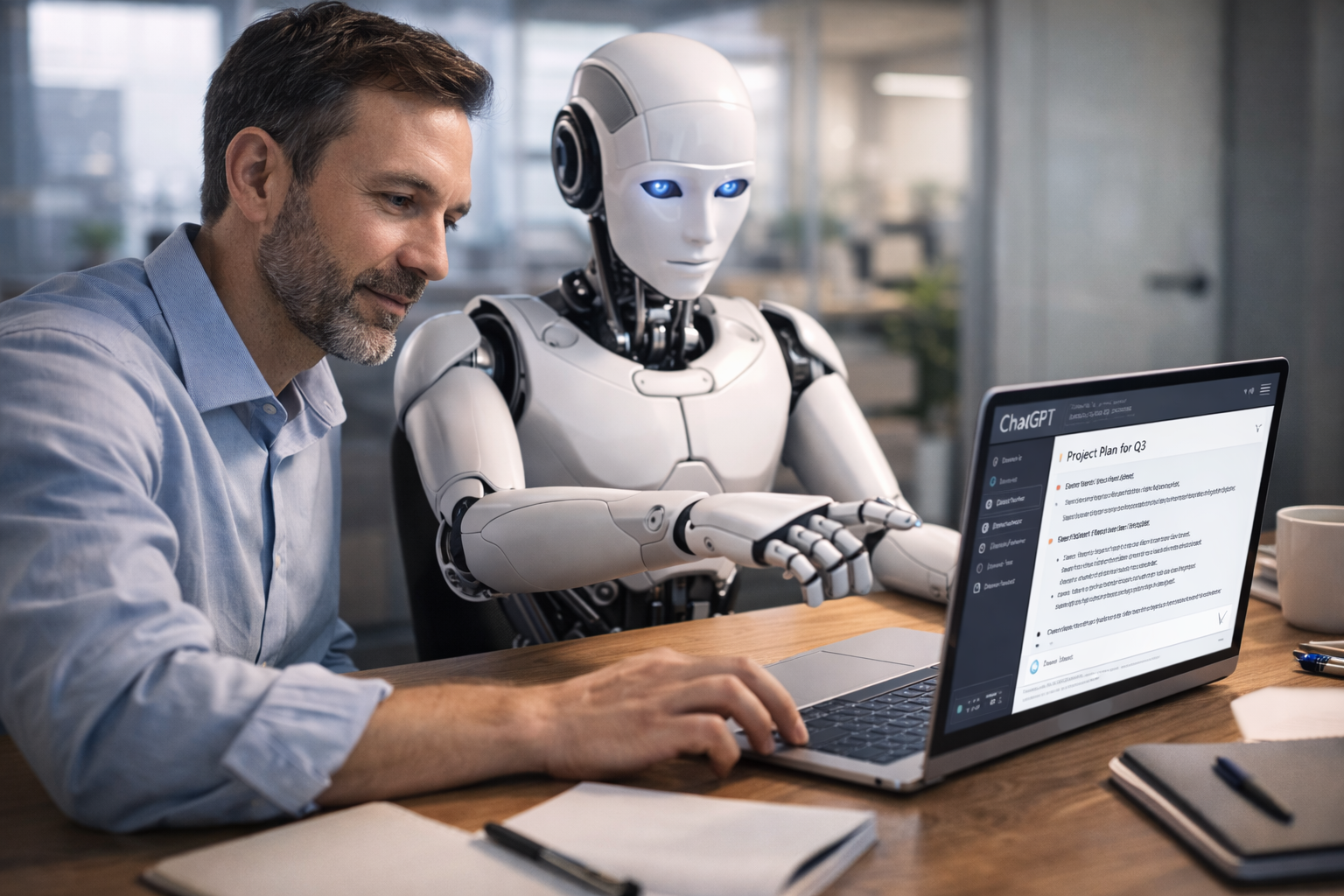



Does AI replace jobs? This in-depth 7,000-word guide explains why AI doesn’t eliminate work—but reshapes roles, skills, and careers. Real examples, economics, history, and what workers must do next.
For more than a century, every major technological shift has sparked the same fear:
“This time, jobs are finished.”
From the steam engine to computers to the internet, history shows a clear pattern: technology changes jobs far more than it replaces them. Artificial Intelligence is no different—but it feels different because it touches thinking, not just muscle.
So let’s answer the real question head-on:
Does AI replace jobs?
Short answer: No.
Long answer: AI changes how work is done, what skills matter, and which roles grow or shrink.
This long-form guide explains why AI doesn’t replace jobs, what it actually replaces instead, and how work evolves in the age of intelligent tools.
😨 Why the Question “Does AI Replace Jobs?” Feels So Scary
AI fear is emotional, not irrational.
Unlike past technologies, AI:
- Writes text
- Generates images
- Analyzes data
- Mimics reasoning
It doesn’t just assist hands—it assists thinking.
That makes people ask:
- “What’s left for humans?”
- “If AI can do my task, why hire me?”
- “Am I training my replacement?”
These fears are understandable—but they’re based on a false assumption:
That jobs are single, automatable actions.
They’re not.
🏭 A Brief History of “Job-Killing” Technology
Let’s zoom out.
The Industrial Revolution
Machines replaced:
- Manual weaving
- Hand farming
But they created:
- Factory jobs
- Logistics
- Engineering
- Management
Employment didn’t disappear—it shifted.
The Computer Revolution
Computers replaced:
- Typists
- Manual bookkeeping
- Physical filing
But they created:
- IT roles
- Software development
- Data analysis
- Entire digital industries
Again, jobs evolved.
The Internet Era
The internet destroyed:
- Travel agents
- Classified ads
- Physical media distribution
But created:
- Digital marketing
- E-commerce
- Online education
- Remote work
The pattern is consistent.
🤖 What AI Can Do (And What It Can’t)
What AI Is Good At
AI excels at:
- Pattern recognition
- Repetition
- Prediction
- Speed at scale
That’s why companies like OpenAI, Google, and Microsoft deploy AI for:
- Drafting text
- Sorting data
- Assisting coding
- Automating routine analysis
What AI Is Bad At
AI struggles with:
- Judgment
- Accountability
- Ethics
- Contextual responsibility
- Human trust
AI can generate answers—but it can’t own consequences.
That distinction matters more than most people realize.
🧩 Jobs vs Tasks: The Most Important Distinction
Here’s the core insight most debates miss:
AI replaces tasks, not jobs.
What Is a Job?
A job is a bundle of tasks, including:
- Technical execution
- Decision-making
- Communication
- Responsibility
- Social interaction
AI usually touches some tasks, not the whole bundle.
Example: Accountant
AI can:
- Categorize transactions
- Flag anomalies
- Generate reports
Humans still:
- Interpret results
- Advise clients
- Ensure compliance
- Make judgment calls
The job doesn’t disappear—it changes shape.
🔄 How AI Changes Jobs Instead of Replacing Them
AI typically causes job evolution, not extinction.
Step 1: Repetitive Tasks Get Automated
This frees time—but also removes busywork.
Step 2: Human Work Shifts Up the Value Chain
Workers focus on:
- Strategy
- Interpretation
- Creativity
- Relationships
Step 3: New Hybrid Roles Emerge
Examples:
- AI-assisted marketers
- Prompt-aware analysts
- Technical translators
- AI-literate managers
The job title stays. The job content evolves.
🏢 Real Job Examples Across Industries
Marketing
AI handles:
- First drafts
- A/B variations
- SEO formatting
Humans handle:
- Brand voice
- Strategy
- Ethics
- Original ideas
Marketers don’t disappear—they become editors, directors, and strategists.
Software Development
AI assists with:
- Boilerplate code
- Syntax suggestions
- Debugging
Developers still:
- Design systems
- Make architectural decisions
- Understand user needs
Coding becomes less mechanical, not obsolete.
Healthcare
AI supports:
- Image analysis
- Scheduling
- Triage
Doctors and nurses still:
- Diagnose
- Treat
- Build trust
- Handle responsibility
AI reduces burnout—it doesn’t replace care.
📉 Why Some Jobs Shrink While Others Grow
Yes—some roles decline.
But this is reallocation, not collapse.
Jobs shrink when they are:
- Entirely repetitive
- Rule-based
- Detached from judgment
Jobs grow when they involve:
- Human trust
- Complexity
- Creativity
- Accountability
This has always been true—even before AI.
🧠 The Myth of “Fully Automated Work”
Fully automated jobs are rare.
Why?
Because real-world work involves:
- Edge cases
- Exceptions
- Human expectations
- Moral responsibility
Even autonomous systems require human oversight.
AI works best as:
A co-pilot, not a pilot.
📈 AI, Productivity & Why Mass Unemployment Hasn’t Happened
If AI replaced jobs, we’d already see:
- Massive unemployment spikes
- Collapsing labor markets
We don’t.
Instead, we see:
- Job transformation
- Skill shifts
- Productivity gains
History shows productivity growth creates new demand, which creates jobs.
🧠 Skills That Matter More in the AI Era
AI raises the value of:
- Critical thinking
- Communication
- Systems thinking
- Ethics
- Domain expertise
Ironically, being human becomes more valuable when machines get smarter.
❓ Frequently Asked Questions
Does AI replace jobs completely?
Very rarely. It mostly replaces tasks.
Which jobs are most at risk?
Highly repetitive, rule-based roles.
Is AI creating new jobs?
Yes—especially hybrid and oversight roles.
Should workers fear AI?
No—but they should adapt.
Is learning AI tools necessary?
Not to become an engineer—but to remain effective.
🏁 Interim Conclusion
So—does AI replace jobs?
No.
AI replaces:
- Repetition
- Busywork
- Inefficiency
It changes jobs, raises expectations, and reshapes careers.
📊 The Economics Behind AI and Employment (What the Data Actually Shows)
Public fear around AI and work often ignores one inconvenient fact:
Technology has consistently increased employment over the long term.
That doesn’t mean transitions are painless—but it does mean collapse narratives are historically wrong.
Productivity vs Employment
When productivity rises:
- Costs drop
- Demand increases
- New markets open
This creates more work, not less.
AI increases output per worker, which allows:
- Smaller teams to do more
- Companies to attempt things previously impossible
- Entirely new roles to appear
This is why economists track task substitution, not job extinction.
Why AI Productivity Doesn’t Equal Job Loss
AI-driven productivity:
- Reduces bottlenecks
- Speeds experimentation
- Lowers entry barriers
This leads to:
- More startups
- More niche services
- More customization
Paradoxically, automation creates variety, and variety creates work.
🏭 Industry-by-Industry Breakdown (Who Changes, How, and Why)
Let’s move beyond theory.
🏢 Office & Administrative Work
What AI automates
- Scheduling
- Transcription
- Data entry
- Document formatting
What humans do more of
- Coordination
- Judgment
- Stakeholder communication
- Exception handling
Administrative roles don’t vanish—they become operations and coordination roles.
📞 Customer Support
AI handles
- First-line questions
- FAQs
- Ticket routing
Humans handle
- Edge cases
- Emotional situations
- Retention decisions
Companies discover quickly that:
Customers accept bots for speed—but demand humans for trust.
This raises, not lowers, the value of skilled support staff.
🧑⚖️ Law & Compliance
AI assists
- Document review
- Case summarization
- Contract comparison
Lawyers still
- Interpret intent
- Argue cases
- Advise clients
- Bear liability
Legal work becomes more analytical and strategic, less clerical.
📰 Media & Journalism
AI can
- Draft summaries
- Rewrite press releases
- Analyze data
Journalists still
- Investigate
- Interview
- Verify
- Provide context
AI lowers the cost of producing content, which increases demand for original reporting.
🏥 Healthcare
AI supports:
- Diagnostics
- Scheduling
- Triage
- Imaging analysis
But healthcare remains fundamentally human because:
- Trust matters
- Ethics matter
- Accountability matters
AI reduces burnout—it doesn’t replace caregivers.
🧠 Why Humans Still Matter: The Accountability Gap
Here’s the line AI cannot cross:
Responsibility.
When something goes wrong:
- Who explains it?
- Who fixes it?
- Who is legally accountable?
Not the algorithm.
This creates a permanent role for humans in:
- Decision approval
- Oversight
- Ethical judgment
AI can recommend. Humans must decide.
⚠️ Where Job Loss Does Happen (And Why That’s Not the End)
Let’s be honest: some roles do shrink.
This happens when:
- Tasks are fully standardized
- Human judgment adds little value
- Speed and scale dominate
Examples historically include:
- Switchboard operators
- Typists
- Film developers
But every loss was followed by role migration, not mass unemployment.
The same pattern applies now.
🔁 Job Transformation in Practice (Before vs After AI)
Before AI
- Manual reports
- Long meetings
- Repetitive drafts
- Low leverage work
After AI
- Interpretation
- Strategy
- Quality control
- Human-facing decisions
The job title remains.
The value focus shifts.
📈 Why AI Often Creates More Work
This sounds counterintuitive, but it’s consistent.
When work becomes cheaper:
- More of it gets done
- Expectations rise
- Customization increases
Example:
- Websites became cheaper → more websites
- Content became easier → more content
- Design tools improved → more design
AI lowers friction—and friction was limiting output.
🧩 The Complementarity Effect (The Missing Concept)
AI doesn’t just replace tasks—it amplifies complementary skills.
Skills that rise in value:
- Domain expertise
- Communication
- Leadership
- Systems thinking
- Creativity
Skills that decline:
- Pure repetition
- Mechanical execution
This creates skill polarization, not job elimination.
🧠 The Psychological Trap: Why AI Feels More Threatening Than It Is
AI feels different because:
- It produces language
- It imitates reasoning
- It operates invisibly
This triggers identity fear, not economic logic.
But imitation ≠ understanding
Generation ≠ responsibility
Once this distinction is clear, panic fades.
🏢 Does AI replace jobs? What Companies Get Wrong About AI & Jobs
Common mistakes:
- Treating AI as a cost-cutting hammer
- Removing humans too quickly
- Ignoring trust and quality
Smart companies use AI to:
- Support employees
- Increase output quality
- Reduce burnout
Short-term layoffs often backfire through:
- Quality loss
- Brand damage
- Hidden complexity
🛠️ Does AI replace jobs? A Practical Playbook for Workers (What to Do, Not Fear)
1. Learn to Work With AI
Not engineering—collaboration.
- Use AI for drafts
- Use it for summaries
- Use it to clarify thinking
2. Move Toward Judgment-Based Work
Ask:
- Where does my role require decisions?
- Where do people rely on my trust?
That’s where your value compounds.
3. Build Domain Depth
AI is broad. Humans win with depth.
Experts don’t disappear—they become multipliers.
4. Communicate Better Than Machines
Clear explanation, empathy, persuasion—these matter more, not less.
🧭 Does AI replace jobs? The Long-Term Outlook (2026–2040)
What we are likely to see:
- Fewer purely mechanical roles
- More hybrid roles
- Lifelong reskilling
- AI literacy as baseline
What we won’t see:
- Job extinction at scale
- Fully automated economies
- Human irrelevance
Work adapts because human needs don’t vanish.
🌐 Does AI replace jobs? Society, Policy & Why This Isn’t Just a Tech Issue
Governments matter.
Education systems matter.
Corporate incentives matter.
The risk isn’t AI—it’s unequal adaptation.
Societies that:
- Invest in reskilling
- Support transitions
- Encourage augmentation
Will thrive.
Those that panic—or ignore change—won’t.
- Khan Academy — AI Study Assistant
- OpenAI — Study & Research Tools
- Duolingo AI Learning Tools
- Quizlet — AI Flashcards & Recall Tools
- Microsoft Copilot for Students
- Notion AI — Study Notes & Summaries
- PCMag — Best AI Tools
❓ Does AI replace jobs? Final Expanded FAQs
Will AI replace my job specifically?
Unlikely. It may change how you do it.
Should I switch careers because of AI?
Only if your work is purely repetitive and non-adaptive.
Is AI adoption slowing hiring?
It’s changing hiring criteria—not eliminating demand.
Is this different from past tech shifts?
In impact, no. In speed, yes.
What’s the safest career strategy?
Be adaptable, not defensive.
🏁 Does AI replace jobs? Final Conclusion (Full Synthesis)
So—does AI replace jobs?
No.
AI replaces:
- Repetition
- Mechanical effort
- Low-context execution
AI changes:
- Job content
- Skill priorities
- Career paths
And it elevates:
- Judgment
- Creativity
- Responsibility
- Humanity
The real risk isn’t AI taking jobs.
The real risk is treating work as static in a dynamic world.
Those who adapt don’t just survive—they become more valuable than ever.
All Rights Reserved © 2026