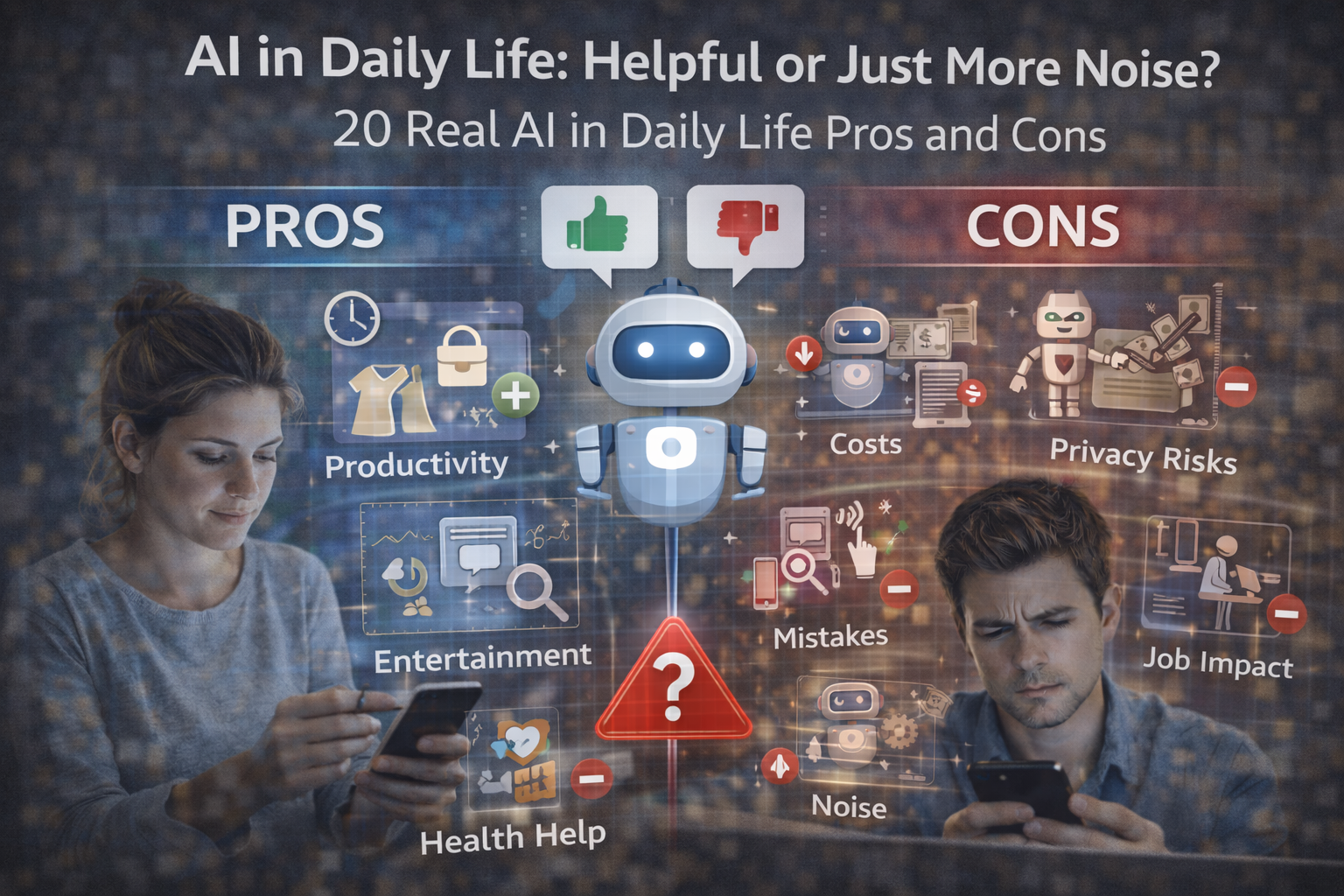



Explore AI in daily life, the real AI in daily life pros cons, how AI helps, where it adds noise, and how to decide what’s actually worth using.
Artificial intelligence is no longer something people “try.”
It is something they live inside.
From phones and cars to email, maps, feeds, and reminders, AI in daily life has become constant—often helpful, sometimes overwhelming, and frequently invisible.
This raises an important question:
Is AI actually improving daily life—or is it just adding more noise?
Understanding the real AI in daily life pros cons helps separate genuine value from digital clutter.
AI Is Everywhere—But Is It Improving Life?
AI adoption accelerated quietly.
People didn’t vote for it.
They didn’t fully understand it.
They simply adapted.
Now AI:
- Suggests what to read
- Predicts what to type
- Decides what to show
- Optimizes what to prioritize
Presence alone does not equal benefit.
What “AI in Daily Life” Really Means
AI in daily life refers to AI systems that:
- Operate continuously
- Influence everyday choices
- Require little to no interaction
This includes:
- Recommendation engines
- Smart notifications
- Predictive text
- Navigation and scheduling systems
These systems shape experience—even when unnoticed.
Why AI Feels Both Helpful and Overwhelming
AI feels helpful because it:
- Reduces friction
- Saves time
- Anticipates needs
It feels overwhelming because it:
- Competes for attention
- Adds suggestions
- Creates decision pressure
The same mechanism produces both effects.
The Real Benefits of AI in Daily Life
To be fair, AI delivers real value.
Convenience and Time Savings
AI excels at:
- Autocomplete
- Navigation
- Scheduling
- Filtering
Small savings accumulate quickly.
Reduced Cognitive Effort
AI reduces mental load by:
- Remembering preferences
- Surfacing relevant information
- Handling repetition
This can free mental space—when used intentionally.
Accessibility and Inclusion
AI enables:
- Live captions
- Voice control
- Image descriptions
These features significantly improve quality of life for many users.
Personalization That Actually Helps
When done well, personalization:
- Improves relevance
- Reduces clutter
- Supports goals
This is AI at its best—quiet and supportive.
Where AI Starts Becoming Noise
Problems arise when AI exceeds usefulness.
Notification Overload and Attention Drain
AI-driven notifications:
- Interrupt focus
- Create urgency
- Compete constantly
Attention becomes fragmented.
This is one of the most common AI in daily life pros cons trade-offs.
Decision Fatigue From Constant Suggestions
Every suggestion demands evaluation.
Over time:
- Mental energy drains
- Choices feel heavier
- Avoidance increases
AI that suggests too much reduces clarity.
When Automation Replaces Awareness
Automation can remove:
- Reflection
- Intentional choice
- Situational awareness
Convenience becomes dependency.
AI That Solves Problems You Don’t Have
Some AI features exist because they can—not because they should.
These features:
- Add complexity
- Distract from goals
- Create unnecessary interaction
Noise often comes from over-engineering.
The Subtle Cost of Constant Optimization
Optimization sounds positive.
But constant optimization:
- Encourages speed over depth
- Rewards efficiency over meaning
- Reduces tolerance for friction
Not all friction is bad.
Some friction protects focus.
AI in Daily Life at Work vs at Home
At work, AI:
- Increases speed
- Shapes decisions
- Alters authority
At home, AI:
- Manages routines
- Curates entertainment
- Influences habits
Both contexts require boundaries.
How AI Changes Habits and Behavior
AI shapes behavior by:
- Repeating suggestions
- Reinforcing patterns
- Reducing randomness
Over time, habits narrow.
This can increase efficiency—or reduce exploration.
Helpful AI vs Performative AI
Helpful AI:
- Solves real problems
- Reduces effort
- Stays quiet
Performative AI:
- Shows off features
- Demands attention
- Adds noise
Value is measured by absence—not presence.
How to Decide What AI Is Worth Keeping
Ask simple questions:
- Does this save time or steal attention?
- Does this reduce stress or add pressure?
- Does this support my goals?
If the answer is unclear, the AI may not be worth it.
Practical Rules for Reducing AI Noise
- Disable non-essential notifications
- Remove redundant tools
- Keep AI in support roles
- Revisit settings quarterly
- Prioritize silence over novelty
Less AI often leads to better outcomes.
Frequently Asked Questions
Is AI in daily life mostly helpful or harmful?
It depends on how intentionally it is used.
Why does AI feel overwhelming sometimes?
Because suggestions and notifications accumulate.
Should people try to avoid AI?
Avoidance is unrealistic; selective use is effective.
Can AI improve mental clarity?
Yes—when it reduces cognitive load instead of adding to it.
Is AI noise a design problem or a user problem?
Both—design choices and usage habits matter.
What’s the best mindset for using AI daily?
Use AI as support, not as a guide.
Conclusion: Useful AI Is Quiet, Not Loud
The real question is not whether AI in daily life is good or bad.
It is whether it is intentional.
The true AI in daily life pros cons become clear when attention is valued.
Helpful AI:
- Reduces friction
- Respects focus
- Disappears when not needed
Noise announces itself.
Value does not.
For a neutral, non-sales overview of real-world AI benefits and risks, see NIST’s AI Risk Management Framework.
All Rights Reserved © 2026