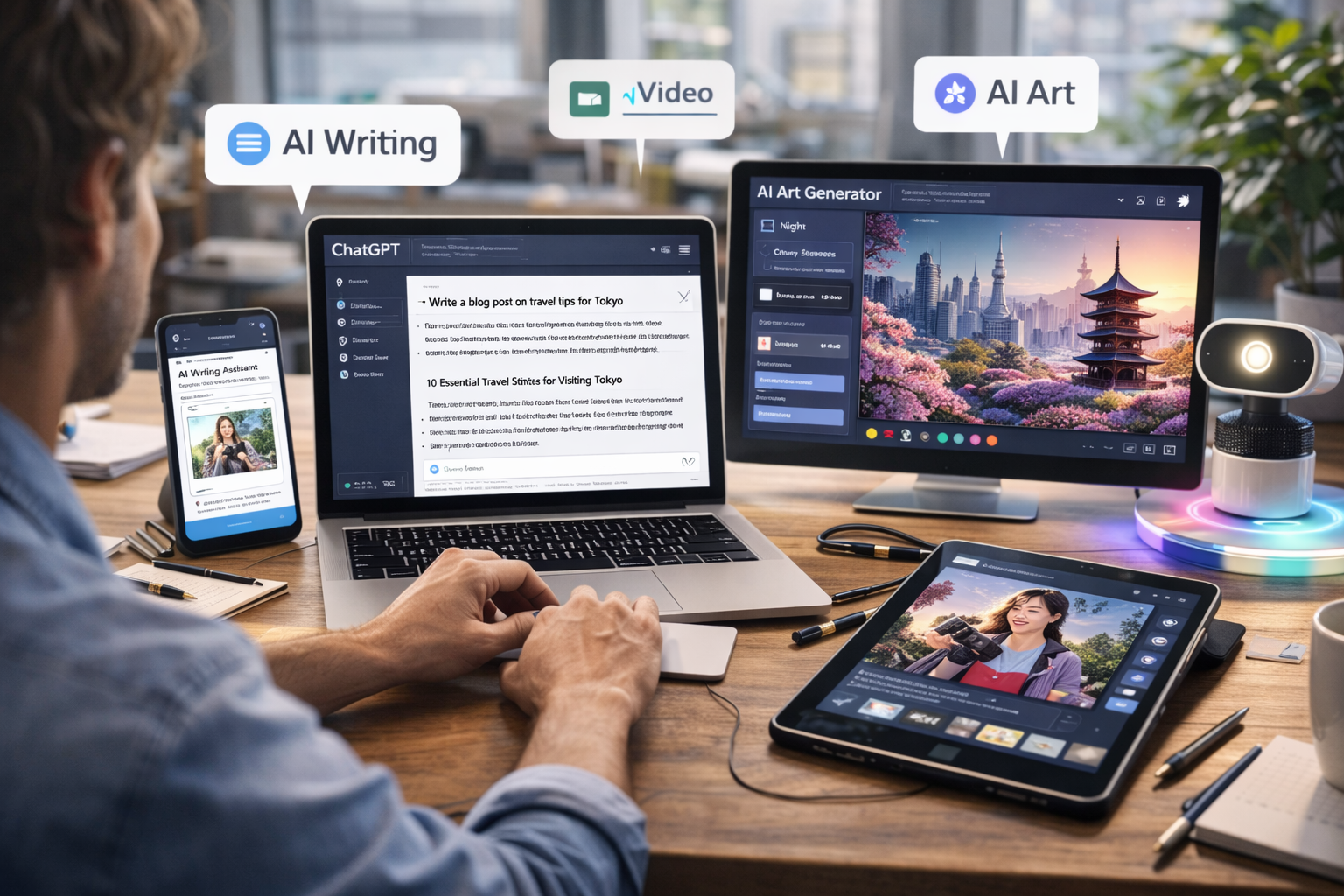



AI content creation impact explained—how AI is reshaping blogging, video, social media, SEO, and creative work in 2026, what’s improving, what’s breaking, and what creators must do next.
Online content creation has changed more in the last five years than in the previous twenty.
Not because humans stopped creating—but because AI became part of the creative process.
So the real question is no longer “Is AI used in content creation?”
It’s:
What is the real AI content creation impact—and who benefits from it?
This article breaks down how AI is changing online content creation, where it genuinely helps, where it causes problems, and what creators must do to stay relevant in 2026 and beyond.
🚀 Why AI Changed Content Creation So Quickly
AI didn’t change content creation because it’s “smart.”
It changed it because it removed friction.
AI tools now:
- Draft faster than humans
- Summarize instantly
- Repurpose content automatically
- Adapt tone and format in seconds
Thanks to models developed by organizations like OpenAI and large-scale platforms such as Google, AI capabilities became:
- Cheap
- Accessible
- Embedded into everyday tools
Once friction disappeared, volume exploded.
That’s the first major AI content creation impact.
🤖 What AI Is Actually Doing in Content Creation
Despite the hype, AI is not “replacing creators.”
It is automating specific parts of the workflow:
- First drafts
- Variations and rewrites
- Summaries and outlines
- Formatting and optimization
In other words:
AI accelerates production, not originality.
This distinction matters more than most debates admit.
✍️ Blogging & Written Content
What Changed
AI dramatically lowered the cost of producing text.
This led to:
- More blog posts
- Faster publishing cycles
- Content saturation
The AI content creation impact here is clear:
quantity skyrocketed, average quality dropped.
What Still Works
AI-written content performs well only when:
- Humans guide structure and intent
- Real experience is added
- Editing is intentional
Blogs that rely purely on AI-generated text struggle with:
- Trust
- Engagement
- Long-term rankings
Search engines increasingly reward experience, insight, and originality, not raw output.
📱 Social Media & Short-Form Content
Where AI Helps
AI is extremely effective at:
- Caption generation
- Hook variations
- Hashtag suggestions
- Content repurposing
Creators use AI to:
- Stay consistent
- Reduce burnout
- Maintain output cadence
Where AI Fails
AI struggles with:
- Cultural timing
- Humor nuance
- Authentic voice
Audiences can sense templated content quickly.
The AI content creation impact here is paradoxical:
- Posting became easier
- Standing out became harder
🎥 Video, Audio & Multimedia
AI now assists with:
- Script drafts
- Video summaries
- Automatic subtitles
- Audio cleanup
This lowered barriers to entry for:
- YouTubers
- Podcasters
- Educators
But AI still can’t replace:
- On-camera presence
- Storytelling instincts
- Emotional connection
The creator remains the differentiator.
🔍 SEO, Discovery & Search
One of the biggest AI content creation impacts is how content is discovered.
AI has:
- Flooded search with similar articles
- Reduced the value of surface-level SEO
- Increased competition for attention
As a result:
- Generic content performs worse
- Deep, experience-based content performs better
Search is moving from:
“Who wrote the most?”
to
“Who offers the most insight?”
⚖️ Quality vs Quantity: The Core Tension
AI made content cheap.
Cheap content creates noise.
Noise reduces trust.
This creates a new hierarchy:
- High-quality, human-led content rises
- Mass-produced content collapses into irrelevance
The true AI content creation impact is not automation—it’s polarization.
🧠 What AI Can’t Replace in Content Creation
AI cannot replace:
- Lived experience
- Original opinion
- Ethical judgment
- Accountability
- Taste
AI generates possibilities.
Humans decide what matters.
That human layer is now more valuable, not less.
🧭 How Creators Should Adapt in 2026
Creators who thrive with AI:
- Use AI as a drafting assistant
- Focus more on insight and perspective
- Build trust and authority
- Reduce output, increase depth
Creators who struggle:
- Chase volume
- Publish without editing
- Compete on speed alone
The winning strategy is human-led, AI-assisted creation.
❓ Frequently Asked Questions
What is the biggest AI content creation impact?
The explosion of content volume and the decline of average quality.
Does AI replace content creators?
No. It replaces repetitive steps, not creativity or accountability.
Is AI content bad for SEO?
Only when it lacks originality, experience, or value.
Should creators disclose AI use?
Transparency helps—but value matters more than tools.
Is AI good for beginners?
Yes—for learning and drafting. Mastery still takes human skill.
- Khan Academy — AI Study Assistant
- OpenAI — Study & Research Tools
- Duolingo AI Learning Tools
- Quizlet — AI Flashcards & Recall Tools
- Microsoft Copilot for Students
- Notion AI — Study Notes & Summaries
- PCMag — Best AI Tools
🏁 Conclusion
The real AI content creation impact isn’t that AI writes content.
It’s that AI forces creators to be more human.
In a world where anyone can generate words:
- Insight matters more
- Experience matters more
- Voice matters more
AI didn’t kill content creation.
It raised the bar.
All Rights Reserved © 2026