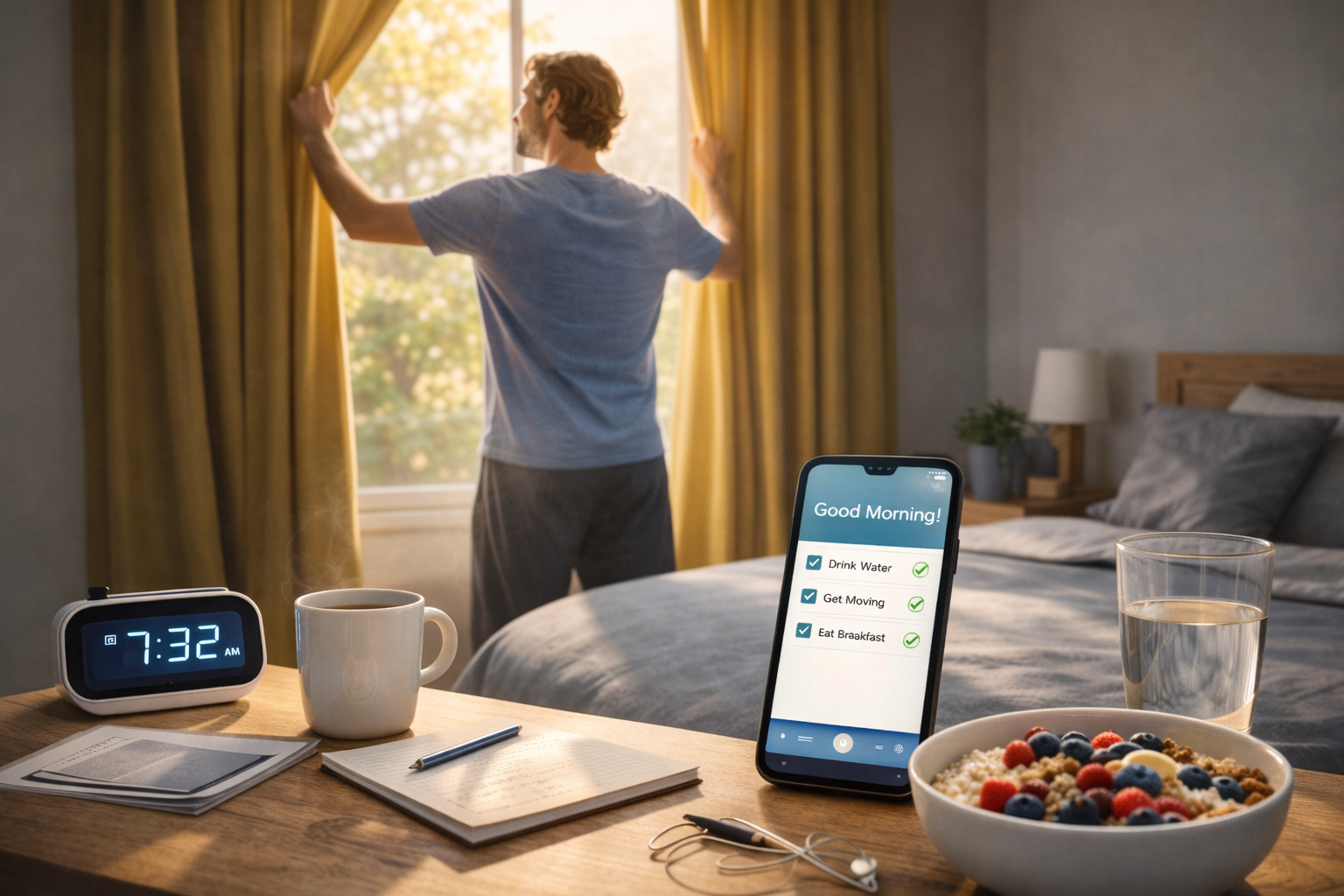



Learn how to build a simple morning routine that actually sticks in real life. A deep, realistic 9,000-word guide explaining why most routines fail, how habits really form, and how to design a calm, flexible morning that works long-term.
Morning routines are everywhere.
Wake up at 5 a.m.
Cold showers.
Journaling.
Meditation.
Workout.
Reading.
Gratitude.
And yet—most people abandon their morning routine within two weeks.
So let’s be honest:
Why do most morning routines fail, and how do you build a simple morning routine that actually sticks?
This guide is not about extreme discipline, hustle culture, or copying influencers with unlimited time. It’s about human behavior, energy, psychology, and building a simple morning routine that works on normal days, bad days, and exhausted days.
No perfection.
No guilt.
Just something that lasts.
🧨 Why Most Morning Routines Fail
Before building a simple morning routine, we need to understand why so many fail—because failure isn’t about laziness.
1. They’re Built for Ideal Lives
Most routines assume:
- Perfect sleep
- No interruptions
- Full control over time
- Unlimited energy
Real life has:
- Kids
- Commutes
- Stress
- Unpredictability
A routine that only works on perfect days will not stick.
2. They Rely on Willpower
Willpower is fragile in the morning.
People wake up:
- Groggy
- Emotionally neutral at best
- Already behind
A routine that requires motivation first will collapse fast.
3. They’re Too Long
A 60–90 minute routine is not a routine—it’s a lifestyle.
Long routines:
- Create pressure
- Increase failure points
- Trigger all-or-nothing thinking
Miss one step → quit everything.
4. They Try to Fix Your Whole Life
Morning routines are often overloaded with goals:
- Health
- Productivity
- Mental health
- Personal growth
That’s too much for 7 a.m.
🌱 What a Simple Morning Routine Really Is
A simple morning routine is not about optimization.
It’s about stability.
A routine that sticks:
- Anchors your day
- Calms your nervous system
- Requires minimal decision-making
- Works even when motivation is low
Think of it as:
A soft landing into the day, not a performance.
🧠 The Psychology of Habits That Stick
To build a simple morning routine that lasts, you must respect how habits actually form.
Habit Formation Truths
- Habits stick through repetition, not intensity
- Consistency beats ambition
- Identity follows behavior, not the other way around
The brain resists:
- Complexity
- Uncertainty
- High effort early in the day
That’s why simplicity wins.
The Habit Loop (Simplified)
- Cue – Waking up
- Routine – One or two easy actions
- Reward – Calm, clarity, relief
Morning routines fail when the routine is too demanding or the reward is unclear.
🚫 The Biggest Mistakes People Make
Before building anything, avoid these common traps:
Mistake 1: Copying Someone Else’s Routine
What works for:
- Influencers
- CEOs
- Single people
- Athletes
May fail completely for you.
Mistake 2: Adding Too Many Habits
Five habits don’t make a routine stronger.
They make it fragile.
Mistake 3: Starting Too Early
Waking up earlier doesn’t create discipline—it often creates resentment.
Mistake 4: Punishing Yourself for Missing a Day
Missed days are normal.
Quitting because of them is optional.
⚡ Designing Your Morning Around Energy (Not Time)
One of the most important principles of a simple morning routine:
Energy matters more than clock time.
Some people think best early.
Others don’t.
A good routine:
- Works at 6 a.m. or 9 a.m.
- Adapts to sleep quality
- Doesn’t depend on peak performance
Your goal is readiness, not productivity.
🧱 Non-Negotiables vs Optional Habits
A routine sticks when it has:
- One or two non-negotiables
- Everything else optional
Non-Negotiables
These are habits you do even on bad days:
- Drink water
- Sit quietly for 2 minutes
- Open a window
- Write one sentence
Optional habits:
- Exercise
- Journaling
- Reading
- Planning
Optional habits expand when energy is high—and disappear without guilt when it’s low.
✅ A Minimal 5-Step Simple Morning Routine
Here’s a foundation routine that works for most people.
Not mandatory. Just a starting point.
Step 1: Wake + Hydrate (1 minute)
Drink water before anything else.
This:
- Signals wakefulness
- Reduces grogginess
- Requires zero motivation
Step 2: No Input for 10 Minutes
No phone.
No email.
No news.
This prevents immediate mental hijacking.
Step 3: Gentle Movement (2–5 minutes)
Stretch.
Walk.
Stand outside.
Movement wakes the brain faster than caffeine.
Step 4: One Focus Anchor (2 minutes)
Ask:
“What is the one thing that would make today feel okay if done?”
Write it down or say it out loud.
Step 5: Transition, Not Optimization
Instead of “start working,”:
- Shower
- Make tea
- Change clothes
This creates a psychological shift into the day.
That’s it.
No heroics.
⏱️ How Long Should a Simple Morning Routine Be?
Short answer: 10–30 minutes.
Longer routines:
- Increase friction
- Depend on perfect conditions
- Fail more often
A routine that feels “too easy” is often the one that lasts.
👨👩👧 Morning Routines for Different Life Situations
Parents
- Focus on calm, not productivity
- One quiet moment is enough
Remote Workers
- Prioritize mental separation between sleep and work
Students
- Use routine for grounding, not pressure
Freelancers
- Focus on clarity over hustle
People With Low Energy or Burnout
- Start with one habit only
- Build slowly
😴 How to Make Your Routine Stick on Bad Days
This is where routines are truly tested.
A routine that sticks must:
- Shrink under stress
- Never disappear completely
The “Minimum Version” Rule
Decide in advance:
“On bad days, my routine is just this one thing.”
That might be:
- Drinking water
- Sitting quietly
- Opening the window
Success is showing up, not performing.
🤖 Technology & AI: Help or Hindrance?
Technology can:
- Support reminders
- Reduce decision-making
- Track consistency
But too much tech:
- Adds pressure
- Creates dependency
The best routines rely on environment, not apps.
🔄 How to Evolve Your Routine Without Breaking It
Routines fail when people:
- Constantly change them
- Add new habits weekly
- Chase optimization
Instead:
- Change one thing at a time
- Wait 2–3 weeks
- Keep the core intact
Evolution beats reinvention.
❓ Frequently Asked Questions
How long does it take for a simple morning routine to stick?
Usually 2–4 weeks of gentle consistency.
Should I wake up earlier?
Only if it feels sustainable—not forced.
What if I miss several days?
Resume without judgment. That is the habit.
Is exercise required in a morning routine?
No. Movement helps, but pressure hurts.
Can night owls have morning routines?
Yes—just later in the morning.
🏁 Interim Conclusion
A simple morning routine doesn’t change your life overnight.
It does something better:
It creates a stable beginning—even when the rest of the day is messy.
That stability compounds quietly.
🧠 Why Discipline-Based Morning Routines Fail Long-Term
One of the biggest myths around morning routines is that they fail because people “lack discipline.”
In reality, discipline-based routines collapse under normal human conditions.
Why Discipline Is a Weak Foundation
Discipline depends on:
- Sleep quality
- Stress levels
- Emotional state
- Life circumstances
Mornings are when discipline is least reliable:
- Willpower is low
- Cognitive load is high
- The body is still waking
A simple morning routine must work without discipline, not require more of it.
The Hidden Cost of Discipline
Discipline-heavy routines create:
- Self-judgment
- Pressure
- All-or-nothing thinking
Miss one day → feel like a failure → abandon routine.
That’s not a personal flaw.
That’s a design flaw.
🧘 Morning Routines & Mental Health
A topic most productivity advice avoids.
Morning routines don’t exist in a vacuum — they interact with:
- Anxiety
- Depression
- Burnout
- Grief
- Chronic stress
A routine that ignores mental health will not stick.
Anxiety & Mornings
Anxiety often peaks in the morning.
Helpful habits:
- Fewer inputs
- Slower transitions
- Predictability
Harmful habits:
- Checking email immediately
- Consuming news
- Overplanning
A simple morning routine should lower nervous system activation, not spike it.
Depression & Low-Energy Mornings
Depression reduces:
- Motivation
- Energy
- Executive function
This is where minimalist routines matter most.
On low days, success might be:
- Getting out of bed
- Drinking water
- Opening a window
That counts.
A routine that demands “feeling good” will fail for people who need support the most.
🧍 Identity: The Invisible Reason Routines Stick or Fail
Most people think habits change identity.
In reality:
Identity changes when behavior is repeated without pressure.
When your routine is simple and repeatable, your brain starts thinking:
- “I’m someone who starts gently”
- “I’m someone who shows up”
- “I’m someone who takes care of mornings”
This identity shift happens quietly — and powerfully.
Why Overly Ambitious Routines Damage Identity
When routines are too intense:
- Failure becomes frequent
- Self-trust erodes
- Identity becomes fragile
A simple morning routine builds identity through reliability, not performance.
🌦️ Morning Routines Across Seasons of Life
One of the biggest reasons routines fail is that people expect them to be permanent.
But life has seasons.
High-Energy Seasons
You may:
- Add exercise
- Journal longer
- Plan deeply
This is fine — as long as the core stays simple.
Low-Energy or Chaotic Seasons
Examples:
- New parenthood
- Health challenges
- High-stress work periods
Your routine should:
- Shrink
- Simplify
- Focus on grounding
If it disappears entirely, it was too complex.
The Rule of Seasonal Flexibility
A routine that sticks for years:
- Expands when life is calm
- Contracts when life is hard
- Never breaks completely
That’s the goal.
⏰ Morning Routine vs “Morning Control”
Many people secretly want a routine to:
- Control the day
- Guarantee productivity
- Prevent bad outcomes
This is understandable — but unrealistic.
A simple morning routine does not control the day.
It does something more achievable:
It gives you a stable starting point, regardless of how the day unfolds.
Stability beats control every time.
🔁 Why Consistency Beats Intensity (Again and Again)
Let’s be blunt.
A 5-minute routine done 300 times is more powerful than:
- A 60-minute routine done 10 times
Consistency works because:
- The brain predicts it
- Resistance drops
- Habit energy compounds
If your routine feels “too small,” you’re probably doing it right.
🛠️ A Long-Term Simple Morning Routine Framework
Here is a no-pressure framework you can use for years.
Not a checklist. A structure.
Layer 1: The Non-Negotiable Core (5 minutes)
This never changes.
Examples:
- Drink water
- Sit quietly
- Open the window
If this is all you do, the routine still counts.
Layer 2: The Flexible Middle (Optional)
This adapts daily.
Examples:
- Light movement
- Journaling
- Planning
You choose based on energy, not obligation.
Layer 3: The Transition Ritual
Something that marks:
“Morning → day has begun”
Examples:
- Shower
- Changing clothes
- Stepping outside
This psychological transition matters more than people realize.
🚫 What NOT to Add to a Simple Morning Routine
Avoid habits that:
- Require perfect conditions
- Depend on motivation
- Punish inconsistency
Common offenders:
- Long workouts
- Complex journaling prompts
- Strict time targets
- Multiple apps
Remember:
The more impressive a routine looks online, the less likely it is to stick offline.
📉 Why Tracking Can Hurt Morning Routines
Tracking feels helpful — but it can backfire.
Problems with heavy tracking:
- Turns routines into performance
- Creates streak anxiety
- Adds pressure to mornings
If you track:
- Track gently
- Track presence, not perfection
Or don’t track at all.
Many long-term routines survive because nothing is watching them.
🧘 The Nervous System Angle (Why Calm Beats Motivation)
The best simple morning routine supports:
- Parasympathetic activation
- Emotional regulation
- Mental safety
That’s why habits like:
- Slow movement
- Silence
- Natural light
Are more effective long-term than:
- Loud alarms
- Immediate stimulation
- Aggressive planning
Calm is a productivity strategy — just not a flashy one.
📆 What a “Successful” Morning Routine Looks Like After 6 Months
Not dramatic.
It looks like:
- Less resistance to mornings
- Faster mental clarity
- Reduced anxiety
- More predictable energy
No fireworks.
Just quiet reliability.
❓ Final Expanded FAQs
Do I need to wake up early for a simple morning routine?
No. Wake up sustainably.
What if my mornings are chaotic?
That’s exactly why simplicity matters.
Should I include meditation?
Only if it feels supportive, not forced.
Can I change my routine often?
Small changes are fine. Frequent overhauls are not.
What’s the biggest reason routines fail?
They demand too much on days when you have the least to give.
🏁 Final Conclusion: How to Build a Simple Morning Routine That Sticks
Here’s the truth most advice avoids:
A simple morning routine sticks because it respects human limits.
It doesn’t rely on:
- Motivation
- Discipline
- Perfect mornings
It works because it:
- Reduces decisions
- Creates stability
- Allows imperfection
- Adjusts with life
The best routine isn’t the one that transforms your life.
It’s the one you quietly return to — again and again — without guilt.
That’s how habits actually last.
All Rights Reserved © 2026