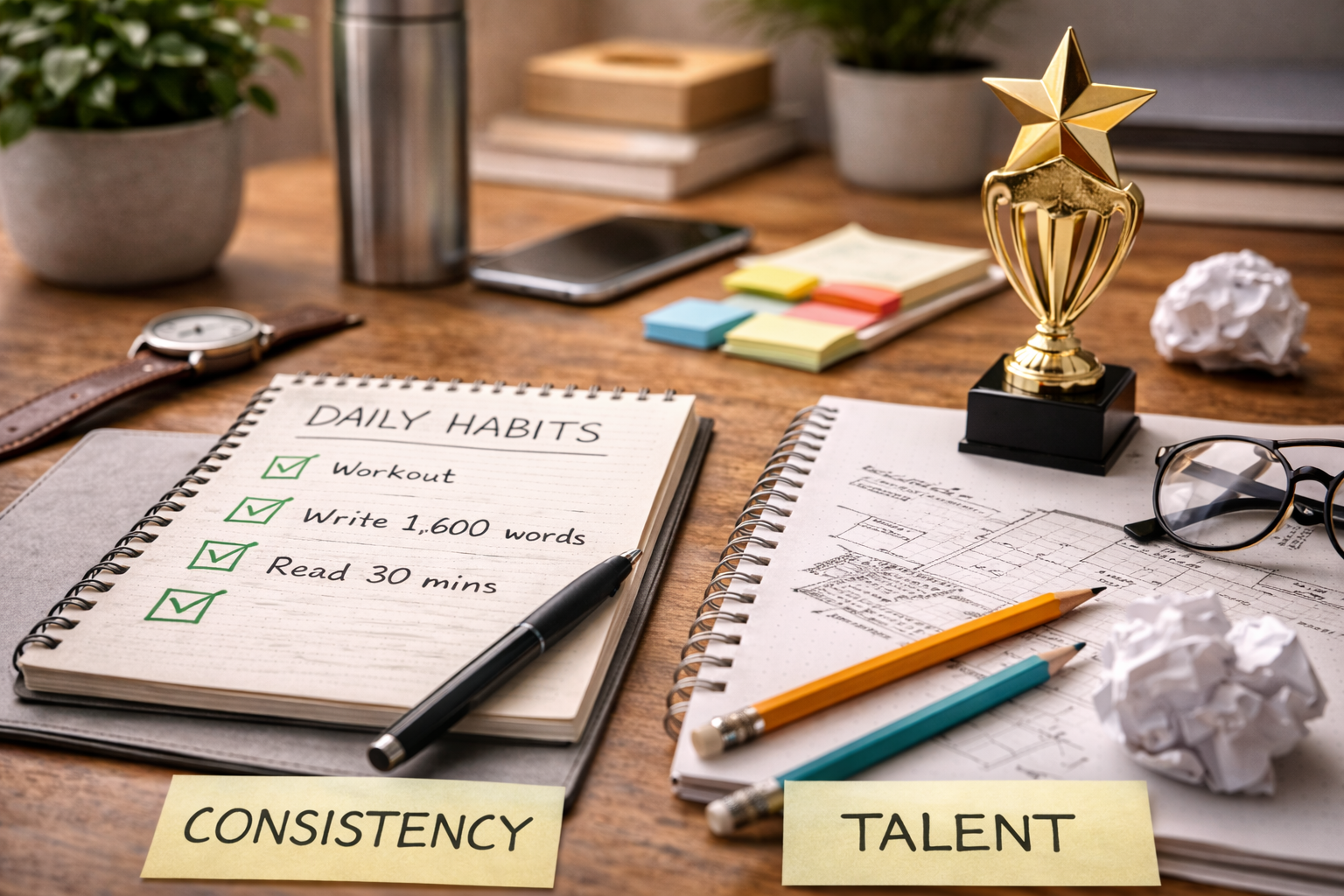



A deep, honest breakdown of consistency vs talent—why steady effort outperforms raw ability over time, how consistency compounds results, and what actually determines long-term success in work, learning, and life.
Why Consistency Beats Talent
Talent is admired.
Consistency is underestimated.
We praise:
- Natural ability
- Early success
- Fast learners
- “Gifted” people
But when you look at real outcomes—careers, skills, health, creative work, businesses—one pattern shows up again and again:
Talent creates potential.
Consistency turns potential into results.
This article explores consistency vs talent honestly—why talent fades without repetition, why consistency compounds quietly, and why most long-term success stories are far less glamorous (and far more repeatable) than they appear.
Why Talent Gets So Much Credit
Talent is visible.
It shows up as:
- Fast progress
- Early wins
- Impressive starts
Consistency is invisible.
It happens quietly, slowly, and without drama.
Culture rewards:
- Breakthrough moments
- Viral success
- “Overnight” achievements
So we assume talent is the cause.
In reality, talent often explains early advantage, not long-term outcomes.
This misunderstanding sits at the heart of the consistency vs talent debate.
What Talent Actually Is (And Isn’t)
Talent is often described as:
- Natural ability
- Genetic advantage
- Effortless skill
But in practice, talent usually means:
- Faster early learning
- Lower initial friction
- Early positive feedback
What talent does not guarantee:
- Long-term improvement
- Resilience under failure
- Sustained effort
- Adaptability
Talent is a head start—not a finish line.
The Problem With Relying on Talent
Relying on talent creates hidden risks.
1. Talent Reduces Early Effort
When things come easily, effort feels optional.
2. Talent Delays Skill-Building Habits
Talented people often skip fundamentals early.
3. Talent Struggles Under Adversity
When progress slows, talented people are often less prepared.
This is why many “gifted” people plateau early—while consistent people pass them later.
Why Consistency Feels Less Impressive
Consistency doesn’t look like success.
It looks like:
- Showing up again
- Repeating the basics
- Making small improvements
- Progress without applause
There’s no dramatic moment.
No viral milestone.
That’s why consistency is undervalued—even though it’s far more reliable.
Consistency vs Talent in Skill Building
In almost every skill:
- Writing
- Fitness
- Learning
- Music
- Business
The pattern is the same.
Talent
- Faster early gains
- Slower long-term growth
- Higher quit rates
Consistency
- Slower start
- Steady improvement
- Long-term mastery
Over time, consistency doesn’t just catch up to talent—it surpasses it.
How Consistency Compounds Over Time
Consistency works because of compounding.
Each repetition:
- Reinforces neural pathways
- Reduces friction
- Builds confidence
- Improves efficiency
Small daily actions stack:
- Skill on skill
- Habit on habit
- Identity on identity
This compounding effect is why consistency beats talent in the long run—even when progress feels invisible early.
The Psychology Behind Consistency
Consistency isn’t about discipline.
It’s about:
- Predictability
- Low emotional cost
- Clear routines
People stay consistent when:
- Tasks feel safe
- Expectations are realistic
- Identity aligns with action
This is why consistency is a system problem, not a motivation problem.
Why Talent Often Leads to Early Plateaus
Talented people often experience:
- Early praise
- Fast wins
- External validation
When improvement slows—as it always does—the shock is bigger.
Plateaus feel like:
“Maybe I’m not actually good.”
Consistent people expect plateaus.
They’ve already learned how to persist.
This difference explains many long-term outcomes in the consistency vs talent comparison.
Consistency, Identity, and Self-Trust
Consistency builds something talent alone cannot:
Self-trust
Each time you show up:
- Confidence becomes earned
- Identity stabilizes
- Resistance decreases
Eventually, action feels normal.
Talent without consistency builds ego.
Consistency builds reliability.
Consistency in Work, Learning, and Health
Across domains, the pattern repeats:
Work
Consistent output beats occasional brilliance.
Learning
Daily exposure beats sporadic cramming.
Health
Routine beats motivation every time.
Talent might start the race faster—but consistency finishes it.
Common Myths About Consistency
Myth 1: Consistency Is Boring
It is—and that’s why it works.
Myth 2: Consistency Requires Discipline
It requires design, not force.
Myth 3: Consistency Means Doing More
It often means doing less, more often.
These myths keep people chasing talent instead of building systems.
How to Build Consistency Without Burnout
Consistency fails when:
- Expectations are too high
- Recovery is ignored
- Identity is tied to outcomes
Consistency works when:
- Minimums are small
- Schedules are predictable
- Rest is built in
Sustainable consistency always beats heroic effort.
❓ Frequently Asked Questions
Is talent useless then?
No. Talent helps early—but doesn’t replace consistency.
Can consistency really beat talent?
Yes, in nearly every long-term domain.
Why do talented people quit more often?
They’re less prepared for slow progress and failure.
Is consistency genetic?
No. It’s behavioral and environmental.
What matters more: talent or consistency?
Talent influences speed. Consistency determines distance.
🏁 Conclusion (Part 1)
The real lesson in consistency vs talent isn’t that talent doesn’t matter.
It’s that talent is fragile without repetition.
Consistency:
- Builds skill
- Builds confidence
- Builds identity
- Builds results
Talent opens doors.
Consistency decides whether you walk through them—and how far you go once you do.
Why Consistency Beats Talent (Part 2): How Repetition Quietly Wins Where Ability Stalls
Keyword focus: consistency vs talent
Why Early Success Can Be a Disadvantage
Early success feels good.
It brings:
- Praise
- Validation
- Confidence
- External rewards
But it also creates a hidden risk.
When progress comes easily, people learn:
“This shouldn’t feel hard.”
Later, when difficulty appears—as it always does—friction feels abnormal.
Talented people often interpret struggle as:
- A sign they’re losing ability
- Proof they’re “not meant for this”
- Evidence they peaked
Consistent people expect struggle.
They’ve already normalized effort.
This difference explains many long-term outcomes in the consistency vs talent debate.
The Psychological Comfort of Consistency
Consistency reduces uncertainty.
When you show up at the same time, in the same way:
- The brain relaxes
- Decision fatigue drops
- Resistance decreases
Talent often depends on mood.
Consistency depends on routine.
Routine feels boring—but boredom is stable.
And stability is what allows growth.
Why Consistency Lowers Emotional Cost
Each repeated action:
- Feels less risky
- Requires less energy
- Triggers less self-doubt
Over time, consistent behavior becomes emotionally cheap.
Talent, by contrast, often carries:
- Performance pressure
- Fear of “losing it”
- Identity attachment
Consistency builds skill without drama.
Consistency vs Talent in the Long Run
At the beginning:
- Talent looks impressive
- Consistency looks slow
At the midpoint:
- Talent plateaus
- Consistency accumulates
At the long run:
- Talent alone stagnates
- Consistency compounds
This is why long-term excellence is rarely flashy.
It’s the result of boring reliability, not brilliance.
How Consistency Changes Identity
Identity shifts through evidence.
Each consistent action says:
“I am someone who shows up.”
Over time:
- Confidence becomes earned
- Self-trust solidifies
- Resistance weakens
Talent-based identity says:
“I succeed when it’s easy.”
Consistency-based identity says:
“I succeed because I persist.”
Only one survives difficulty.
Why Consistency Beats Talent Under Stress
Stress exposes foundations.
Under pressure:
- Talent-dependent people often freeze
- Consistent people fall back on routine
Stress removes motivation and inspiration.
What remains is habit.
This is where consistency shows its true advantage.
The Compounding Effect Nobody Sees
Consistency compounds in ways talent can’t.
It compounds:
- Skill
- Confidence
- Efficiency
- Learning speed
Each repetition slightly improves the next.
The gains are invisible day to day—but undeniable over years.
This is the quiet math behind consistency vs talent.
Why Consistency Feels Slow (But Isn’t)
Consistency feels slow because:
- Progress isn’t dramatic
- Gains are incremental
- Feedback is delayed
Talent feels fast because:
- Early gains are visible
- Praise comes quickly
- Results arrive sooner
But speed at the start doesn’t matter if direction is wrong.
Consistency points in the same direction every day.
Talent Creates Pressure—Consistency Reduces It
Talent often creates expectations:
- From others
- From yourself
Expectations increase fear of failure.
Consistency lowers stakes:
- One day doesn’t matter
- One session doesn’t define you
This psychological safety allows:
- Experimentation
- Learning
- Recovery
And that leads to better outcomes.
Why Consistency Produces More Opportunities
People trust consistency.
They trust:
- Reliable output
- Predictable behavior
- Follow-through
Consistency attracts:
- Opportunities
- Collaboration
- Responsibility
Talent attracts attention.
Consistency attracts trust.
And trust creates long-term success.
Consistency vs Talent in Creative Work
In creative fields:
- Talent creates flashes of brilliance
- Consistency creates bodies of work
A single great idea rarely changes a career.
A sustained body of work often does.
Creative success almost always belongs to the consistent—not the most gifted.
Why Most People Overestimate Talent
We notice:
- Highlights
- Peaks
- Public wins
We don’t notice:
- Daily practice
- Quiet repetition
- Years of showing up
Talent is visible.
Consistency is not.
That’s why people misattribute success.
How Consistency Reduces Burnout
Burnout often comes from:
- Intensity
- Overcommitment
- Emotional spikes
Consistency emphasizes:
- Manageable effort
- Predictable pace
- Built-in recovery
Consistency protects energy.
Talent often ignores limits.
Over time, consistency outlasts intensity.
What Consistency Actually Requires (Hint: Not Discipline)
Consistency doesn’t require:
- Constant motivation
- Extreme discipline
- High energy
It requires:
- Small minimums
- Clear routines
- Reduced friction
Design beats willpower.
This is how consistency wins even when talent fades.
The Hidden Advantage: Consistency Is Teachable
Talent is unevenly distributed.
Consistency is learnable.
Anyone can:
- Show up regularly
- Reduce friction
- Build habits
That’s why consistency is empowering.
It’s not reserved for the gifted.
Reframing Success in the Consistency vs Talent Debate
Success isn’t:
- Who starts fastest
- Who gets praised earliest
Success is:
- Who stays longest
- Who adapts
- Who compounds
And that person is almost always the consistent one.
🏁 Conclusion (Part 2)
Talent may open the door—but consistency decides whether you stay in the room.
When things get hard:
- Talent hesitates
- Consistency continues
That’s why, in the real world, consistency vs talent isn’t a close contest.
Consistency doesn’t just compete with talent.
It quietly replaces it.
Why Consistency Is a Design Problem, Not a Personality Trait
People often think consistency is something you are.
In reality, consistency is something you engineer.
When consistency fails, it’s usually because:
- The task is too large
- The routine is unclear
- The environment adds friction
- Expectations are unrealistic
Talent doesn’t solve any of these.
Design does.
This is why consistency vs talent isn’t a fair fight—consistency can be built intentionally, while talent can’t be summoned on demand.
The Small-Enough Rule (Why Size Determines Survival)
Consistency survives when tasks are small enough to repeat on bad days.
If your “minimum” requires:
- High energy
- Perfect conditions
- Strong motivation
It will eventually fail.
Consistent people define a minimum that:
- Feels almost too easy
- Can be done when tired
- Still counts as showing up
That minimum is what keeps the chain unbroken.
Talent thrives on peaks.
Consistency survives valleys.
Why Consistency Builds Confidence Faster Than Success
Success is unpredictable.
Consistency is not.
Confidence built on success:
- Fluctuates
- Depends on outcomes
- Breaks under failure
Confidence built on consistency:
- Comes from evidence
- Grows through repetition
- Survives setbacks
Each time you show up, you reinforce:
“I can be trusted to do what I said.”
That self-trust outperforms raw ability over time.
Consistency vs Talent in Failure Recovery
Failure is inevitable.
The difference is recovery speed.
Talent-Driven Recovery
- Interprets failure as identity threat
- Hesitates to try again
- Avoids situations that expose weakness
Consistency-Driven Recovery
- Treats failure as data
- Returns to routine
- Continues without drama
Consistency doesn’t eliminate failure.
It makes failure non-fatal.
Why Consistency Creates Momentum (Even When Progress Is Invisible)
Momentum doesn’t come from results.
It comes from:
- Predictable action
- Familiar routines
- Reduced resistance
When action becomes automatic, momentum exists even if outcomes lag.
Talent waits for feedback.
Consistency generates momentum internally.
The Role of Time in the Consistency vs Talent Equation
Time is talent’s enemy—and consistency’s ally.
Talent shines early.
Consistency shines late.
Over time:
- Skills refine
- Errors decrease
- Efficiency improves
- Confidence stabilizes
Consistency benefits from time passing.
Talent often depends on early advantage.
Why Consistency Makes Learning Easier Over Time
Learning curves flatten for consistent people.
Why?
- Neural pathways strengthen
- Cognitive load decreases
- Fundamentals become automatic
This frees mental space for:
- Creativity
- Strategy
- Adaptation
Talent often skips fundamentals.
Consistency masters them.
Consistency vs Talent in Professional Life
In careers:
- Talent impresses in interviews
- Consistency builds reputation
Employers and collaborators value:
- Reliability
- Follow-through
- Predictable output
Over time, consistent professionals are trusted with:
- Bigger responsibilities
- Better opportunities
- Long-term roles
Talent opens doors.
Consistency keeps them open.
Why Consistency Is Quietly Scarce
Consistency is rare not because it’s hard—but because it’s unglamorous.
It requires:
- Repetition without applause
- Progress without recognition
- Patience without proof
Most people abandon consistency before it has time to work.
Those who don’t eventually stand out—without trying to.
How to Build Consistency Without Burnout
Consistency fails when it’s confused with intensity.
Sustainable consistency requires:
- Clear start times
- Defined stop points
- Built-in rest
- Permission to do the minimum
Burnout comes from overreaching.
Consistency comes from restraint.
The Anti-Heroic Approach That Actually Works
Heroic effort feels productive.
It’s also fragile.
The anti-heroic approach:
- Small actions
- Predictable schedules
- Low emotional cost
Looks unimpressive.
Produces lasting results.
This is why consistency vs talent is really a comparison between systems and traits.
Why Consistency Is Fairer Than Talent
Talent is unevenly distributed.
Consistency is available to everyone.
Anyone can:
- Show up regularly
- Lower friction
- Build routines
That makes consistency more democratic—and more powerful.
Reframing “Slow Progress”
What feels like slow progress is often:
- Invisible compounding
- Skill consolidation
- Habit stabilization
Most breakthroughs are the result of long periods of unremarkable consistency.
Talent seeks breakthroughs.
Consistency manufactures them.
The Long Game: Where Consistency Always Wins
Over years—not weeks—the pattern becomes undeniable:
- Consistent people outlast talented ones
- Consistent systems outperform raw ability
- Consistent effort produces disproportionate results
Time exposes foundations.
And consistency has the strongest one.
🏁 Conclusion (Part 3)
Talent may get attention.
Consistency gets results.
Talent impresses early.
Consistency dominates eventually.
When the novelty fades, the applause stops, and the work remains—
only one strategy keeps moving forward.
That’s why, in the real world, consistency vs talent isn’t a debate.
It’s a timeline.
Turning Consistency Into a Daily System (Not a Struggle)
By now, the conclusion is clear: consistency wins because it’s designed, not demanded.
Here’s how consistent people actually operate—without relying on motivation or raw ability.
1. Fixed Time, Flexible Output
- Same time every day
- Different output allowed
This removes daily negotiation. You show up first; quality follows later.
2. Minimum That Never Changes
- One page
- One set
- One paragraph
- Five minutes
The minimum exists to protect the streak, not to impress.
3. Clear Stop Point
Knowing when to stop:
- Prevents burnout
- Preserves energy
- Encourages return tomorrow
Consistency survives when effort has boundaries.
Why Consistency Needs Constraints to Survive
Unlimited ambition kills consistency.
Constraints keep it alive:
- Time limits
- Scope limits
- Energy limits
Talent often resists constraints.
Consistency depends on them.
This is why professionals rely on routines, not inspiration.
The Most Common Consistency Traps (And How to Avoid Them)
Trap 1: Raising the Minimum Too Soon
Early success tempts people to do more.
Doing more is fine—as long as the minimum stays small.
Trap 2: All-or-Nothing Thinking
Missing one day doesn’t matter.
Quitting because of it does.
Consistency is about returning—not perfection.
Trap 3: Confusing Consistency With Intensity
Intensity burns out.
Consistency survives.
Trap 4: Measuring Only Outcomes
Outcomes lag.
Effort compounds.
Track showing up—not just results.
Why Consistency Wins When Life Gets Messy
Life eventually disrupts everyone.
Stress, illness, travel, and chaos expose foundations.
Talent-dependent systems collapse.
Consistency-based systems adapt.
Why?
Because consistency already plans for:
- Low energy
- Bad days
- Imperfect conditions
That resilience is its greatest strength.
Consistency vs Talent in the Long Arc of a Career
Careers are long.
Over decades, what matters most is:
- Reliability
- Adaptability
- Skill accumulation
- Trust
Talent might determine where you start.
Consistency determines how far you go—and how long you stay relevant.
This is why consistent professionals quietly dominate over time.
The Confidence Loop Consistency Creates
Consistency creates a positive feedback loop:
- You show up
- You trust yourself more
- Resistance decreases
- Action becomes easier
- Identity stabilizes
Talent often creates a fragile loop based on outcomes.
Consistency creates a durable loop based on evidence.
Why Consistency Is the Ultimate Equalizer
Talent is uneven.
Opportunity is uneven.
Circumstances are uneven.
Consistency levels the field.
It rewards:
- Patience
- Adaptation
- Persistence
That’s why consistency isn’t just effective—it’s fair.
Anyone willing to show up regularly can benefit.
The Long-Term Advantage Nobody Sees Coming
From the outside, consistent progress looks unremarkable.
From the inside, it feels calm.
Then one day:
- Skills are deep
- Confidence is solid
- Opportunities multiply
And people ask:
“How did you get so good?”
The answer is never dramatic.
It’s consistency.
Final Reframe: Talent Is a Multiplier, Not a Foundation
Talent can amplify effort.
But it cannot replace it.
Without consistency:
- Talent fades
- Skill stagnates
- Confidence erodes
With consistency:
- Talent compounds
- Skill deepens
- Identity strengthens
This is the real lesson in consistency vs talent.
🏁 Final Conclusion
Talent starts the race.
Consistency finishes it.
Talent attracts attention.
Consistency builds results.
Talent shines early.
Consistency dominates late.
If you care about long-term success—real, durable, repeatable success—there is no real debate.
Consistency beats talent.
Every time.
Given enough time.
All Rights Reserved © 2026