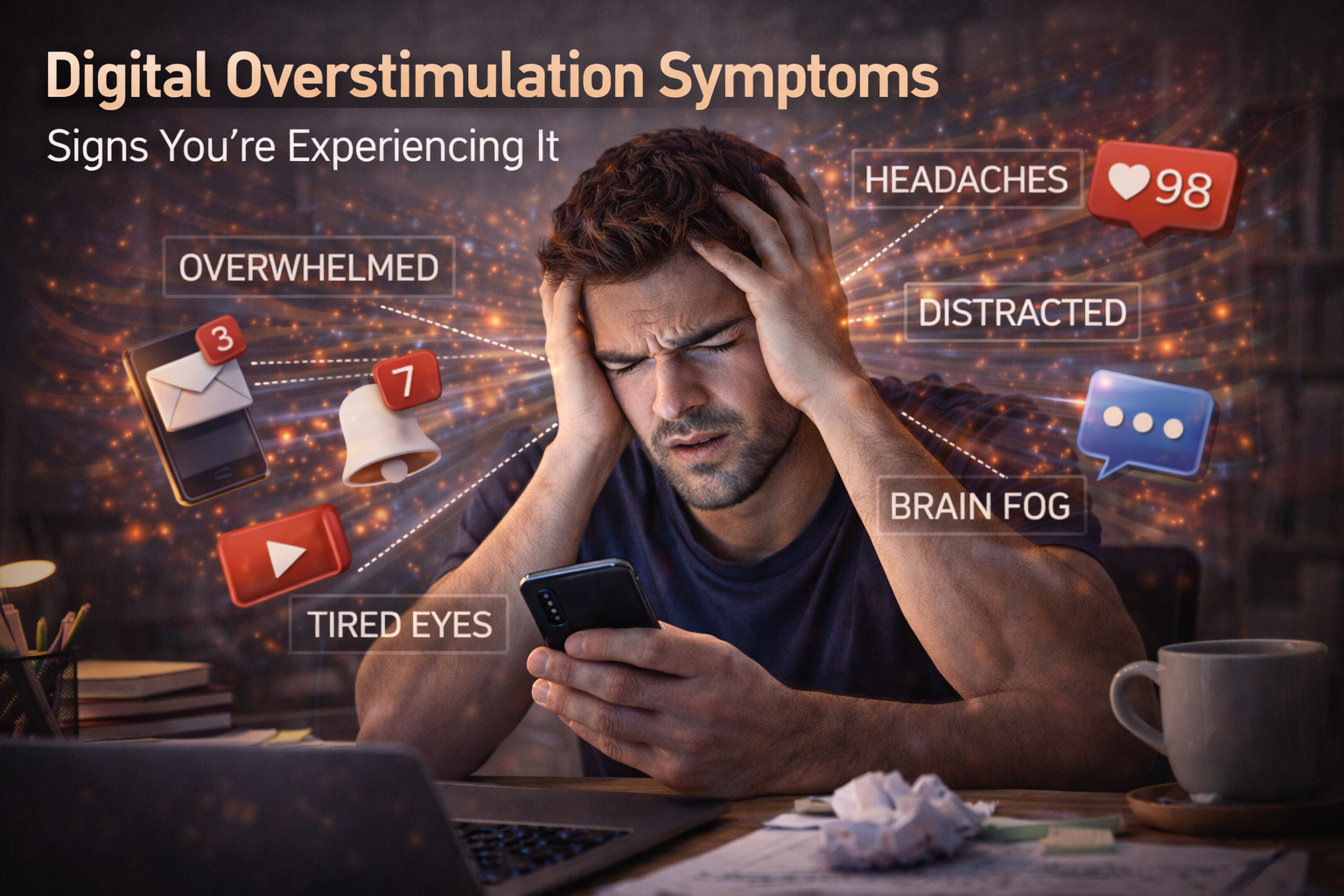



Learn the most common digital overstimulation symptoms, why constant input overwhelms the brain, and how overstimulation affects focus, mood, and energy.
When Everything Feels Like Too Much
You’re not exactly stressed—but you’re not calm either.
Your mind feels busy even when nothing urgent is happening. Concentration slips easily. Small tasks feel harder than they should. You feel tired, yet restless. Stimulated, yet unfocused.
These experiences are increasingly common, and they often point to one underlying issue: digital overstimulation.
Digital overstimulation doesn’t arrive all at once. It builds gradually, through constant exposure to screens, notifications, content, and information. Recognizing digital overstimulation symptoms is the first step toward understanding why attention, energy, and emotional balance feel harder to maintain.
What Digital Overstimulation Really Is
Digital overstimulation occurs when the brain receives more input than it can comfortably process or recover from.
This input includes:
- Notifications
- Messages
- Feeds
- Videos
- Alerts
- Background noise
- Constant information updates
Even when content is neutral or enjoyable, the sheer volume overwhelms cognitive systems.
Digital overstimulation is not about screen time alone—it’s about density, frequency, and lack of recovery.
This article completes our exploration of modern attention and stimulation patterns outlined in: The Attention Crisis: How Modern Digital Life Is Rewiring Our Minds .
- Why Everything Feels Urgent Online
- The Psychology of Infinite Scroll
- Why We Check Phones Without Thinking
- How Apps Are Designed to Interrupt You
- Why Silence Feels Uncomfortable Now
Why Digital Overstimulation Is So Common Now
Modern digital environments are designed for constant engagement.
Input is:
- Continuous
- Fast-paced
- Emotionally charged
- Always available
The brain evolved to handle bursts of stimulation—not uninterrupted streams.
When stimulation never stops, recovery never fully happens.
The Most Common Digital Overstimulation Symptoms
Digital overstimulation symptoms vary, but several patterns appear consistently.
1. Mental Fatigue Without Clear Cause
You feel exhausted despite not doing physically demanding work.
This fatigue comes from:
- Constant attention switching
- Continuous decision-making
- Processing endless information
Mental energy drains quietly—without a clear endpoint.
2. Difficulty Focusing on Simple Tasks
Tasks that once felt easy now feel heavy.
You may notice:
- Trouble starting
- Frequent distraction
- Needing stimulation to work
This isn’t a motivation problem—it’s an attention overload problem.
3. Restlessness and the Need for Constant Input
Sitting still feels uncomfortable.
Silence feels awkward. Doing nothing feels wrong.
This restlessness reflects a nervous system accustomed to stimulation—and unsettled without it.
4. Irritability and Reduced Patience
Small frustrations feel bigger than they should.
Digital overstimulation increases:
- Sensory sensitivity
- Emotional reactivity
- Short temper
The brain has less capacity to regulate responses when it’s overloaded.
5. Feeling “Wired but Tired”
You feel alert but exhausted.
This paradox happens when stimulation keeps the nervous system activated while energy reserves are depleted.
It’s one of the clearest digital overstimulation symptoms—and one of the most confusing.
6. Reduced Enjoyment of Activities
Things that should feel enjoyable feel muted.
This happens because reward systems adapt to constant novelty. Ordinary experiences struggle to compete.
Pleasure isn’t gone—it’s drowned out.
7. Trouble Relaxing or Unwinding
Even during downtime, your mind feels busy.
You may:
- Check your phone reflexively
- Feel uneasy without stimulation
- Struggle to transition into rest
Overstimulation keeps the brain in “input mode.”
8. Difficulty Being Present
Conversations feel thinner. Moments pass quickly.
Your attention:
- Drifts
- Anticipates
- Scans
Presence requires settled attention—which overstimulation disrupts.
Why Digital Overstimulation Feels Invisible
Digital overstimulation doesn’t announce itself.
There’s no alarm—just gradual erosion.
Because stimulation is normalized, its effects are often misattributed to:
- Stress
- Burnout
- Laziness
- Lack of discipline
The real issue—excessive input—goes unnoticed.
Why Overstimulation Affects Emotions
The brain regulates emotion through attention.
When attention is overloaded:
- Emotional processing slows
- Stress lingers
- Anxiety increases
Overstimulation doesn’t create new emotions—it prevents resolution of existing ones.
The Difference Between Stimulation and Nourishment
Not all input is harmful.
The issue is unfiltered, constant stimulation without pause.
Nourishing input:
- Has boundaries
- Allows rest
- Creates meaning
Overstimulating input:
- Never ends
- Demands reaction
- Prevents closure
Digital environments favor the latter.
Why Digital Overstimulation Is Not a Personal Failure
Digital overstimulation symptoms are not signs of weakness.
They are predictable responses to:
- Always-on environments
- Attention-harvesting design
- Cultural expectations of constant availability
The brain is doing exactly what it was trained to do.
Why Reducing Input Feels Hard at First
When stimulation drops, discomfort often rises briefly.
This happens because:
- The nervous system is adjusting
- Unprocessed thoughts surface
- Silence becomes noticeable
This phase passes—but many people quit before it does.
Digital Overstimulation and the Attention Crisis
Digital overstimulation is one of the clearest manifestations of the attention crisis.
It reflects:
- Too much input
- Too little recovery
- Too few boundaries
Addressing it restores not just focus—but emotional balance and energy.
How to Recognize Early Warning Signs
Early digital overstimulation symptoms include:
- Checking devices compulsively
- Difficulty tolerating boredom
- Feeling rushed without reason
- Needing stimulation to feel normal
Catching these signs early prevents deeper fatigue.
Why Rest Alone Doesn’t Always Fix It
Sleep helps—but it doesn’t reset attention habits.
If stimulation patterns don’t change, overstimulation returns quickly.
Recovery requires both rest and reduced input.
Why Simplicity Feels Calming
Reducing stimulation:
- Lowers cognitive load
- Restores attention stability
- Improves emotional regulation
Calm often returns not through effort—but through subtraction.
FAQs: Digital Overstimulation Symptoms
1. What are digital overstimulation symptoms?
Mental fatigue, restlessness, irritability, and difficulty focusing caused by excessive digital input.
2. Is digital overstimulation the same as burnout?
No—but it can contribute to burnout over time.
3. Can digital overstimulation cause anxiety?
Yes. Constant input keeps the nervous system activated.
4. Does reducing screen time help?
Reducing unnecessary stimulation helps most.
5. How long does recovery take?
Relief often begins within days—but attention rebuilds gradually.
6. Is digital overstimulation avoidable?
Not entirely—but it can be managed intentionally.
Conclusion: Listening to the Signal
Digital overstimulation symptoms are signals—not flaws.
They indicate that attention and nervous systems are overloaded, not broken.
When stimulation is reduced and recovery is allowed, clarity returns. Focus steadies. Emotions settle.
The mind doesn’t need more input—it needs more space.
The American Psychological Association outlines how chronic cognitive overload affects mental energy and emotional regulation: The Science of Mental Fatigue.
Harvard Business Review explores why constant input exhausts attention and how reducing stimulation improves performance: Manage Your Energy, Not Your Time.
All Rights Reserved © 2026