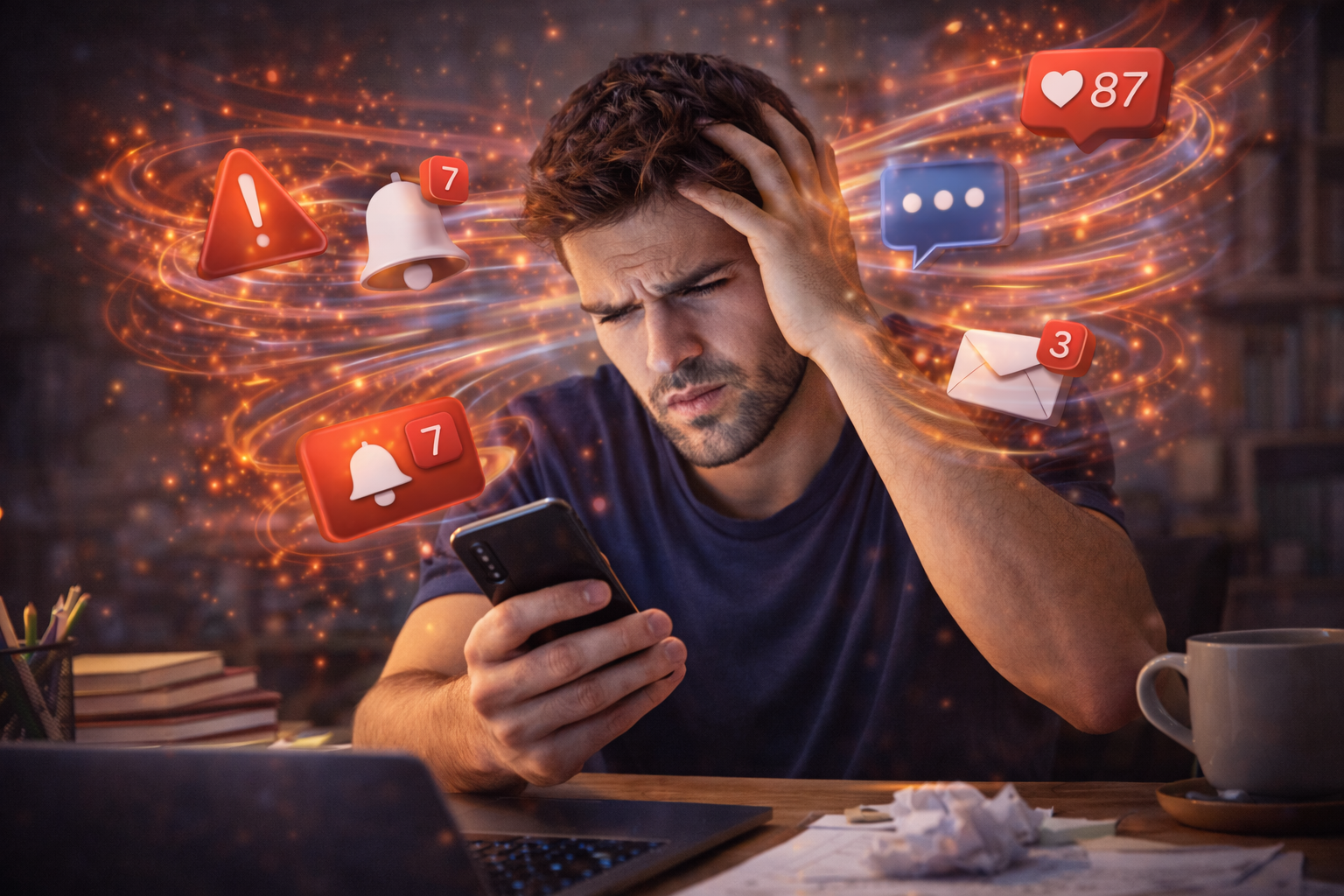



Discover how app interruption design captures attention, why interruptions are built into digital products, and how constant alerts reshape focus and behavior.
Interruptions Aren’t Accidental
A notification appears. A banner slides down. A badge turns red. A vibration taps your pocket.
None of these are random.
Modern apps are deliberately designed to interrupt you—not occasionally, but repeatedly. These interruptions aren’t bugs or oversights. They are the result of app interruption design, a system built around capturing attention in an always-connected world.
This article explains how apps are designed to interrupt you, why interruption is so central to digital products, and what this constant disruption does to attention, focus, and mental well-being.
What App Interruption Design Really Means
App interruption design refers to the intentional use of:
- Notifications
- Alerts
- Badges
- Sounds
- Visual prompts
to pull users back into an app—even when they’re doing something else.
The goal isn’t to inform. It’s to re-engage.
Every interruption is an invitation to return—and often to stay longer than intended.
Why Interruption Is the Default Strategy
Most apps operate in a competitive attention economy.
If users forget about an app, it loses relevance. If they don’t return frequently, engagement metrics drop.
Interruption solves this problem.
By breaking into your attention at unpredictable moments, apps ensure they stay mentally present—even when closed.
Why App Interruption Design Feels So Urgent
Interruptions don’t just notify—they signal importance.
Design cues such as:
- Red badges
- Push sounds
- “Just now” labels
trigger reflexive attention. The brain interprets these signals as time-sensitive, even when they aren’t.
This creates urgency without context.
Why Notifications Bypass Rational Thought
App interruptions are designed to bypass conscious evaluation.
Instead of asking:
“Is this important?”
The brain reacts:
“Something happened.”
This reaction happens before logic intervenes.
The faster the interruption, the harder it is to ignore.
The Psychology Behind Interruption Timing
Timing matters more than content.
Many interruptions are sent:
- During work hours
- In the evening
- During known downtime
- At moments of habit vulnerability
The goal is not relevance—it’s availability.
Interruptions work best when attention is already fragile.
Why “Just One Notification” Is Never Just One
An interruption rarely ends where it begins.
Opening an app often leads to:
- Additional alerts
- New content
- Suggested actions
- Endless feeds
What started as a brief check becomes a longer session.
This is a key feature of app interruption design.
Why Apps Prefer Interruptions Over Choice
Interruptions reduce user effort.
Instead of relying on users to remember an app, interruptions do the remembering for them.
This shifts behavior from:
- Intentional use
to - Reactive engagement
Choice is replaced by response.
Why App Interruption Design Fragments Focus
Each interruption breaks attention continuity.
Even brief alerts:
- Reset mental context
- Disrupt flow
- Increase cognitive load
Returning to focused work takes longer than the interruption itself.
Repeated interruptions prevent depth entirely.
Why Interruption Creates Mental Fatigue
Interruptions demand evaluation:
- Is this important?
- Should I respond?
- Can it wait?
Each decision consumes mental energy.
Over time, this leads to fatigue—not from workload, but from constant evaluation.
Why Apps Compete to Be the Loudest
In crowded digital environments, subtlety loses.
Apps escalate interruption tactics:
- More frequent notifications
- More visual emphasis
- More emotional language
This creates an arms race for attention—at the user’s expense.
Why Interruption Design Works Even When You Hate It
Many people dislike interruptions—yet still respond to them.
This happens because:
- The brain is wired to notice change
- Alerts trigger alertness
- Ignoring requires effort
Design exploits reflex, not preference.
The Role of Interruption in Habit Formation
Repeated interruptions create habits.
Over time:
- Alerts condition response
- Response becomes automatic
- The app gains mental priority
Eventually, the app no longer needs to interrupt—the user checks proactively.
Why App Interruption Design Extends Beyond Notifications
Interruption isn’t limited to alerts.
Apps interrupt through:
- Email digests
- “We miss you” messages
- Badge counts
- Lock-screen previews
Even subtle cues keep the app mentally present.
Why Interruption Design Affects Emotional State
Interruptions increase:
- Stress
- Restlessness
- Irritability
Because attention is constantly pulled, the nervous system remains activated.
Even when nothing urgent exists, the design creates urgency.
Why This Isn’t About Bad Apps or Bad Users
App interruption design isn’t about malicious intent.
It’s about incentives.
Platforms are rewarded for engagement—not calm, focus, or restraint.
Users are responding normally to environments designed to interrupt them.
Why Willpower Isn’t Enough
Turning off notifications helps—but it doesn’t eliminate interruption design.
Many cues remain:
- Visual badges
- Habitual checking
- Anticipation
Relying solely on willpower creates friction—but doesn’t change the system.
How Interruption Design Shapes Modern Attention
Over time, constant interruption trains the brain to:
- Expect disruption
- Avoid sustained focus
- Seek stimulation
Silence feels unfamiliar. Stillness feels wrong.
Attention becomes reactive by default.
Seeing Interruption Design Clearly
Once interruption is recognized as a design feature, not a personal failing, its power weakens.
Interruptions lose authority when they’re seen as invitations—not commands.
How to Reduce the Impact of App Interruption Design
Effective approaches include:
- Fewer apps allowed to interrupt
- Delayed notification delivery
- Checking on your schedule, not theirs
- Treating alerts as optional
The goal isn’t elimination—it’s reclaiming control.
App Interruption Design and the Attention Crisis
App interruption design is one of the strongest forces driving the attention crisis.
It:
- Normalizes distraction
- Undermines focus
- Keeps urgency constant
Understanding it is essential to rebuilding attention.
FAQs: App Interruption Design
1. What is app interruption design?
It’s the intentional use of alerts and cues to pull users back into apps.
2. Why are apps designed to interrupt?
Because frequent engagement drives growth and revenue.
3. Are notifications the main problem?
They’re one part of a larger interruption system.
4. Why do interruptions feel urgent?
Design cues trigger reflexive attention.
5. Can interruption design be resisted?
Yes—by changing defaults and expectations.
6. Is this a personal discipline issue?
No. It’s a systemic design issue.
Conclusion: Interruptions Are Designed—So Attention Must Be Protected
Apps are designed to interrupt you because interruption works.
But working for platforms doesn’t mean working for you.
When interruption design is recognized for what it is, attention can be defended—not through constant resistance, but through awareness and boundaries.
Focus returns not when apps stop interrupting—but when interruptions stop controlling attention.
The American Psychological Association explains how frequent interruptions increase cognitive load and reduce performance: Multitasking: Switching Costs.
For a design-industry perspective on how notifications and alerts are engineered, see this analysis from the Nielsen Norman Group: Notification Design Guidelines.
All Rights Reserved © 2026