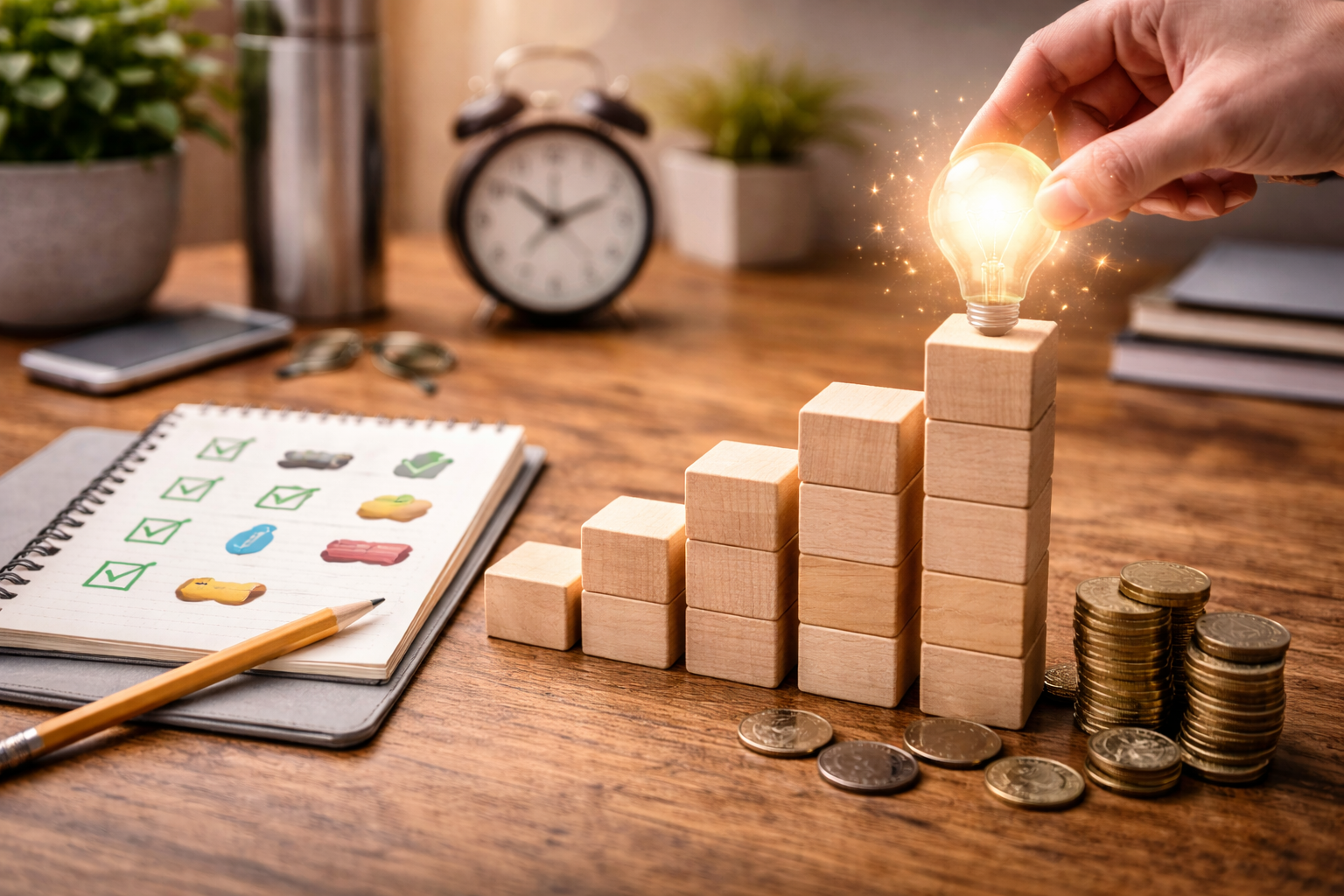



An in-depth guide to the habit compounding effect—how small daily habits quietly build massive long-term results, why progress feels invisible at first, and how compounding actually works in real life.
How Small Habits Compound Over Time
Most people expect change to be dramatic.
They imagine:
- Big transformations
- Sudden breakthroughs
- Overnight success
But real change almost never works that way.
Real change is quiet.
Repetitive.
Often invisible.
And that’s because progress is governed by something most people misunderstand:
The habit compounding effect.
This article explains how small habits compound over time, why they feel pointless at first, why most people quit too early, and how long-term results are built without intensity, motivation, or radical life overhauls.
Why People Expect Linear Progress
Humans are taught to expect linear cause and effect.
- Work harder → get paid
- Study more → get better grades
- Train harder → see results
But habits don’t work linearly.
Habit progress is exponential—and exponential growth always looks flat at the beginning.
This mismatch between expectation and reality is why people misunderstand the habit compounding effect and abandon habits long before they start paying off.
What the Habit Compounding Effect Really Is
The habit compounding effect describes how:
Small, repeated actions create disproportionately large results over long periods of time.
Not because each action is powerful on its own—but because:
- Habits reinforce identity
- Habits reduce friction
- Habits stack on each other
- Habits reshape behavior automatically
Each repetition slightly improves:
- Skill
- Confidence
- Efficiency
- Self-trust
Those tiny improvements accumulate.
Not overnight.
But inevitably.
Why Early Effort Feels Useless
At the beginning, habits feel pointless.
You:
- Exercise but see no change
- Write but gain no traction
- Study but feel just as confused
This isn’t failure.
It’s the lag phase of compounding.
During this phase:
- Results are internal
- Neural pathways are forming
- Resistance is decreasing
- Identity is shifting
None of this is visible yet.
That’s why early habit work feels unrewarding—and why most people quit.
The Invisible Phase of Habit Building
Every compounding system has an invisible phase.
In habits, this phase includes:
- Learning mechanics
- Reducing mental friction
- Normalizing behavior
- Building consistency
Nothing looks different on the outside.
But internally, the system is being built.
The habit compounding effect only becomes visible after this foundation exists.
Why Small Habits Feel Too Small to Matter
People dismiss small habits because they judge them individually.
They ask:
“What difference does this make today?”
The correct question is:
“What difference does this make if repeated for years?”
Small habits feel weak because their power comes from time, not intensity.
Compounding requires patience—not belief in daily impact.
Compounding vs Motivation
Motivation spikes.
Compounding doesn’t.
Motivation creates:
- Short bursts
- Emotional highs
- Inconsistent effort
Compounding requires:
- Repetition
- Predictability
- Low emotional cost
That’s why motivation-driven habits rarely compound.
They don’t last long enough.
The habit compounding effect only works when habits survive bad days.
How Compounding Works in the Brain
Neurologically, repetition strengthens neural pathways.
Each repetition:
- Lowers activation energy
- Increases automaticity
- Reduces decision-making
Eventually:
- The habit feels normal
- Resistance disappears
- Behavior becomes default
At that point, effort drops while output increases.
That’s the neurological side of the habit compounding effect.
Why Big Changes Rarely Stick
Big changes fail because:
- They demand high energy
- They rely on motivation
- They overwhelm identity
Small habits succeed because:
- They feel safe
- They’re repeatable
- They don’t threaten self-image
Compounding favors small and stable, not bold and dramatic.
Habit Compounding in Real Life (Early Examples)
Health
- One daily walk doesn’t change much
- Months of walking reshape energy, sleep, and metabolism
Learning
- One study session doesn’t feel useful
- Daily exposure compounds understanding
Work
- One small improvement seems irrelevant
- Repeated improvements reshape competence
Each example looks unimpressive short-term—and powerful long-term.
Why People Quit Before Compounding Begins
People quit because:
- Results lag
- Effort feels unrewarded
- Progress isn’t visible
- Comparison kills patience
Most people abandon habits right before the curve bends upward.
The habit compounding effect punishes impatience and rewards persistence.
Reframing “Slow Progress”
What feels like slow progress is often:
- Foundation building
- Friction reduction
- Identity reinforcement
The absence of visible results doesn’t mean the absence of progress.
It means compounding hasn’t surfaced yet.
🏁 Conclusion (Part 1)
The most powerful habits don’t feel powerful.
They feel small.
Boring.
Repetitive.
And that’s exactly why they work.
The habit compounding effect isn’t about doing more.
It’s about doing something small—long enough for time to do the heavy lifting.
- James Clear: The Compounding Effect of Habits
- Harvard Business Review: How to Build Habits That Stick
The Curve Everyone Misunderstands
The habit compounding effect follows a curve most people don’t expect.
It looks like this:
- Long flat line
- Minimal visible progress
- Sudden upward bend
This is the same pattern seen in:
- Investing
- Skill mastery
- Language learning
- Physical training
Early on, effort piles up with little visible return. Later, the same effort produces outsized results.
People quit because they mistake the flat part for failure.
Why the Flat Phase Is Not Wasted Time
During the flat phase, critical things are happening quietly:
- Neural pathways are strengthening
- Friction is being reduced
- Identity is adjusting
- Consistency is stabilizing
None of this shows up as “results.”
But without it, compounding never begins.
The habit compounding effect depends on this invisible groundwork.
The Difference Between Linear Effort and Exponential Results
Linear thinking says:
“I did X today, so I should see X results.”
Compounding reality says:
“I did X today so that future X becomes easier.”
Each repetition:
- Slightly lowers resistance
- Slightly improves efficiency
- Slightly increases confidence
Those “slightlies” stack.
And eventually, they stack fast.
Why Habits Feel Pointless Right Before They Work
This is the cruel part of compounding:
The moment people are closest to results is often when habits feel most pointless.
Why?
- Effort has become normal
- Improvement feels incremental
- No dramatic feedback appears
The brain says:
“This isn’t working.”
But mathematically, this is often the moment before acceleration.
How Identity Is the Real Compounding Engine
Results compound after identity shifts.
At first:
- You are someone trying a habit
Later:
- You are someone who does this
That shift changes:
- Decision-making
- Self-expectation
- Emotional resistance
Once identity aligns, behavior becomes self-reinforcing.
This is a hidden but central part of the habit compounding effect.
Why Compounding Requires Boring Repetition
Compounding needs:
- Stability
- Predictability
- Low variance
Excitement introduces variance.
Variance breaks compounding.
That’s why:
- Boring routines outperform intense bursts
- Predictable schedules beat flexible intentions
The less dramatic the habit, the longer it lasts.
The Role of Friction in Habit Compounding
Friction determines whether habits survive long enough to compound.
High friction:
- Requires motivation
- Increases failure risk
- Shortens habit lifespan
Low friction:
- Encourages repetition
- Reduces emotional cost
- Extends consistency
The habit compounding effect only works when friction is engineered out of the process.
Why Small Improvements Beat Big Changes
Big changes demand:
- Energy
- Motivation
- Identity disruption
Small improvements demand:
- Almost nothing
A 1% improvement repeated daily compounds.
A 100% improvement attempted once usually fails.
Compounding rewards humility.
The Snowball Effect in Skill Building
In skills, compounding looks like:
- Faster learning
- Better pattern recognition
- Reduced cognitive load
Each session makes the next session easier.
Eventually:
- What once felt difficult feels obvious
- What once took effort becomes automatic
This is the skill side of the habit compounding effect.
Why Habits Compound Unevenly
Not all habits compound at the same rate.
Fast-compounding habits:
- Sleep routines
- Exercise
- Writing
- Reading
Slow-compounding habits:
- Investing
- Learning complex subjects
- Building reputation
Slow compounding is not weak compounding.
It’s just delayed.
The Emotional Shift That Signals Compounding Has Started
You know compounding has begun when:
- You miss the habit when you skip it
- Resistance drops sharply
- Effort feels lighter
- Consistency feels natural
At this point, stopping feels harder than continuing.
That’s compounding at work.
Why Comparison Kills Compounding
Comparison focuses attention on:
- Other people’s results
- Short-term outcomes
- External validation
Compounding requires:
- Internal consistency
- Long time horizons
- Patience
Comparing your early stage to someone else’s late stage is the fastest way to abandon compounding.
How Time Does the Heavy Lifting
Habits don’t feel powerful because time is doing most of the work.
Your job is only to:
- Show up
- Reduce friction
- Avoid quitting
Time multiplies everything else.
This is why the habit compounding effect favors those who stay—not those who push hardest.
Reframing Progress the Right Way
Instead of asking:
“Is this working?”
Ask:
“Is this sustainable?”
If it’s sustainable, compounding is already happening—even if results are invisible.
How Habits Compound in Health (Slow Changes, Massive Payoff)
Health is where the habit compounding effect is most misunderstood.
People expect:
- Quick weight loss
- Immediate energy
- Visible transformation
But health habits compound quietly.
Early Phase
- You feel almost the same
- Effort feels unrewarded
- Progress is internal (sleep, digestion, recovery)
Middle Phase
- Energy stabilizes
- Fewer bad days
- Recovery improves
Late Phase
- Health becomes your default
- Illness hits less often
- Baseline performance is higher
No single workout changes your life.
Hundreds of ordinary ones do.
This is compounding in its purest form.
Habit Compounding in Learning (Why Knowledge Suddenly “Clicks”)
Learning habits feel especially slow early.
You read.
You study.
You practice.
And still feel confused.
That’s because learning compounds through:
- Pattern recognition
- Familiarity
- Reduced cognitive load
At first:
- Everything feels new
- Effort is high
Later:
- Concepts connect
- Understanding accelerates
- Learning speed increases
That moment when things suddenly “click” isn’t magic.
It’s delayed compounding finally becoming visible.
How Habits Compound in Work and Careers
Career growth rarely comes from single breakthroughs.
It comes from:
- Showing up reliably
- Small skill upgrades
- Incremental responsibility
Daily habits compound into:
- Reputation
- Trust
- Opportunity
One extra email doesn’t matter.
One extra improvement doesn’t stand out.
But years of steady contribution quietly change how people see—and rely on—you.
That’s the career side of the habit compounding effect.
Why Compounding Feels Unfair (But Isn’t)
Compounding rewards:
- Time in the system
- Persistence
- Consistency
It punishes:
- Impatience
- Comparison
- Quitting
This can feel unfair when:
- Others appear to “skip ahead”
- Results seem uneven
- Effort doesn’t match reward short-term
But over long timelines, compounding is one of the fairest systems that exists.
Everyone gets the same rule:
What you repeat, you become.
The Silent Enemy of Compounding: Inconsistency
Compounding requires continuity.
Inconsistency breaks:
- Momentum
- Identity
- Neural reinforcement
You don’t need perfect streaks—but you do need frequent returns.
Missing occasionally doesn’t stop compounding.
Stopping entirely does.
The habit compounding effect survives mistakes—but not abandonment.
Why People Accidentally Sabotage Compounding
Common ways people break compounding:
- Increasing difficulty too fast
- Changing habits too often
- Chasing optimization instead of repetition
- Expecting visible results too early
Each of these introduces instability.
Compounding requires boring stability.
Why Variety Feels Good but Slows Results
Variety excites the brain.
Compounding prefers sameness.
Constantly changing:
- Routines
- Tools
- Methods
Resets progress.
Mastery comes from:
- Repeating the same basics
- Refining small details
- Letting skill deepen naturally
Compounding thrives on repetition—not novelty.
The “Set and Forget” Advantage
The best habits eventually:
- Require no decision
- Trigger automatically
- Feel strange to skip
At that point:
- Effort drops
- Results continue
This is the ideal compounding state.
When habits become defaults, time does the rest.
Why You Can’t Rush the Habit Compounding Effect
People try to rush compounding by:
- Doing more
- Pushing harder
- Adding pressure
This backfires.
Rushing:
- Increases burnout
- Breaks consistency
- Shortens habit lifespan
Compounding is slow by design.
Trying to speed it up usually resets it.
How to Tell If a Habit Will Compound or Collapse
Ask:
- Can I do this on bad days?
- Can I imagine doing this for years?
- Does this reduce friction over time?
- Does it fit my identity?
If the answer is no, compounding won’t survive.
Sustainability is the gatekeeper of compounding.
The Quiet Confidence Compounding Creates
When habits compound:
- You stop questioning yourself
- Progress feels normal
- Identity stabilizes
Confidence isn’t emotional.
It’s mathematical.
You trust yourself because evidence has accumulated.
Why Compounding Beats Motivation Long-Term
Motivation spikes.
Compounding accumulates.
Motivation fades.
Compounding persists.
That’s why people who rely on habits eventually outperform those who rely on intensity.
Reframing the Question That Matters Most
Stop asking:
“Is this habit working?”
Start asking:
“Would this still matter if I did it for 5 years?”
If yes, compounding is already on your side.
Why Most Habits Die Young
Most habits don’t fail because they’re ineffective.
They fail because they’re unsustainable.
Common reasons habits collapse:
- They demand high motivation
- They rely on perfect conditions
- They clash with identity
- They require too much time or energy
The habit compounding effect only works when a habit survives long enough for time to multiply it.
Longevity—not intensity—is the gatekeeper.
The Rule That Protects Compounding: “Easy Enough on Bad Days”
A habit that only works on good days will not compound.
The single most important test for any habit is this:
Can I still do this on my worst realistic day?
If the answer is no, compounding is at risk.
This is why the most effective habits:
- Look almost trivial
- Feel slightly underwhelming
- Appear too small to matter
Their strength is survivability.
The 3-Layer Habit Design That Compounds
Long-lasting habits share a common structure:
Layer 1: Identity Fit
- “This is something people like me do”
- No internal conflict
Layer 2: Environmental Support
- Tools are ready
- Friction is reduced
- Cues are visible
Layer 3: Minimum Viable Action
- Clear
- Small
- Always achievable
When these three align, the habit compounding effect becomes automatic.
Why Habit Size Matters More Than Habit Quality
People overthink what habit to choose.
But compounding depends far more on size than type.
A mediocre habit repeated for years beats a perfect habit done for weeks.
This is why:
- Reading one page daily compounds
- Writing one paragraph compounds
- Walking ten minutes compounds
Small habits win because they keep showing up.
How to Avoid the “Upgrade Trap”
One of the most common ways people break compounding is by upgrading too soon.
The trap looks like this:
- Habit becomes easy
- Confidence increases
- You add more
- Habit collapses
The fix:
- Keep the minimum fixed
- Let extra effort be optional
Compounding survives when the floor stays low—even as the ceiling rises.
Why Rest Is Part of Compounding (Not a Break From It)
Burnout destroys compounding.
Rest protects it.
Rest:
- Preserves consistency
- Prevents negative associations
- Keeps habits emotionally safe
A habit that includes rest compounds longer than one that glorifies strain.
The Difference Between Tracking Results and Tracking Reps
Results lag.
Reps are immediate.
Tracking results:
- Creates impatience
- Encourages comparison
- Undermines consistency
Tracking repetitions:
- Reinforces identity
- Builds momentum
- Rewards showing up
The habit compounding effect accelerates when you measure presence, not outcomes.
Why “Missing a Day” Doesn’t Break Compounding
Missing a day doesn’t matter.
What matters is:
- How quickly you return
- Whether identity stays intact
Compounding breaks when people interpret misses as failure.
The correct interpretation:
“This is normal. I return.”
Returning quickly protects the curve.
The Long-Term Identity Shift Compounding Creates
Over time, habits stop feeling like effort.
They become:
- Part of who you are
- Non-negotiable defaults
- Strange to skip
At this point:
- Motivation is irrelevant
- Willpower is unnecessary
- Progress feels natural
This is the hidden reward of the habit compounding effect.
Common Myths That Kill Compounding
Myth 1: “I need the perfect habit”
You need a durable one.
Myth 2: “More effort = more results”
More repetition = more results.
Myth 3: “I’ll know when it’s working”
By the time you know, it’s already worked.
Myth 4: “Small habits are a waste of time”
Small habits are the only ones that survive long enough to matter.
A Simple Habit Compounding Framework (Use This)
Before committing to a habit, ask:
- Can I do this on bad days?
- Does this fit who I believe I am?
- Is the minimum crystal clear?
- Will this reduce friction over time?
- Can I imagine doing this for years?
If yes, compounding will take care of the rest.
Why Time Is the Real Multiplier
Effort starts habits.
Time multiplies them.
The habit compounding effect rewards:
- Patience
- Stability
- Persistence
Not brilliance.
Not intensity.
Not motivation.
Just time plus repetition.
Final Reframe: Habits Don’t Change Your Life—Time Does
Habits are not powerful because they are impressive.
They are powerful because they:
- Stay
- Repeat
- Accumulate
When habits stick, time works for you.
And when time works for you, results become inevitable.
🏁 Final Conclusion
The habit compounding effect explains why small actions outperform big intentions.
Not because they’re better.
But because they last.
If you want change that actually holds:
- Make habits small
- Make them repeatable
- Make them survivable
Then stop checking for results.
Time will handle that part.
All Rights Reserved © 2026