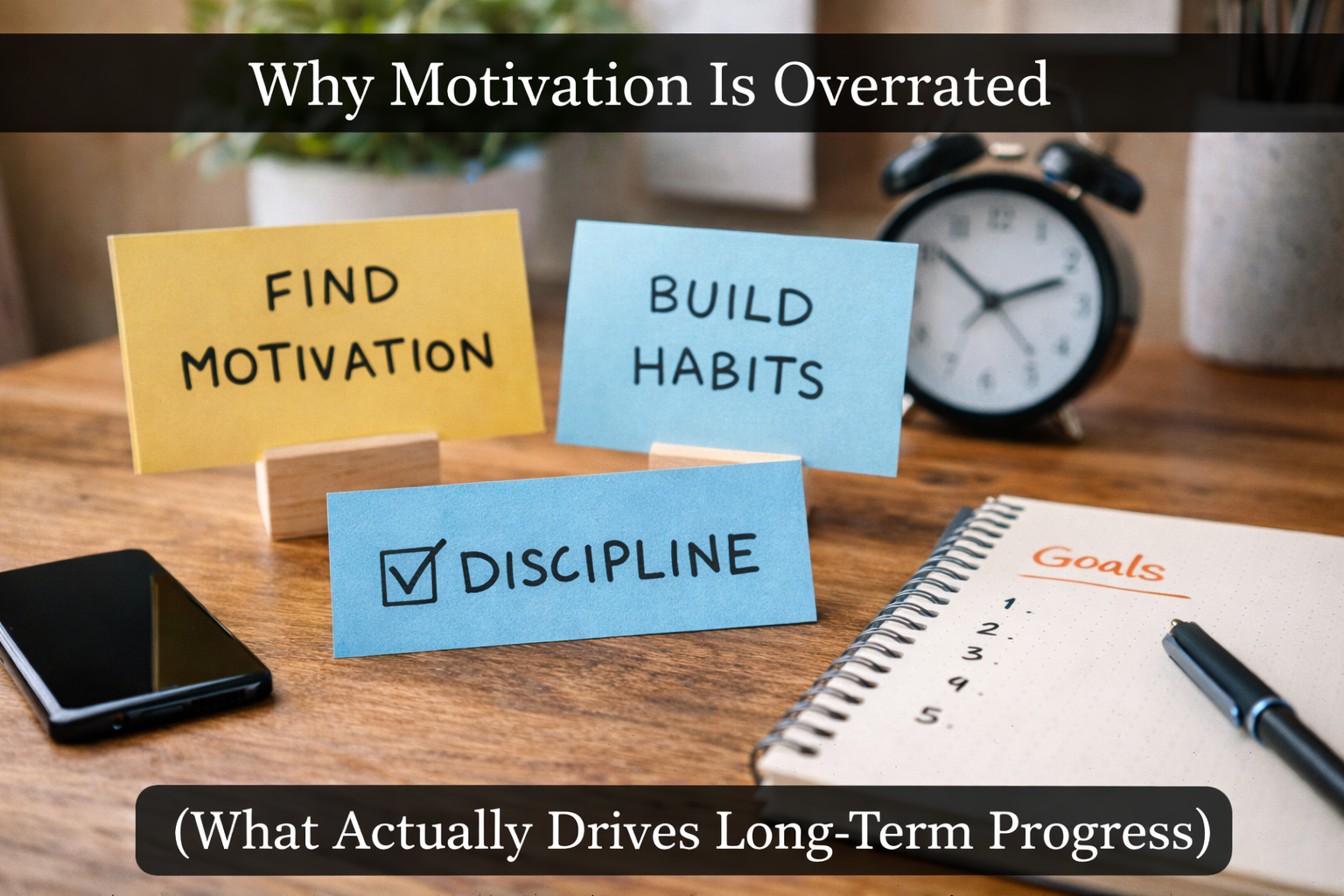



Learn why motivation is overrated when it comes to real progress, productivity, and success. This deep guide explains what actually works long term—and why relying on motivation quietly sabotages results.
Why Motivation Is Overrated
Motivation is everywhere.
- “Get motivated.”
- “Find your why.”
- “Wait until you feel inspired.”
It sounds reasonable. Even empowering.
But here’s the uncomfortable truth most people discover too late:
Motivation is unreliable, short-lived, and a terrible foundation for long-term success.
This article explains why motivation is overrated, where the idea came from, why it keeps failing people, and what actually sustains progress when motivation disappears—which it always does.
This is not a hype piece.
It’s a reality check.
How Motivation Became the Center of Self-Help
Motivation wasn’t always the hero.
Early productivity and success philosophies focused on:
- Routine
- Duty
- Craft
- Repetition
Motivation became dominant because:
- It’s emotionally appealing
- It sells well
- It feels empowering in the moment
But the rise of motivation culture coincided with:
- Shorter attention spans
- Faster content cycles
- Social media highlight reels
Motivation fits perfectly into a world that prefers bursts of intensity over long-term consistency.
That doesn’t make it effective.
What Motivation Actually Is (Psychologically)
Motivation is a temporary emotional state.
It is influenced by:
- Mood
- Sleep
- Stress
- Novelty
- External rewards
Psychologically, motivation is:
- Reactive
- Context-dependent
- Unstable
That’s why relying on it feels like:
- One good day
- Followed by three inconsistent ones
This is the core reason motivation is overrated:
It’s not designed to be consistent.
Why Motivation Always Fades
Motivation fades for predictable reasons:
1. Novelty Wears Off
New goals feel exciting. Routine doesn’t.
2. Progress Slows
Early wins create excitement. Plateaus kill it.
3. Life Interferes
Stress, illness, and obligations drain emotional energy.
4. Motivation Is Consumed
Using motivation doesn’t replenish it—it depletes it.
This is not a personal flaw.
It’s how the nervous system works.
The Motivation–Action Trap
Most people believe:
“I’ll act when I feel motivated.”
High performers do the opposite:
“I’ll act so motivation has a chance to appear.”
Motivation is often the result of action—not the cause.
Waiting for motivation creates:
- Delay
- Overthinking
- Self-doubt
- Inconsistency
This is why motivation is overrated as a starting mechanism.
Why Waiting to Feel Ready Destroys Momentum
Readiness is a feeling—not a requirement.
Waiting to feel ready:
- Keeps people stuck
- Reinforces avoidance
- Creates false standards
Most meaningful progress begins:
- While unsure
- While tired
- While unmotivated
Action creates clarity.
Motivation follows later—if at all.
Motivation vs Environment
Environment beats motivation every time.
People who appear “highly motivated” often have:
- Clear routines
- Fewer decisions
- Structured environments
- Reduced friction
They don’t wake up motivated.
They wake up in systems that make action easier than avoidance.
This is where motivation loses relevance.
Discipline Is Also Overrated (And Why)
Discipline is often positioned as the solution to weak motivation.
But discipline has limits:
- It relies on self-control
- It drains energy
- It collapses under stress
Discipline without systems becomes another form of burnout.
So if motivation is overrated—and discipline is limited—what actually works?
What Actually Drives Consistency
Long-term consistency comes from:
- Reduced decision-making
- Predictable routines
- Clear defaults
- Identity alignment
Consistency isn’t heroic.
It’s boring, repeatable, and quietly powerful.
This is why motivation is overrated in real-world progress.
Systems vs Willpower
Willpower asks:
“Can I push myself today?”
Systems ask:
“What happens by default?”
Systems:
- Work when you’re tired
- Work when you’re distracted
- Work when motivation is gone
If something requires daily willpower, it will eventually fail.
Identity-Based Action
The most powerful shift is identity.
Not:
- “I’m motivated to write”
But: - “I’m someone who writes daily”
Identity reduces friction.
You don’t debate actions that feel self-consistent.
This bypasses motivation entirely.
Habits That Work Without Motivation
Examples:
- Writing one sentence
- Doing five minutes
- Showing up without expectations
These habits:
- Lower resistance
- Preserve energy
- Create momentum
Small actions beat motivated bursts every time.
Why High Performers Don’t Rely on Motivation
People who sustain results long-term:
- Expect low motivation
- Design around it
- Normalize resistance
They don’t ask:
“Do I feel like it?”
They ask:
“What’s the smallest version I can do today?”
That mindset outperforms motivation endlessly.
Motivation in Work, Fitness, and Learning
Across domains, the pattern is identical:
- Fitness fails when motivation fades
- Learning fails when excitement dips
- Work fails when energy fluctuates
What survives?
- Structure
- Defaults
- Identity
- Environment
Motivation is a bonus—not a foundation.
Replacing Motivation With Something Better
Instead of chasing motivation, build:
- Systems
- Habits
- Identity
- Friction reduction
Motivation will still appear sometimes.
But it won’t be required.
That’s the real freedom.
❓ Frequently Asked Questions
Is motivation useless?
No—but it’s unreliable and shouldn’t be your main strategy.
Why does motivation feel so powerful at first?
Because novelty temporarily boosts emotional energy.
What should I rely on instead of motivation?
Systems, habits, identity, and environment.
Can motivation still help?
Yes—as a catalyst, not a crutch.
Why do people keep promoting motivation?
Because it feels good and sells easily.
🏁 Conclusion (Part 1)
The reason motivation is overrated isn’t because motivation is bad.
It’s because:
- It fades
- It fluctuates
- It lies about sustainability
Progress isn’t built on feeling ready.
It’s built on showing up when you don’t—and designing life so that showing up is the default.
Why “More Motivation” Becomes a Trap
When people struggle to stay consistent, the default response is:
“I just need more motivation.”
This belief creates a loop that quietly sabotages progress.
Here’s how the trap works:
- You feel motivated → you start
- Motivation fades → effort feels heavy
- You stop → guilt appears
- You seek more motivation → repeat
The problem isn’t lack of motivation.
The problem is depending on a state that cannot be depended on.
This is the core reason motivation is overrated—it trains people to wait for a feeling instead of building conditions that make action inevitable.
The Emotional Cost of Relying on Motivation
Relying on motivation doesn’t just slow progress.
It affects how people see themselves.
Over time, people start thinking:
- “I’m inconsistent”
- “I lack discipline”
- “Something is wrong with me”
In reality, nothing is wrong.
They are responding normally to an unstable system.
When motivation is the engine, inconsistency is guaranteed—and self-trust erodes.
This is why so many people become stuck in cycles of self-blame instead of redesigning the process.
Why Motivation Works Best as a Side Effect
Motivation is not useless—but it’s misplaced.
Motivation works best as:
- A byproduct of progress
- A temporary boost, not a foundation
- A signal, not a requirement
Most people experience motivation after:
- Taking action
- Seeing small wins
- Feeling momentum
Action creates motivation far more reliably than motivation creates action.
This reversal is where most people finally break free.
The Real Drivers of Long-Term Behavior Change
If motivation is overrated, what actually drives long-term behavior?
Across psychology, behavioral science, and real-world observation, the same drivers appear repeatedly:
1. Friction (More Important Than Motivation)
People do what is easiest.
If a behavior has:
- Low friction → it happens
- High friction → it doesn’t
Motivation can temporarily overcome friction—but systems remove the need to.
Examples:
- A guitar in the corner gets played
- A gym bag by the door increases workouts
- A document already open gets written in
Design beats desire.
2. Defaults
Humans follow defaults more than intentions.
Defaults answer the question:
“What happens if I don’t think about it?”
If your default is:
- Scroll → you scroll
- Open email → you react
- Sit down → you work
Progress follows defaults, not motivation.
3. Identity Consistency
People protect their identity instinctively.
They act in ways that feel:
- Normal
- Self-consistent
- Aligned with who they believe they are
When behavior matches identity, motivation becomes unnecessary.
This is why identity-based habits outperform motivational goals every time.
Why High Motivation Often Leads to Burnout
This sounds counterintuitive, but it’s true.
Highly motivated starts often create:
- Unrealistic expectations
- Overcommitment
- Unsustainable pace
People ride a wave of motivation, then crash.
Burnout isn’t caused by laziness.
It’s caused by temporary intensity being mistaken for a sustainable system.
This is another reason motivation is overrated—it encourages spikes instead of stability.
Consistency Is Boring (And That’s Why It Works)
The behaviors that change lives are rarely exciting:
- Writing a few sentences
- Walking daily
- Studying consistently
- Showing up even when bored
They don’t feel heroic.
They don’t feel inspiring.
They work because they’re repeatable.
Motivation thrives on excitement.
Progress thrives on repetition.
How Systems Quietly Replace Motivation
A system answers three questions automatically:
- When do I do this?
- Where do I do this?
- What is the smallest acceptable version?
Once these are answered:
- Debate disappears
- Resistance shrinks
- Action becomes normal
Systems don’t eliminate effort.
They eliminate decision-making.
And decision-making is what motivation was compensating for in the first place.
Real-World Example: Writing Without Motivation
Motivated approach:
- “I’ll write when I feel inspired”
- Outcome: inconsistent output
System-based approach:
- Same time, same place
- One paragraph minimum
- No requirement to feel good
Outcome:
- More writing
- Better writing
- Motivation appears later, not first
This pattern repeats in fitness, learning, business, and health.
Why Motivation Advice Keeps Failing
Motivation advice fails because it:
- Treats emotions as controllable
- Ignores environment
- Overestimates willpower
- Underestimates fatigue
It places responsibility on feeling instead of design.
That’s why people feel empowered temporarily—and then stuck again.
What to Do Instead of “Getting Motivated”
Replace motivation-seeking with these actions:
Lower the Entry Bar
Make the task almost impossible to refuse.
Decide Once
Remove daily decision-making.
Anchor to Existing Habits
Stack new behavior onto something already automatic.
Normalize Low-Energy Days
Design systems that work when motivation is zero.
Track Showing Up, Not Outcomes
Consistency precedes results.
These steps work even when motivation doesn’t.
Motivation in Different Life Areas
Work
Motivation-based work leads to procrastination.
System-based work leads to output.
Fitness
Motivation-based fitness leads to cycles.
Routine-based fitness leads to health.
Learning
Motivation-based learning fades.
Scheduled learning compounds.
The domain doesn’t matter—the pattern is universal.
Why Motivation Is Overrated but Still Popular
Motivation stays popular because:
- It feels good
- It’s easy to sell
- It creates hope without structure
Systems are less exciting.
But they’re far more effective.
People don’t need more motivation.
They need fewer points of failure.
The Long-Term Payoff of Ignoring Motivation
When you stop chasing motivation:
- Progress feels calmer
- Identity strengthens
- Confidence becomes earned
- Results compound quietly
Life becomes less dramatic—but more effective.
This is the paradox:
Letting go of motivation leads to better outcomes than chasing it.
Final Reframe: Motivation Is Optional
The most freeing realization is this:
You don’t need to feel motivated to:
- Do meaningful work
- Improve your health
- Learn something valuable
- Build something lasting
You need:
- A small, repeatable action
- A predictable structure
- An environment that supports action
That’s why motivation is overrated—not because it’s useless, but because it was never meant to carry the weight we put on it.
🏁 Conclusion (Part 2)
Motivation is a feeling.
Systems are a strategy.
Feelings fluctuate.
Strategies endure.
The people who make progress long-term aren’t more motivated than others.
They simply stopped waiting to feel ready—and built lives where action happens by default.
- How to Build Better Habits (Hub)
- How to Stop Procrastinating
- Why Consistency Beats Talent
- Morning Routines in 2026
- How to Plan Your Week
- Minimalist Productivity
- James Clear: Motivation vs Systems
- Harvard Business Review: What Actually Motivates Long-Term
Why Habits Outperform Motivation Every Time
Motivation asks:
“Do I feel like doing this today?”
Habits answer:
“This is just what happens.”
That difference is everything.
Habits:
- Reduce decision fatigue
- Lower emotional resistance
- Continue during stress
- Survive bad days
Motivation, by contrast:
- Depends on mood
- Collapses under pressure
- Disappears when results slow
This is why motivation is overrated as a long-term strategy—and habits quietly dominate outcomes.
The Hidden Power of Repetition Over Intensity
Most people overvalue intensity and undervalue repetition.
Intensity looks impressive:
- Long sessions
- Big efforts
- Dramatic starts
Repetition looks boring:
- Small actions
- Modest effort
- Same thing, again
But repetition:
- Builds neural pathways
- Reduces resistance
- Normalizes behavior
- Compounds over time
A habit repeated at 60% effort beats a motivated burst at 120% every time.
Why “Big Goals” Often Undermine Progress
Goals aren’t bad—but they’re often misused.
Big goals create:
- Pressure
- Performance anxiety
- All-or-nothing thinking
When goals are tied to motivation, people think:
“If I don’t feel driven, I must not want it badly enough.”
That belief is destructive.
Goals should inform direction, not dictate daily emotional states.
Progress comes from process, not passion.
Identity Beats Goals (Here’s Why)
Goals say:
“I want to do X.”
Identity says:
“I am the kind of person who does X.”
Identity-based behavior:
- Requires less negotiation
- Feels natural
- Persists under stress
You don’t need motivation to act in ways that feel self-consistent.
This is why motivation is overrated compared to identity alignment.
How Identity Is Actually Formed (Not Affirmations)
Identity isn’t built by saying things.
It’s built by evidence.
Every small action casts a vote:
- You write → you become a writer
- You train → you become someone who trains
- You show up → you become consistent
You don’t wait for identity to change before acting.
You act—and identity follows.
Motivation tries to shortcut this process.
It can’t.
The Psychology of “I’ll Start Tomorrow”
“I’ll start tomorrow” feels responsible—but it’s avoidance in disguise.
Why?
Because tomorrow promises:
- Better motivation
- More energy
- Ideal conditions
But tomorrow is imaginary.
Action today—even imperfect—creates:
- Psychological momentum
- Reduced fear
- Proof of capability
Waiting for motivation pushes action into a future that never arrives.
Why Consistency Feels Uncomfortable at First
Consistency feels uncomfortable because:
- It removes novelty
- It exposes plateaus
- It lacks emotional payoff early
Motivation thrives on novelty.
Consistency survives without it.
This discomfort isn’t a signal to stop.
It’s a sign you’re transitioning from emotion-driven action to identity-driven behavior.
Why Talent Loses to Consistency
Talent:
- Feels effortless early
- Encourages complacency
- Struggles under adversity
Consistency:
- Feels slow
- Builds resilience
- Accumulates skill
Most long-term success stories aren’t about gifted people.
They’re about people who kept going when motivation disappeared.
This is another reason motivation is overrated—talent plus motivation often collapses without systems.
What People Get Wrong About Discipline
Discipline is often framed as:
“Forcing yourself to do hard things.”
That version fails.
Real discipline looks like:
- Reducing options
- Automating decisions
- Designing environments
Discipline is less about strength—and more about design.
If something requires daily force, it will eventually fail.
Designing a Life That Doesn’t Need Motivation
Here’s what that actually looks like.
1. Fixed Time, Flexible Output
Same time every day.
Different output allowed.
2. Minimum Viable Action
Define the smallest version that counts.
3. Visible Triggers
Make the behavior obvious and unavoidable.
4. Immediate Closure
Finish with a clear stop point.
These designs make motivation optional.
Why Tracking Effort Works Better Than Tracking Results
Results lag.
Effort is immediate.
When people track:
- Revenue
- Weight
- Followers
They get discouraged early.
Tracking:
- Days shown up
- Repetitions completed
- Sessions finished
Builds confidence before results arrive.
Motivation chases outcomes.
Systems reward effort.
The Role of Emotion (And Why It’s Misunderstood)
Emotion isn’t the enemy.
But emotion is information, not instruction.
Feeling unmotivated often signals:
- Fatigue
- Overload
- Poor system design
Ignoring that and pushing harder leads to burnout.
Adjusting the system solves the problem—without chasing motivation.
Why Motivation Advice Persists (Even Though It Fails)
Motivation advice persists because:
- It’s simple
- It feels empowering
- It avoids uncomfortable truths
The truth is harder:
Progress requires structure, patience, and repetition.
That’s less exciting—but far more reliable.
The Quiet Confidence That Replaces Motivation
When systems are in place:
- You trust yourself
- You stop negotiating
- You stop overthinking
Confidence comes from evidence, not hype.
And evidence comes from showing up—especially when motivation is gone.
Long-Term Success Is Anti-Dramatic
The most effective paths:
- Look boring
- Feel repetitive
- Lack emotional highs
But they work.
Motivation seeks excitement.
Progress seeks stability.
That’s why motivation is overrated in real life.
Practical Replacement Framework (Use This Instead of Motivation)
Whenever you feel stuck, ask:
- Is the task too big?
- Is the environment fighting me?
- Is the habit unclear?
- Is the minimum too demanding?
- Am I expecting motivation instead of designing defaults?
Fixing these solves the problem—without motivational tricks.
🏁 Conclusion (Part 3)
Motivation feels powerful—but it’s fragile.
What lasts is:
- Systems
- Identity
- Environment
- Repetition
When you stop relying on motivation, progress becomes calmer, more predictable, and far more sustainable.
That’s not a downgrade.
That’s mastery.
The Final Shift: From Emotion-Driven to Design-Driven Living
By now, one thing should be clear:
Motivation is overrated because it places responsibility on emotion instead of structure.
People don’t fail because they lack drive.
They fail because their lives require drive every single day just to function.
That’s not sustainable.
The highest-performing people don’t wake up motivated.
They wake up inside systems that carry them forward automatically.
This final section focuses on how to design that kind of life.
What a Motivation-Free System Actually Looks Like
A motivation-free system has four characteristics:
1. It Works on Bad Days
If it only works when you feel good, it’s fragile.
2. It Requires Minimal Decision-Making
Decisions drain energy faster than effort.
3. It Has a Defined Minimum
You always know what “enough” looks like.
4. It Respects Recovery
Burnout is not a badge of honor—it’s system failure.
When these four are present, motivation becomes optional.
The Role of Structure in Long-Term Success
Structure gets a bad reputation because people confuse it with rigidity.
In reality, structure creates freedom.
Structure:
- Reduces anxiety
- Protects focus
- Preserves energy
- Prevents overthinking
Unstructured freedom requires constant motivation.
Structured freedom does not.
That’s why motivation is overrated in environments that lack structure.
Why Hustle Culture Depends on Motivation (And Why It Breaks People)
Hustle culture glorifies:
- Long hours
- Intensity
- Emotional highs
- Constant pushing
It survives by:
- Selling motivation
- Shaming rest
- Celebrating burnout as dedication
But hustle culture collapses because it ignores biology.
Humans:
- Have limited energy
- Need recovery
- Cannot sprint indefinitely
Motivation temporarily overrides limits.
Systems respect them.
The Calm Advantage Nobody Talks About
People who stop relying on motivation often experience:
- Less anxiety
- More consistency
- Higher-quality output
- Quiet confidence
They don’t feel dramatic progress.
They feel steady progress.
And steady progress compounds.
This calm advantage is invisible on social media—but decisive in real life.
Why “Feeling Ready” Is a Trap
Feeling ready is not a prerequisite.
It’s a luxury.
Most meaningful progress happens when people feel:
- Unsure
- Tired
- Uninspired
- Neutral at best
Waiting to feel ready delays action indefinitely.
Systems don’t wait.
They operate.
How This Applies to Real Life (Not Just Productivity)
This isn’t just about work.
Health
People who rely on motivation exercise inconsistently.
People who rely on routine stay healthy.
Learning
Motivated learners quit.
Scheduled learners grow.
Relationships
Consistency matters more than emotional peaks.
Finances
Systems beat impulse every time.
In every domain, motivation spikes—and then fades.
Structure remains.
Why Self-Trust Replaces Motivation Over Time
Self-trust is built through evidence.
Every time you show up without motivation:
- Confidence increases
- Resistance decreases
- Identity solidifies
Eventually, you stop asking:
“Will I do this?”
You already know the answer.
That’s when motivation becomes irrelevant.
The Long-Term Identity Shift
Over time, people stop saying:
- “I’m trying to be consistent”
And start saying:
- “This is just how I live”
That shift changes everything.
You no longer need:
- Pep talks
- Motivation videos
- Emotional hype
You’ve become someone who acts by default.
Why This Approach Outperforms Talent and Passion
Talent fades without consistency.
Passion fluctuates with mood.
But systems:
- Accumulate skill
- Protect progress
- Scale quietly
This is why motivation is overrated—and why boring systems win.
A Simple Summary Framework (Remember This)
When stuck, don’t ask:
- “Why am I not motivated?”
Ask:
- Is the task too big?
- Is the environment wrong?
- Is the habit unclear?
- Is the minimum unrealistic?
- Am I relying on emotion instead of design?
Fix the system.
The behavior follows.
What to Do Starting Tomorrow (Not Someday)
You don’t need a total overhaul.
Start with one change:
- Define a minimum action
- Fix one environment cue
- Lock one routine into a time slot
Do not wait for motivation.
Let action lead.
The Final Truth About Motivation
Motivation is not evil.
It’s just unreliable.
It’s a spark—not a fuel source.
The people who build lasting progress:
- Stop chasing sparks
- Build engines instead
That’s the difference between temporary effort and permanent change.
🏁 Final Conclusion
The reason motivation is overrated isn’t philosophical.
It’s practical.
Motivation:
- Fades
- Lies
- Disappears under stress
Systems:
- Persist
- Scale
- Work quietly
If you want results that last:
- Design your environment
- Reduce decisions
- Build identity through action
- Expect low motivation—and plan for it
When motivation shows up, enjoy it.
But never depend on it again.
All Rights Reserved © 2026