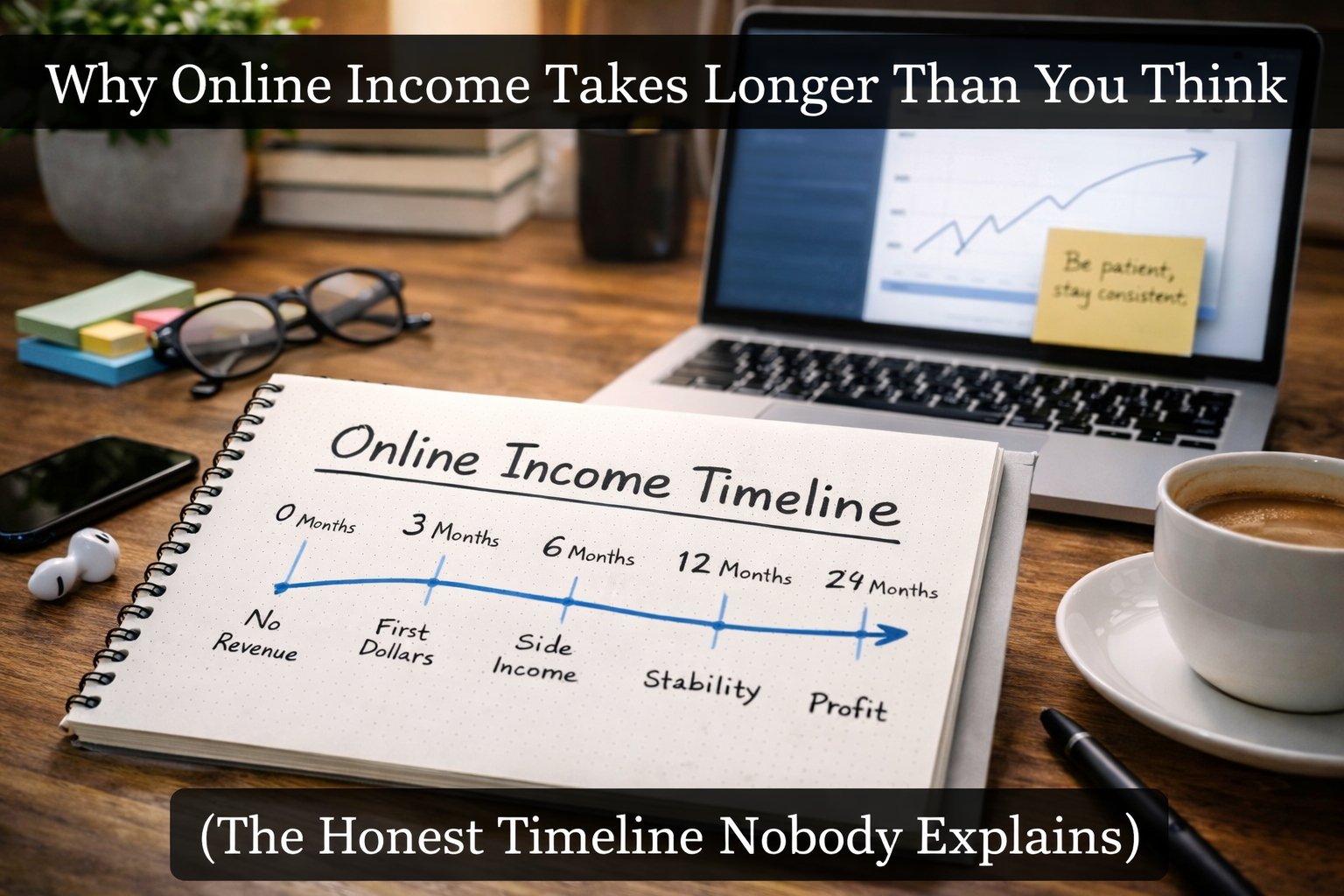



Learn how long online income takes to become real and reliable. This in-depth guide explains realistic timelines, hidden delays, common mistakes, and why patience—not hustle—is what actually pays off.
Making money online is often framed as fast.
“Quit your job in 6 months.”
“Replace your income in 90 days.”
“Just follow the steps.”
Then reality hits.
Weeks pass.
Months pass.
Effort goes in—but income barely moves.
And people start asking the uncomfortable question:
Why does online income take so much longer than everyone says?
This article explains how long online income takes in real life, why progress feels painfully slow at the beginning, and why this delay is not a failure—but a structural feature of how online work actually compounds.
No hype.
No shortcuts.
Just the truth most people only learn after almost quitting.
🧠 The Expectation Gap That Trips Everyone Up
Most people don’t fail at online income because they lack ability.
They fail because of timeline mismatch.
Online income is often expected to behave like:
- A job (effort → paycheck)
- A promotion (do more → earn more)
But online income behaves more like:
- An investment
- A system
- A compounding asset
This creates frustration because:
You’re doing the work—but the feedback is delayed.
Understanding how long online income takes starts with accepting that delay.
⏳ How Long Online Income Takes (Realistic Timelines)
Let’s ground this in reality.
For most legitimate online income paths, timelines look like this:
0–3 Months: Setup & Skill Phase
- Learning tools
- Creating content or services
- No meaningful income yet
3–6 Months: First Signals
- Small wins
- Inconsistent income
- Early validation (or correction)
6–12 Months: Stabilization
- Repeat clients
- Regular traffic
- Predictable (but modest) income
12–24 Months: Compounding
- Reputation effects
- Word of mouth
- Systems replace effort
This isn’t pessimistic—it’s normal.
Most frustration comes from expecting 12-month outcomes in 90 days.
👻 The Invisible Work Phase
The hardest part of online income is the phase where:
- You’re working
- You’re learning
- You’re improving
…but nothing shows externally.
This includes:
- Writing content no one sees yet
- Pitching with no replies
- Building products with no sales
- Learning skills without recognition
This invisible phase feels pointless—but it’s foundational.
People who understand how long online income takes don’t quit here.
⚖️ Why Effort Doesn’t Equal Income Early On
Offline work often pays linearly.
Online work doesn’t.
Early effort goes into:
- Infrastructure
- Skill-building
- Market understanding
- Audience trust
These don’t pay immediately—but they unlock future leverage.
This is why:
Working harder early doesn’t always mean earning more early.
It means earning later.
🧠 Skill, Trust, and Distribution Lag
Online income requires three things to align:
1. Skill
You need to be good enough to deliver value.
2. Trust
People need to believe you can help them.
3. Distribution
People need to actually find you.
Each of these develops on a different timeline.
That’s why how long online income takes feels unpredictable—multiple systems must mature simultaneously.
📉 Platform Myths vs Reality
Many people blame platforms:
- “The algorithm hates me”
- “SEO is dead”
- “Social media is saturated”
The truth is more boring.
Platforms reward:
- Consistency
- Clarity
- Time in market
They don’t reward:
- Sporadic effort
- Constant pivots
- Impatience
Most people leave before platforms ever had a chance to work for them.
📸 Why “Success Stories” Distort Time
Online success stories rarely show:
- The years of prep
- The failed attempts
- The slow months
- The income plateaus
Instead, they compress time:
“I started X and now make Y.”
What’s missing is:
- How long online income took to stabilize
- How many iterations happened
- How much invisible work was involved
Comparing your beginning to someone else’s highlight reel creates false urgency.
📈 The Compounding Phase Most People Never Reach
Online income becomes exciting after compounding begins.
This is when:
- Old work keeps paying
- Referrals arrive unprompted
- Traffic grows without extra effort
- Skills stack naturally
But compounding only works if:
- You stay long enough
- You don’t burn out
- You don’t constantly restart
Most people quit right before this phase.
🚪 Common Reasons People Quit Too Early
Understanding how long online income takes helps avoid these traps:
- Expecting linear growth
- Changing strategies every month
- Chasing trends instead of fundamentals
- Measuring progress only in money
- Treating online income like a sprint
Quitting early isn’t laziness—it’s miscalibrated expectations.
🛠️ What Actually Speeds Things Up (Without Burnout)
There are ways to shorten the timeline—without hustle culture.
1. Narrow Focus
One platform. One offer. One audience.
2. Feedback Loops
Talk to real people early.
3. Skill Before Scale
Get good before getting loud.
4. Consistency Over Intensity
Small, regular output beats bursts.
5. Patience With Measurement
Track progress quarterly—not daily.
These don’t create instant success—but they prevent wasted years.
🧭 Reframing the Timeline (The Mindset Shift That Helps)
Instead of asking:
“Why isn’t this working yet?”
Ask:
“What phase am I realistically in?”
When you understand how long online income takes, frustration turns into strategy.
Progress feels slow only when you expect speed.
❓ Frequently Asked Questions
How long does online income usually take to work?
Most people need 6–12 months for stability and longer for meaningful growth.
Is it possible to make money online faster?
Yes—but usually through high-skill services or existing audiences.
Why does it feel slower than a regular job?
Because feedback and rewards are delayed, not weekly.
Does online income ever become easier?
Yes—after systems, trust, and compounding kick in.
Is it normal to earn nothing at first?
Completely normal—and expected.
🏁 Conclusion
The biggest misunderstanding about online work isn’t effort.
It’s time.
Online income takes longer because:
- Systems need to mature
- Trust must be earned
- Compounding is slow at first
Once you accept how long online income takes, everything changes:
- You stop panicking
- You stop restarting
- You stop comparing
- You start building patiently
The people who succeed online aren’t the fastest.
They’re the ones who stayed long enough for time to finally work with them.
All Rights Reserved © 2026