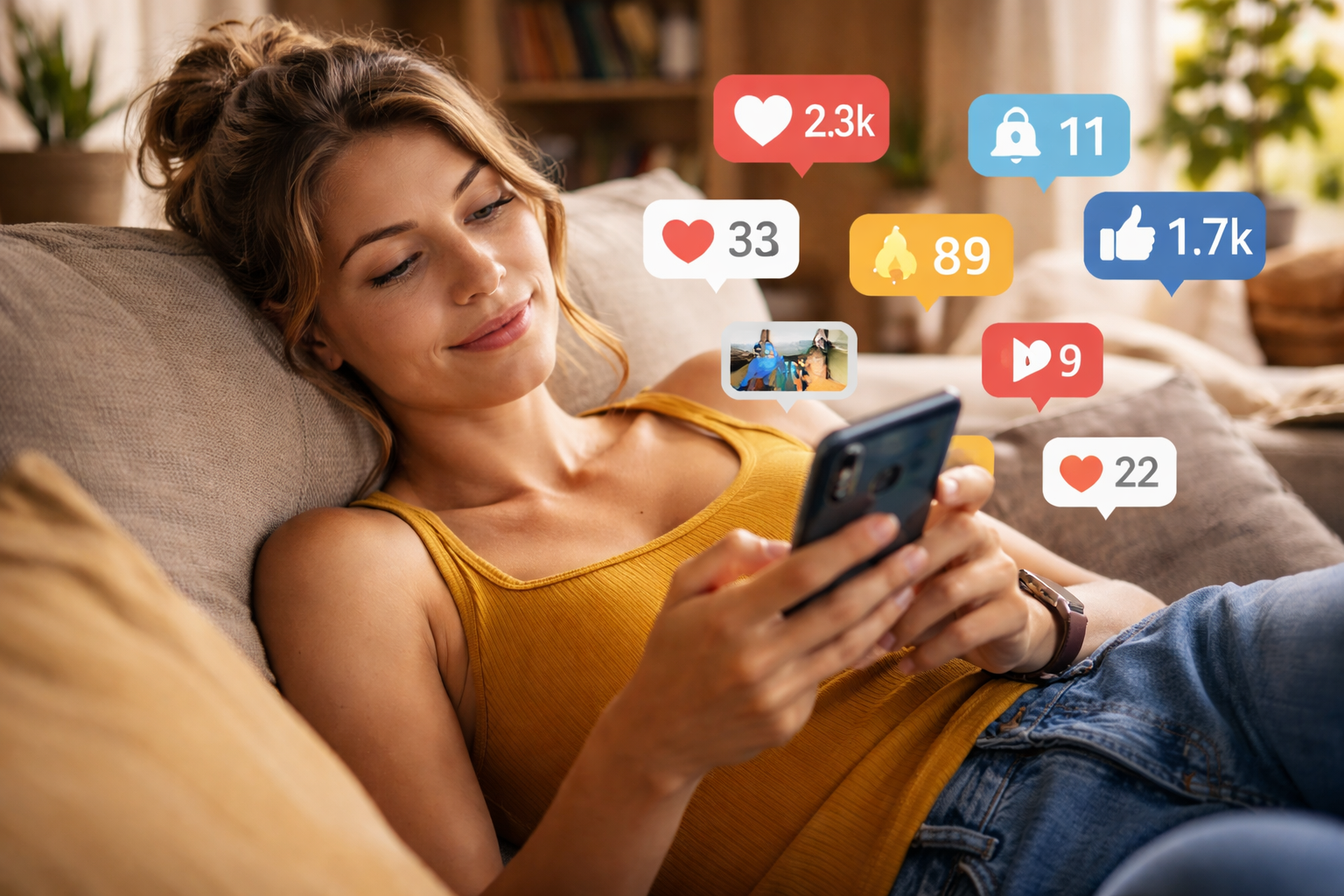



The social media attention span explained—how platforms reshape focus, why attention feels shorter, what’s actually happening in the brain, and how to protect concentration without quitting social media.
It’s a common feeling now:
You sit down to focus.
You open a tab.
Your hand reaches for your phone—almost automatically.
Minutes later, you’re scrolling.
Many people assume this means something is wrong with them.
But the reality is more precise:
Social media changes attention span not by destroying it—but by training it differently.
This article explains how that change happens, why it feels so uncomfortable, and why modern focus struggles are a predictable outcome of how social platforms are designed and used.
🧠 What Attention Span Actually Means
Attention span isn’t a fixed number of minutes.
It’s the ability to:
- Sustain focus on one thing
- Resist irrelevant stimuli
- Return attention after interruption
The social media attention span issue isn’t that attention disappeared.
It’s that attention is now:
- Pulled more frequently
- Interrupted more often
- Rewarded for switching
Attention adapts to environments. Social media is a powerful environment.
📱 Why Social Media Feels Uniquely Distracting
Not all digital content affects attention the same way.
Social media combines:
- Endless novelty
- Social validation
- Emotional triggers
- Fast visual feedback
This creates a uniquely strong pull on attention.
Unlike books or videos with clear endpoints, social platforms are designed without stopping cues.
Your brain never gets a signal that it’s “done.”
🔀 The Shift From Sustained to Fragmented Attention
One of the biggest ways social media changes attention span is by training fragmented attention.
Fragmented attention looks like:
- Frequent checking
- Short bursts of focus
- Difficulty staying with one task
- Restlessness during slow moments
This doesn’t mean the brain is broken.
It means it has adapted to:
High stimulation, fast switching, and constant novelty.
🧠 How Algorithms Train the Brain
Social media platforms don’t just show content—they shape behavior.
Algorithms optimize for:
- Time spent
- Engagement
- Return frequency
They do this by learning:
- What captures your attention
- What emotions trigger interaction
- What keeps you scrolling
Over time, the brain associates:
Attention → reward → more attention
This feedback loop subtly retrains how focus works.
⚡ Dopamine, Novelty, and Reward Loops
Social media doesn’t flood the brain with dopamine—it delivers it intermittently.
This matters.
Intermittent rewards:
- Are more addictive
- Increase checking behavior
- Strengthen habit loops
Your brain keeps seeking:
“The next interesting thing.”
This makes slower, single-task activities feel less stimulating by comparison.
🧠 Why Focus Feels Harder Even Offline
Many people notice something strange:
Even away from social media, focus feels weaker.
This happens because:
- The brain expects stimulation
- Silence feels uncomfortable
- Low-input tasks feel dull
The social media attention span effect spills into offline life because attention habits don’t stay contained.
They generalize.
📉 Social Media and Cognitive Overload
Social media exposes the brain to:
- Massive information volume
- Emotional content
- Social comparison
- Rapid context switching
This creates cognitive overload.
When the brain is overloaded:
- Decision-making slows
- Focus degrades
- Mental fatigue increases
This is why people feel tired without obvious effort.
❤️ Emotional Stimulation and Attention Drain
Social media isn’t just informational—it’s emotional.
It triggers:
- Curiosity
- Anger
- Validation
- Anxiety
- Comparison
Emotional processing consumes attention.
Even passive scrolling uses mental energy.
This is a key reason social media attention span issues feel emotionally exhausting, not just distracting.
🚫 Why Willpower Alone Doesn’t Fix It
Many people try:
- Forcing focus
- Blaming themselves
- Using discipline alone
This rarely works long-term.
Why?
Because social media:
- Is always available
- Is socially expected
- Is integrated into work and life
The problem is environmental, not moral.
Expecting constant self-control in a high-interruption environment sets people up to fail.
🛠️ What Actually Helps Rebuild Attention
Rebuilding attention doesn’t require quitting social media.
What helps instead:
- Reducing notifications dramatically
- Creating phone-free focus zones
- Reintroducing boredom intentionally
- Limiting context switching during work
- Using social media in defined windows
Attention recovers when the brain experiences longer, uninterrupted stretches again.
🧭 A Healthier Way to Think About Attention
The goal isn’t perfect focus.
It’s flexible attention—the ability to:
- Focus when needed
- Rest when needed
- Switch intentionally
Social media changes attention span—but attention remains trainable.
Just not through force.
❓ Frequently Asked Questions
Is social media permanently damaging attention span?
No. Attention is adaptable and can recover with environmental changes.
Why does reading feel harder now?
Because reading requires sustained attention without novelty rewards.
Do short-form videos make attention worse?
They intensify novelty-seeking but don’t eliminate the ability to focus.
Should I quit social media entirely?
Not necessarily. Intentional use matters more than total avoidance.
How long does attention recovery take?
Many people notice improvement within weeks of reduced interruption.
🏁 Conclusion
The social media attention span issue isn’t about weakness or lack of discipline.
It’s about adaptation.
Your brain learned to operate in a world of:
- Infinite content
- Constant novelty
- Emotional stimulation
Focus didn’t disappear—it was redirected.
When interruptions decrease and attention gets room to stretch again, focus returns naturally.
Not overnight.
Not perfectly.
But reliably.
All Rights Reserved © 2026