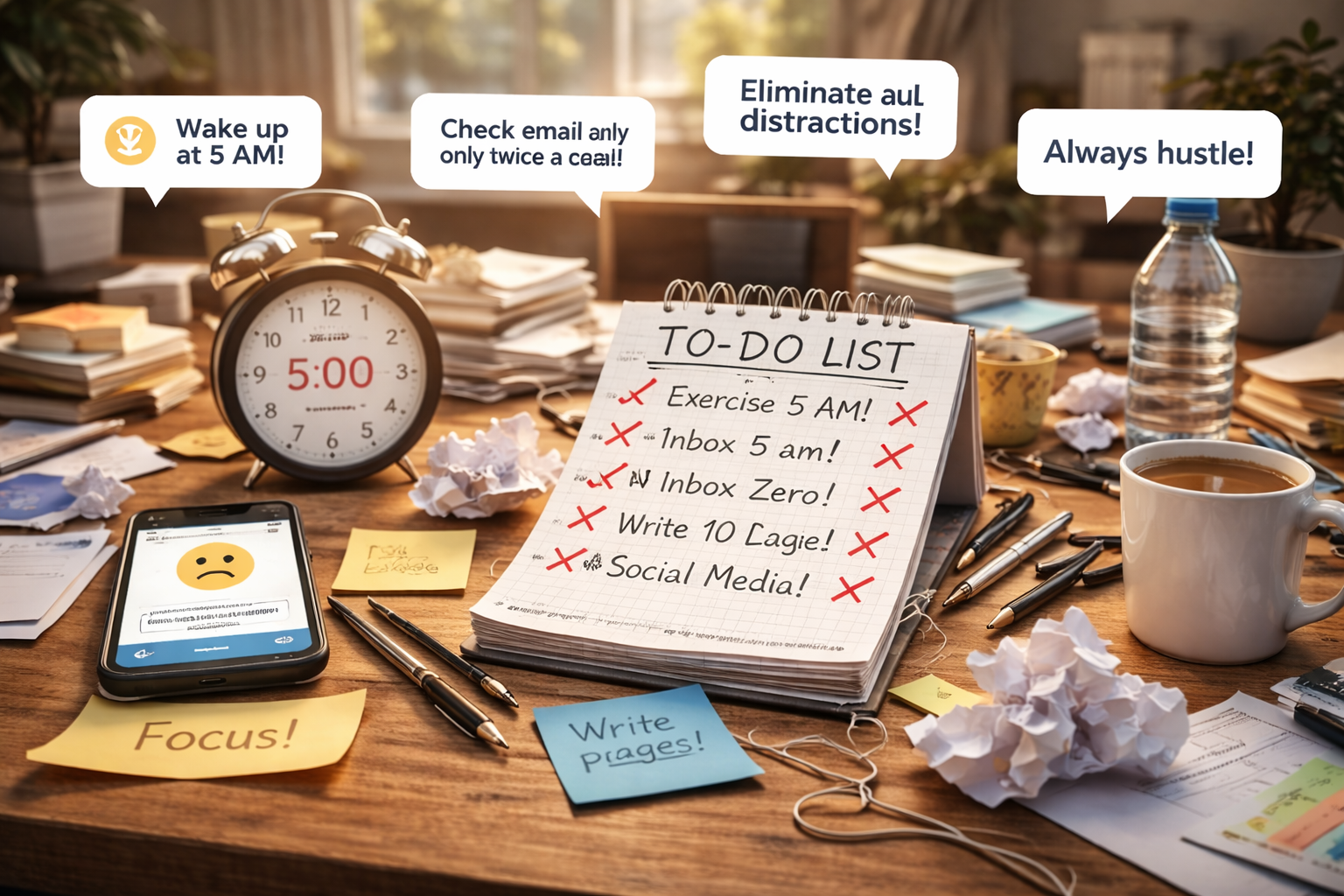



Productivity advice that fails explained in depth—why popular productivity tips don’t work in real life, the psychology behind failure, and what sustainable productivity actually looks like in 2026.
Productivity advice is everywhere.
Wake up at 5 a.m.
Plan every minute.
Use the perfect system.
Optimize harder.
And yet, most people feel busier, more tired, and less fulfilled than ever.
So let’s ask the uncomfortable question:
Why does so much productivity advice fail in real life?
This deep, long-form guide explores why productivity advice that fails keeps circulating, why smart people still fall for it, and what actually works when real humans—with limited energy, emotions, and unpredictable lives—try to get things done.
This isn’t about hacks.
It’s about reality.
🧲 Why Productivity Advice Is So Attractive
Productivity advice appeals because it promises control.
Control over:
- Time
- Chaos
- Overwhelm
- Uncertainty
In an unpredictable world, advice that says:
“Just follow this system”
is deeply comforting.
Unfortunately, comfort ≠ truth.
Most productivity advice is designed to:
- Sound simple
- Be shareable
- Feel empowering
Not to survive contact with real life.
🧱 The Myth of the “Perfect System”
One of the biggest forms of productivity advice that fails is the belief that:
“If I just find the right system, everything will work.”
Why This Fails
- Systems assume stable conditions
- Life is unstable
- Energy fluctuates
- Priorities shift
No system survives:
- Illness
- Family emergencies
- Creative blocks
- Emotional stress
Yet productivity culture blames you, not the system.
That creates guilt instead of progress.
⚡ Motivation vs Energy (The Core Misunderstanding)
Most productivity advice focuses on motivation.
But motivation is unreliable.
Energy is the real constraint.
Why This Matters
You can be motivated and still:
- Be exhausted
- Be cognitively overloaded
- Lack emotional capacity
Advice that says:
“Just push through”
ignores human biology.
This is why productivity advice that fails often works for:
- Short bursts
- Exceptional circumstances
But collapses long-term.
🧍 Why One-Size-Fits-All Advice Breaks Down
Productivity advice assumes:
- Similar lifestyles
- Similar responsibilities
- Similar energy profiles
Reality:
- Parents ≠ students
- Freelancers ≠ executives
- Neurodivergent minds ≠ neurotypical ones
A morning routine that works for a solo creator will fail for:
- Caregivers
- Shift workers
- People with chronic fatigue
Advice that ignores context is fragile.
🧠 The Cognitive Load Problem
One of the most ignored reasons productivity advice that fails is cognitive load.
Every productivity system adds:
- Rules
- Steps
- Decisions
- Maintenance
Eventually, managing the system becomes work.
Example
- Tracking every task
- Categorizing everything
- Reviewing constantly
At some point, you’re optimizing productivity tools, not doing meaningful work.
⏳ The Time Myth: Why We Overestimate Capacity
Most productivity advice assumes:
“You have more time than you think.”
In reality, people:
- Underestimate recovery time
- Ignore mental fatigue
- Overbook themselves
This leads to:
- Chronic backlog
- Constant rescheduling
- Feelings of failure
The problem isn’t laziness.
It’s unrealistic planning.
- Khan Academy — AI Study Assistant
- OpenAI — Study & Research Tools
- Duolingo AI Learning Tools
- Quizlet — AI Flashcards & Recall Tools
- Microsoft Copilot for Students
- Notion AI — Study Notes & Summaries
- PCMag — Best AI Tools
🔀 Context Switching & Fragmented Attention
Advice like:
- “Multitask efficiently”
- “Batch everything”
- “Stay always available”
Directly contradicts how attention works.
Every context switch:
- Burns mental energy
- Reduces quality
- Increases stress
Productivity advice that fails often ignores attention as a limited resource.
🧨 Why Discipline Advice Often Backfires
“Just be more disciplined” is one of the most harmful myths.
Why?
- Discipline relies on willpower
- Willpower is finite
- Stress depletes it fast
When discipline-based advice fails, people blame themselves.
That leads to:
- Shame
- Burnout
- Abandoning systems entirely
🏃 Productivity Culture vs Human Psychology
Productivity culture treats humans like:
- Machines
- Resources
- Output units
But humans:
- Need rest
- Need meaning
- Need flexibility
When productivity advice ignores this, it fails—no matter how logical it sounds.
🤖 Technology & AI: Help or Harm?
AI tools promise to fix productivity.
They help—but they also:
- Add options
- Increase expectations
- Enable overload
Without intention, AI becomes another layer of productivity advice that fails by amplifying busyness instead of clarity.
Used well, AI reduces friction.
Used poorly, it increases pressure.
🧭 What Actually Works in Real Life
Here’s the uncomfortable truth:
Sustainable productivity is boring.
It looks like:
- Fewer priorities
- Slower planning
- More rest
- Clear boundaries
People who are consistently productive:
- Do less
- Say no more
- Protect energy
- Accept imperfection
🧩 A Sustainable Productivity Framework
1. Energy First, Time Second
Plan around:
- When you think best
- When you rest
- When you recover
2. Fewer Systems, Deeper Habits
One simple system beats five complex ones.
3. Define “Enough”
Perfection is productivity poison.
4. Design for Bad Days
If your system only works on good days, it will fail.
5. Measure Outcomes, Not Activity
Busy ≠ effective.
❓ Frequently Asked Questions
Why does productivity advice that fails stay popular?
Because it’s easy to market and hard to disprove emotionally.
Is productivity advice useless?
No—but it must be adapted, not followed blindly.
Are productivity systems scams?
Not scams—just incomplete models of human behavior.
Does discipline matter at all?
Yes—but it’s a tool, not a foundation.
What’s the biggest productivity mistake?
Ignoring energy and context.
🏁 Interim Conclusion
Most productivity advice that fails isn’t wrong.
It’s just incomplete.
It ignores:
- Energy
- Emotion
- Reality
And then blames you when it breaks.
📣 Why Productivity Gurus Succeed Even When Their Advice Fails
One of the strangest things about productivity advice that fails is this:
The advice keeps failing — but the gurus keep succeeding.
Why?
1. Productivity Advice Is Aspirational, Not Practical
Most productivity advice isn’t designed to work every day.
It’s designed to make people feel capable.
Morning routines, perfect planners, extreme schedules — they represent:
- Control
- Mastery
- Identity
People buy the feeling, not the results.
2. Survivorship Bias Is Everywhere
Productivity gurus often:
- Have teams
- Have money
- Have flexibility
- Have social leverage
Their systems worked after they escaped constraints — not before.
When average people fail to replicate results, they blame themselves.
3. Failure Is Framed as a Moral Problem
If advice fails, the narrative becomes:
- “You didn’t try hard enough”
- “You lacked discipline”
- “You weren’t committed”
This protects the advice — and harms the person.
📱 Social Media & Hustle Culture: Why Bad Advice Spreads Faster
Social platforms reward:
- Simplicity
- Extremes
- Certainty
Unfortunately, real productivity is:
- Contextual
- Nuanced
- Boring
So productivity advice that fails spreads faster because it:
- Fits in a tweet
- Looks impressive
- Feels motivating
“Work 12 hours a day” is easier to sell than:
“Work 4 focused hours, rest deeply, and accept limits.”
The Algorithm Problem
Algorithms amplify advice that:
- Creates urgency
- Triggers guilt
- Promises transformation
They don’t reward advice that says:
“You’re human. Slow down.”
🧪 Real-Life Case Studies: Where Productivity Advice Breaks
Let’s look at how productivity advice collapses in actual lives.
Case 1: The Working Parent
Advice given:
- Wake up at 5 a.m.
- Do deep work before others wake up
Reality:
- Sleep deprivation
- Childcare unpredictability
- Emotional exhaustion
Result:
- Burnout
- Guilt
- Abandonment of all routines
The advice wasn’t wrong — it was context-blind.
Case 2: The Freelancer
Advice given:
- Time-block every hour
- Optimize every task
Reality:
- Client interruptions
- Income anxiety
- Irregular workload
Result:
- Constant re-planning
- Decision fatigue
- Feeling “behind” daily
Rigid systems fail in fluid environments.
Case 3: The Knowledge Worker
Advice given:
- Inbox zero
- Always respond fast
Reality:
- Back-to-back meetings
- Slack interruptions
- Cognitive overload
Result:
- Shallow work
- No thinking time
- Stress disguised as productivity
Responsiveness replaced effectiveness.
🧠 Productivity Across Life Stages (Why Timing Matters)
One reason productivity advice that fails persists is that it ignores life stage.
Early Career
Needs:
- Learning
- Exploration
- Mistakes
Advice that over-optimizes too early:
- Kills curiosity
- Creates fear of inefficiency
Mid-Career
Needs:
- Boundaries
- Prioritization
- Sustainability
Advice focused on hustle here:
- Accelerates burnout
Later Career
Needs:
- Leverage
- Delegation
- Judgment
Advice focused on output:
- Misses the value shift
Productivity changes — but advice rarely does.
🧍 Neurodiversity & Productivity Failure
A major reason productivity advice fails is that it assumes:
- Linear thinking
- Stable attention
- Predictable energy
For people with:
- ADHD
- Autism
- Anxiety
- Depression
Rigid systems often:
- Increase shame
- Reduce effectiveness
- Create avoidance
Productivity advice that fails hardest is advice that refuses to adapt.
🔄 Why “Consistency” Is Overrated
Consistency is praised endlessly — but misunderstood.
False Consistency
- Same routine daily
- Same output expectations
- Same pace
This breaks humans.
Real Consistency
- Returning after rest
- Adjusting without quitting
- Working in cycles
The ability to resume matters more than the ability to maintain.
⏳ Rest: The Most Ignored Productivity Tool
Most productivity advice treats rest as:
- A reward
- A luxury
- A weakness
In reality, rest is:
- Maintenance
- Strategy
- Performance support
Advice that ignores rest eventually fails — always.
🧠 The Identity Trap of Productivity
Many people don’t just use productivity systems.
They become them.
“I’m a GTD person.”
“I’m a 5 a.m. person.”
“I’m a hustle person.”
When the system breaks, identity breaks too.
This is why productivity advice that fails feels personally devastating.
🧭 What Actually Survives Real Life (Long-Term)
Let’s be precise.
Productivity that survives real life is:
- Forgiving
- Flexible
- Energy-aware
- Outcome-focused
- Low-maintenance
It adapts when:
- You’re sick
- You’re overwhelmed
- Life changes
Rigid productivity systems don’t adapt — they collapse.
🛠️ A Realistic Productivity Model (Anti-Guru Edition)
1. One Primary Goal Per Day
Not five. One.
Everything else is optional.
2. Two Energy Peaks, Not Endless Focus
Most people have:
- One mental peak
- One lighter peak
Plan accordingly.
3. Defaults for Low-Energy Days
Decide in advance:
“What does ‘good enough’ look like today?”
4. Systems That Shrink Under Stress
If your system needs more effort when life is hard — it will fail.
5. Self-Trust Over Optimization
Trust your judgment more than templates.
🧨 Why Hustle Culture Collapses Eventually
Hustle culture works:
- Short-term
- For a minority
- At a cost
It collapses because:
- Bodies break
- Motivation fades
- Meaning erodes
The people who last are not the most disciplined — they are the most adaptive.
❓ Final Extended FAQs
Is all productivity advice useless?
No — but most of it is incomplete without context.
Why do I keep failing at productivity systems?
Because they weren’t designed for your life.
Is it my fault productivity advice doesn’t work?
No. That belief is part of the problem.
What’s the most reliable productivity skill?
Self-awareness.
Should I stop trying to improve productivity?
No — just stop trying to become a machine.
🏁 Final Conclusion: Why Productivity Advice Often Fails in Real Life
Here’s the truth most productivity advice avoids:
Humans are not broken machines.
Most productivity advice that fails fails because it:
- Overestimates control
- Underestimates fatigue
- Ignores emotion
- Punishes imperfection
Real productivity isn’t about doing more.
It’s about:
- Choosing wisely
- Recovering fully
- Adapting continuously
The most productive people aren’t the most optimized.
They’re the most honest about their limits.
And that honesty is the real productivity skill.
4 thoughts on “Productivity Advice That Fails: Why Productivity Advice Often Fails in Real Life (And What Actually Works Instead)”
Leave a Reply
All Rights Reserved © 2026
“Good enough” today means doing what works and moves things forward without aiming for perfection—something useful, sustainable, and aligned with current priorities, with room to improve later.,😊😊😊
Exactly. “Good enough” isn’t about lowering standards—it’s about choosing sustainability over perfection. Doing something useful today, even imperfectly, is often far more effective than waiting for ideal conditions that never arrive.
Most productivity advice fails because it assumes ideal conditions and tells people to do more, faster. What actually works is simple, personalized, and reality-based: focus on meaningful goals, build tiny habits, and adapt systems to your life—not the other way around.
Well said. Productivity becomes much more effective when it’s grounded in reality instead of pressure. I’m curious — have you found any small habit or system that worked especially well for you over time?