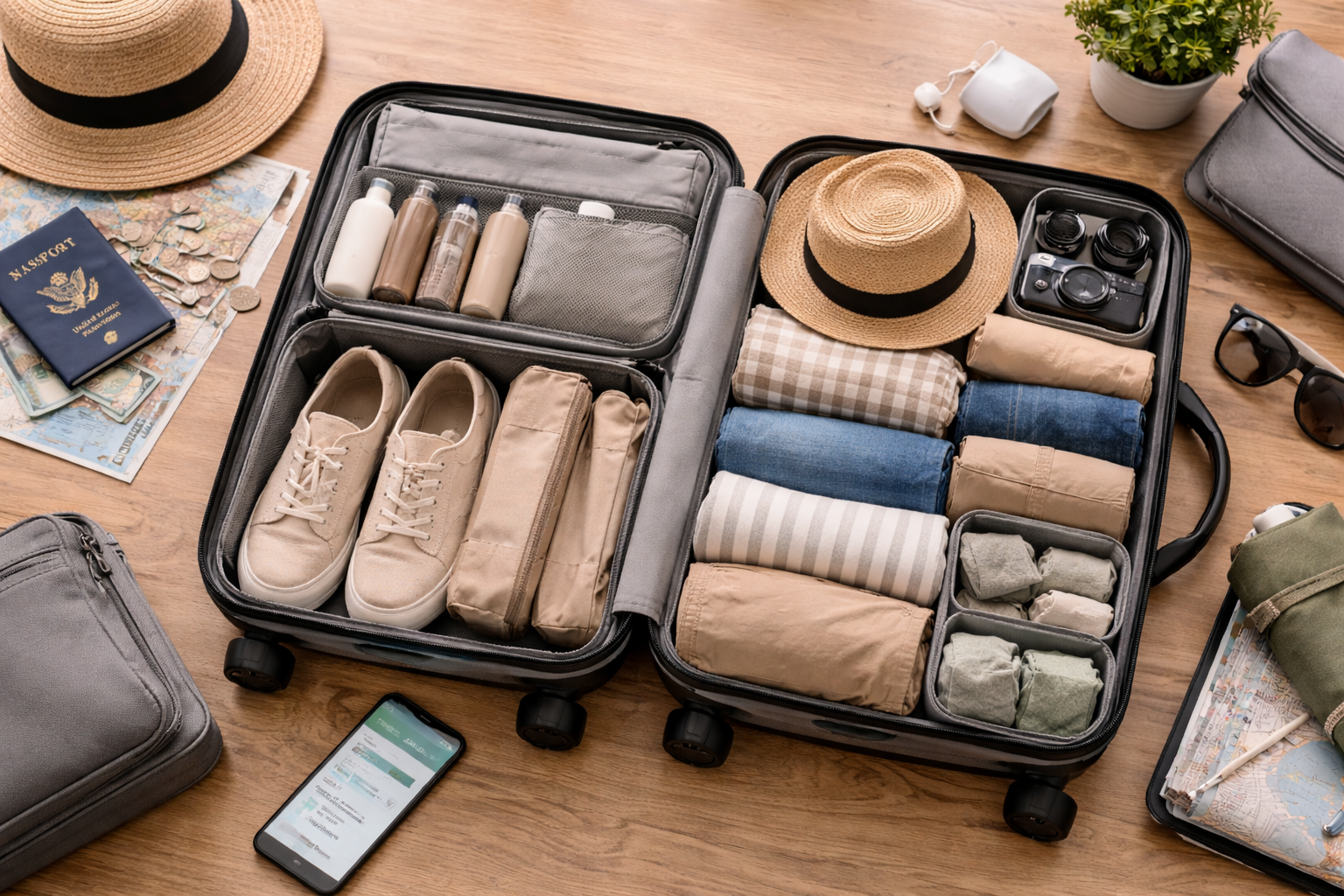



How to Travel Carry-On Only in 2026 – a complete, practical guide to packing lighter, avoiding baggage fees, passing airline size checks, choosing the right bag, and building a carry-on-only system that works for real trips.
Why Carry-On-Only Travel Matters More in 2026
Traveling carry-on only used to be a “minimalist flex.”
In 2026, it’s a strategic advantage.
Here’s why more travelers are ditching checked bags:
- Airline baggage fees are higher and less predictable
- Lost, delayed, and gate-checked bags are still common
- Tight connections punish checked luggage
- Budget airlines price aggressively but charge heavily for bags
- Travelers want speed, flexibility, and less friction
How to Travel Carry-On Only in 2026 Mastering how to travel carry-on only in 2026 means:
- Saving money on every flight
- Moving faster through airports
- Avoiding baggage claim entirely
- Reducing stress on multi-city trips
This guide shows you how to do it comfortably, not miserably.
Carry-On Travel Has Changed Since 2020 — Here’s What’s Different in 2026
Before packing tips, you need to understand the new rules of the game.
1) Airlines are stricter about size
Many airlines now:
- Actively measure carry-ons at the gate
- Enforce weight limits on international routes
- Charge for “oversized carry-ons”
Budget carriers are especially strict.
2) Personal items matter more
Your personal item (under-seat bag) is now:
- Essential for overflow
- Often your tech + essentials bag
- Sometimes more important than the overhead bag
Smart carry-on travelers treat this as a second system, not an afterthought.
3) Clothing and gear are better
In 2026, you have access to:
- Lighter fabrics
- Wrinkle-resistant clothing
- Multi-use shoes
- Compact tech and chargers
Packing light is easier than it used to be — if you plan correctly.
The Carry-On-Only Mindset (This Is the Hard Part)
Most people fail at carry-on travel because of fear, not lack of space.
Common fears:
- “What if I need extra clothes?”
- “What if something gets dirty?”
- “What if the weather changes?”
- “What if I want options?”
Carry-on travel works when you accept one truth:
You don’t need backups for your backups.
Instead, you need:
- Versatile clothing
- Laundry strategy
- Intentional packing
How to Travel Carry-On Only in 2026 Step 1: Know Carry-On Rules Before You Pack
Standard carry-on size (rough guideline)
Most airlines allow around:
- 22 x 14 x 9 inches (56 x 36 x 23 cm)
But this varies — especially internationally.
Budget airline reality
Low-cost carriers often:
- Allow smaller carry-ons
- Charge for overhead bin access
- Enforce size at the gate
Before every trip:
- Check airline carry-on dimensions
- Check weight limits (7–10 kg is common internationally)
Don’t assume consistency.
Step 2: Choose the Right Carry-On Bag (Critical Decision)
Your bag determines everything.
Hard-shell vs soft-shell
- Hard-shell: better protection, less flexibility
- Soft-shell: lighter, easier to squeeze, exterior pockets
For strict airlines, soft-shell bags are often safer.
Backpack vs rolling carry-on
Carry-on backpack
Best for:
- Multi-city trips
- Cobblestones, stairs, trains
- Digital nomads and minimalist travelers
Downside: weight on your back.
Rolling carry-on
Best for:
- Business travel
- Smooth airports
- Travelers who want easy access
Downside: wheels eat internal space.
The overlooked hero: the personal item
A smart under-seat bag:
- Holds tech, documents, meds
- Acts as overflow space
- Saves you if overhead bins fill
Think of it as insurance.
Step 3: Build a Carry-On Capsule Wardrobe
This is where most people overpack.
The core rule
Every item should:
- Match at least 2–3 other items
- Work in multiple situations
- Be wearable multiple times
A proven 7–10 day carry-on clothing formula
Tops (4–6):
- Neutral colors
- Mix of casual + slightly dressy
- Lightweight, quick-dry fabrics
Bottoms (2–3):
- 1 everyday pair
- 1 nicer or technical pair
- Optional: 1 lightweight short or skirt
Layers (2–3):
- Light jacket
- Mid-layer (sweater or fleece)
- Optional packable rain shell
Shoes (2 pairs total):
- 1 worn
- 1 packed
That’s it.
Why this works
- Laundry every 4–7 days
- Mix-and-match outfits
- No single-use clothing
If an item only works once, it doesn’t belong.
Step 4: Laundry Is the Carry-On Cheat Code
Laundry turns a 5-day wardrobe into a 3-week system.
Best laundry strategies
- Sink wash (quick-dry fabrics)
- Hotel or hostel machines
- Local laundromats
- Occasional laundry service
You don’t need to wash everything at once — rotate.
What makes laundry easier
- Merino or synthetic fabrics
- Travel detergent sheets
- Dark colors (hide wear better)
Once you trust your laundry plan, packing becomes easy.
Step 5: Toiletries Without TSA Stress
Liquids are still the biggest bottleneck.
Carry-on liquid rules
- Containers ≤100 ml (3.4 oz)
- All liquids fit in one clear quart bag
Yes, this is still enforced.
Smart carry-on toiletry strategy
- Use solid alternatives (bar soap, shampoo bars)
- Decant essentials into travel containers
- Buy bulky items at destination
In 2026, most cities have pharmacies everywhere.
What to always pack
- Prescription meds (in personal item)
- Minimal first-aid
- One backup essential
Never check critical health items.
Step 6: Tech Without the Cable Explosion
Tech gets heavy fast.
Modern carry-on tech rule
One cable, one charger, one backup.
What most travelers actually need
- Phone
- Lightweight laptop or tablet
- Compact power adapter
- Multi-port USB-C charger
Avoid:
- Redundant cables
- Heavy power bricks
- Single-use gadgets
Your personal item should hold all tech.
Step 7: Packing Techniques That Actually Save Space
Rolling vs folding
- Rolling saves space and reduces wrinkles
- Folding works for structured items
Most travelers use a hybrid.
Packing cubes: yes or no?
Yes — if you:
- Use 2–3 max
- Separate by category
- Compress gently (don’t overstuff)
Cubes add structure, not magic space.
Wear your bulkiest items
- Jacket
- Sneakers
- Heaviest pants
Airplanes are cold anyway.
Step 8: Passing Gate Checks With Confidence
Gate agents don’t care how smart your packing is — only size.
How to avoid gate-checking
- Choose airline-compliant bag
- Avoid overstuffing
- Keep personal item separate
- Board earlier if possible
If your bag looks overpacked, it attracts attention.
Emergency overflow plan
If forced:
- Move dense items to personal item
- Wear layers
- Remove shoes temporarily
Confidence matters more than panic.
Step 9: Carry-On Only for Different Travel Types
City trips
Easiest scenario:
- Great laundry access
- Mild clothing needs
Perfect for first carry-on-only attempt.
Business travel
Stick to:
- Neutral colors
- Wrinkle-resistant fabrics
- One versatile jacket
Shoes are usually the limiting factor.
Long-term or multi-country travel
Carry-on works best here if:
- You accept repetition
- You plan laundry
- You adapt locally
Many long-term travelers use less, not more.
Cold or mixed climates
This is hardest — but possible.
Key strategies:
- Layering instead of bulk
- Packable insulation
- Neutral outerwear
One good jacket beats three mediocre ones.
Step 10: The Carry-On-Only Packing List (Realistic)
Carry-on bag
- Clothing
- Shoes (1 pair)
- Packing cubes
- Toiletry kit
Personal item
- Passport + documents
- Phone + charger
- Laptop/tablet
- Medications
- Day essentials
If it’s critical, it goes under the seat.
Common Carry-On-Only Mistakes
- Packing “just in case” items
- Overpacking shoes
- Ignoring laundry options
- Bringing full-size toiletries
- Choosing a bag that’s too heavy empty
The bag itself shouldn’t weigh half your allowance.
Carry-On Travel Saves More Than Money
Yes, you save:
- Baggage fees
- Taxi time
- Stress
But you also gain:
- Flexibility
- Faster exits
- Fewer lost items
- More control
Once you travel this way successfully, it’s hard to go back.
FAQs: How to Travel Carry-On Only in 2026
1) Is carry-on-only realistic for more than a week?
Yes — with laundry. Many travelers go months with one bag.
2) What if I need formal clothes?
Choose one neutral outfit that can be dressed up or down. Wear it more than once.
3) What if airlines force gate-checking?
Use a compliant bag, board early when possible, and keep essentials in your personal item.
4) Is carry-on travel harder internationally?
Sometimes — mainly due to weight limits. Choose lighter bags and pack carefully.
5) Do packing cubes really help?
They help with organization and compression — but only if you don’t overfill them.
6) What’s the biggest mindset shift?
Accepting repetition. Most people won’t notice, and you’ll care less every day.
How to Travel Carry-On Only in 2026 Final Thoughts
Learning how to travel carry-on only in 2026 isn’t about minimalism for its own sake — it’s about freedom.
When you pack lighter:
- Travel feels easier
- Airports feel smaller
- Trips feel calmer
Start with one trip. Refine your system.
By the third trip, you’ll wonder why you ever checked a bag.
- Skyscanner Flight Deals
- Google Flights
- Booking.com Hotel Deals
- Airbnb Budget Stays
- Nomadic Matt Budget Travel Tips
All Rights Reserved © 2026